

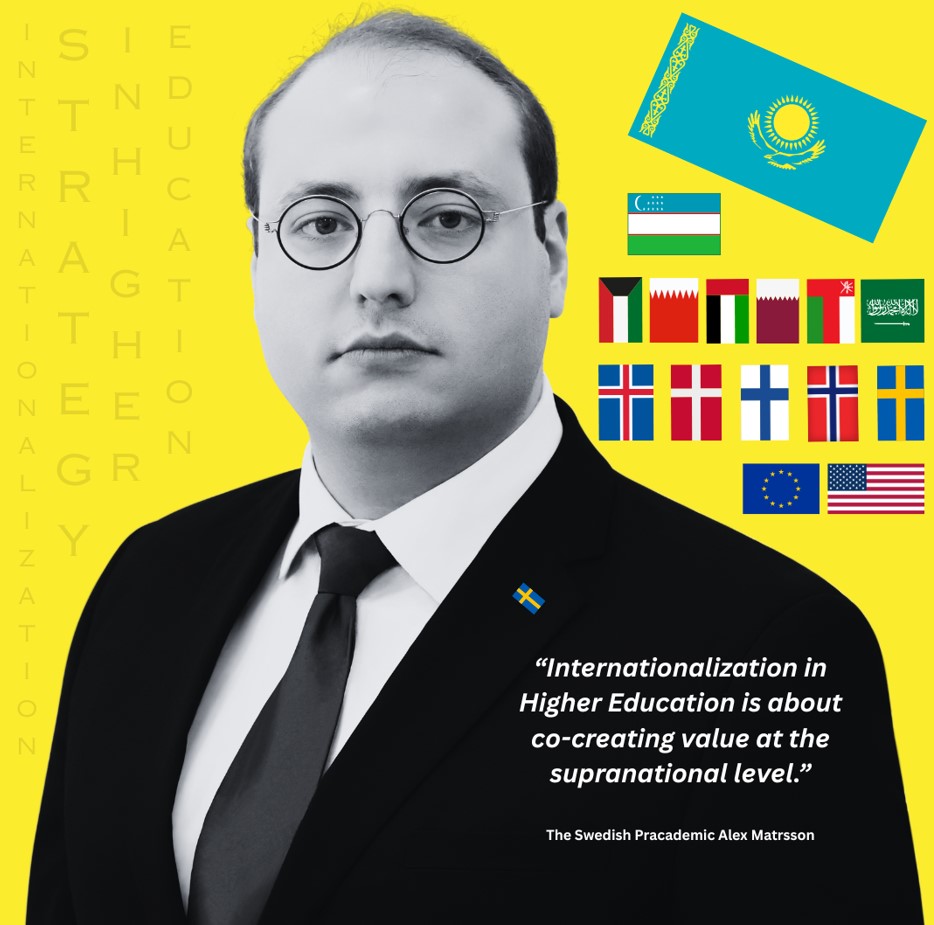
In today’s rapidly changing world, universities are no longer isolated centers of knowledge. They are becoming global hubs where ideas, cultures, and innovations intersect. According to the Swedish pracademic and international business strategist Mr. Alex Matrsson, internationalization in higher education has evolved from an optional strategy into a defining factor of whether universities thrive—or slowly fade into irrelevance, DKNews.kz reports.
Speaking in an exclusive interview, Mr. Matrsson emphasizes that higher education is now operating within a deeply interconnected global knowledge economy. In such an environment, institutions that actively engage with international partners strengthen their academic standing, research capacity, and global reputation. Those that remain inward-looking risk falling behind.
Beyond Exchange Programs
Many universities still interpret internationalization through a narrow lens. Student exchanges, visiting scholars, and international conferences are often treated as the primary indicators of global engagement. While these initiatives are valuable, Mr. Matrsson argues that they represent only the surface of what internationalization truly means.
“Internationalization must be intentional and structural,” he explains. “It requires universities to rethink how they teach, collaborate, conduct research, and build partnerships.”
In other words, internationalization is not a short-term project or a branding exercise. It is a long-term institutional strategy that shapes how universities operate across every level—from leadership and research agendas to curriculum development and student experience.
Why It Matters for Kazakhstan
The discussion is particularly relevant for Central Asia, where higher education systems are rapidly evolving. In Kazakhstan, internationalization has become a central pillar of national development and academic reform.
The country’s Ministry of Higher Education has actively promoted global academic cooperation, encouraging universities to expand partnerships with institutions abroad. As a result, many Kazakh universities have already made notable progress. They are building international research collaborations, incorporating global perspectives into their programs, and strengthening ties with global academic networks.
Yet, according to Mr. Matrsson, the next stage requires a deeper transformation.
“Internationalization should not sit in one administrative office,” he notes. “It must become part of the university’s culture.”
This means involving faculty, students, researchers, and administrators alike. When departments and individual academics actively develop international collaborations within their own fields, global engagement becomes organic rather than bureaucratic.
The Role of Young Specialists
One of Mr. Matrsson’s more interesting recommendations is the growing importance of the young Kazakh professionals specializing in internationalization.
These specialists bring a rare combination of perspectives: they understand the local realities of universities while also recognizing global trends shaping higher education.
For Kazakh universities, such expertise can help translate international opportunities into practical initiatives that align with national priorities and institutional strengths.
In other words, internationalization is not simply about building connections abroad—it is about understanding how those connections can realistically benefit the university and its surrounding ecosystem.
Universities and the Global Knowledge Network
But as Mr. Matrsson emphasizes, modern internationalization increasingly extends far beyond partnerships between universities. Today’s most effective global engagement strategies involve a broader ecosystem that includes industry, research centers, innovation hubs, foundations, and government institutions.
For universities, these partnerships can unlock new research opportunities, stimulate innovation, and open global career pathways for students.
Kazakh universities, in particular, stand to gain significantly from such networks. Positioned between Europe and Asia, the country has the potential to become a regional hub for international academic collaboration.
When Global Meets Local
Yet, according to Mr. Matrsson, Perhaps the most overlooked aspect of internationalization is its impact on local communities.
When universities collaborate globally, they bring back more than academic prestige. They introduce new ideas, research practices, technologies, and economic opportunities to the cities and regions around them.
International partnerships can lead to joint research centers, startup initiatives, industry collaboration, and community development projects. Over time, these connections help strengthen not only universities but also regional economies.
In Kazakhstan, this dynamic could play a key role in shaping the country’s long-term competitiveness in the global knowledge economy.
The Road Ahead
For universities seeking to remain relevant in the coming decades, internationalization is no longer a choice—it is a necessity.
But as Mr. Matrsson emphasizes, meaningful internationalization requires strategy, collaboration, and long-term commitment. It demands that universities move beyond symbolic gestures and instead build deeply integrated global networks.
If approached thoughtfully, this process can transform universities into powerful engines of innovation, global cooperation, and local development.
And for Kazakhstan, embracing this path could position the country’s universities not just as regional leaders, but as influential players in the global academic landscape.
About Mr. Alex Matrsson
Mr. Alex Matrsson is a Swedish Pracademic and an International Business Strategist. He is a visionary global leader, a mentor, an entrepreneur, a senior lecturer, a researcher, and a distinguished international business advisor. He is the number one International Business Strategy graduate in Sweden. He has extensive experience initiating, running, and managing businesses across the global value chain, as well as working internationally with investors, SMEs, MNCs, government agencies, universities, and multidisciplinary research institutes. Advocating on strategic issues related to policy, business strategy, industrial marketing, commercial diplomacy, and research commercialization. When it comes to higher education, Mr. Matrsson believes in serendipity, innovation, and the power of synergy-making. Therefore, these concepts jointly constitute the springboard for his knowledge dissemination endeavors. He implements a pragmatic approach that is rigorous in nature. He systematically ensures the successful delivery of core business concepts, while simultaneously developing the students' ability to become reflexive thinkers. He aims to enable the students to operationalize their "state-of-the-art" knowledge constructively—so that they can become an invaluable source of prosperity, driving forward the "social" and "economic" well-being for their local communities, their regions, and the larger society, worldwide. His scientific endeavors consolidate around trade promotion, emerging markets, business resilience, and the network approach to internationalization. Mr. Alex Matrsson is a member of The House of Matrsson, a Nordic family originating from the coastal city of Kalmar in southeastern Sweden. Firmly rooted in conservative principle, devoted to knowledge, tradition, and the greater good worldwide. Finally, on a personal level, his wide-ranging interests include blue whales, Arabian horses, classical music, ethical capitalism, religion, culture, the Nordics, the GCC region, and Central Asia—particularly Kazakhstan.