
The agreement is moving toward practice. Kazakh scientists may receive a dedicated mechanism for internships and participation in research at CERN, one of the world’s leading centers for high-energy physics, DKNews.kz reports.
The issue was discussed during a meeting between Sayasat Nurbek, Acting Minister of Science and Higher Education of Kazakhstan, and Mark Thomson, Director-General of the European Organization for Nuclear Research. According to the Ministry of Science and Higher Education of Kazakhstan, the sides discussed a draft protocol to the existing cooperation agreement with CERN.
The 2018 agreement may now gain a practical mechanism
The formal basis for cooperation between Kazakhstan and CERN was established on June 29, 2018, when the Government of Kazakhstan and CERN signed an agreement on international scientific and technical cooperation.
The document created a framework for the long-term participation of Kazakh scientists, engineers, students and technical specialists in CERN projects. The agreement was signed by then Energy Minister Kanat Bozumbayev and CERN Director-General Fabiola Gianotti.
Astana and CERN are now moving to the next stage. A draft protocol to the agreement has been developed to create a practical mechanism for Kazakh researchers to participate directly in CERN experiments and research programs.
This is what distinguishes the current talks from a general memorandum of cooperation: the sides are discussing a concrete pathway from applying for an internship to working in an international research environment.
CERN may be linked to Kazakhstan’s Scientific Internships program
Participation of Kazakh researchers at CERN is expected to be connected to the state Scientific Internships program administered by the Center for International Programs.
In 2026, the program provides 250 scholarships. Applications are accepted from March 16 to October 30, while the competitive selection process runs through December 31. The state covers the costs of the internship and academic training, airfare, medical insurance, visa fees and study materials, while also providing a monthly scholarship. The full conditions are available in the official publication of the Ministry of Science and Higher Education.
If the mechanism with CERN is finalized, the program will gain another major international platform for specialists in high-energy physics and related engineering fields.
The protocol, however, remains a draft. The ministry has not announced that it has been signed or entered into force, so it would be premature to say that the new system is already operating.
Nurbek linked CERN cooperation to training for peaceful nuclear energy
The meeting also focused on engineering talent and the development of Kazakhstan’s nuclear sector.
Sayasat Nurbek linked cooperation with CERN to the broader transformation of Kazakhstan’s scientific system, international internships and the training of specialists for high-tech industries.
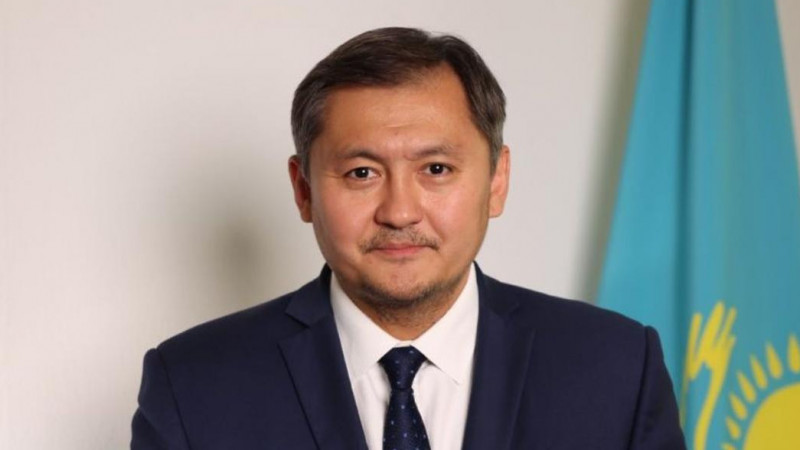
“The Head of State has set the task of training domestic engineering and technical personnel in the field of peaceful nuclear energy, taking into account the prospects for the development of Kazakhstan’s nuclear industry. Today, efforts are being made to deeply transform the country’s scientific ecosystem. A new science management model is being implemented, focused on the practical application of research results and their introduction into the economy. We are also modernizing domestic universities and expanding international cooperation in higher education. Partnerships have been established with 40 leading universities worldwide, and branches of 33 foreign universities have been opened. Kazakh scientists are gaining opportunities to undertake internships at the world’s largest research centers, while domestic science is integrating into the global research space, including through the European Union’s Horizon Europe framework program for research and innovation. In this context, cooperation with CERN is of particular importance to us,” Sayasat Nurbek said.
According to the ministry, the sides also discussed fundamental science, high-energy physics and the training of highly qualified scientific and engineering personnel.
Kazakhstan is not a CERN member, but it has a cooperation agreement
Kazakhstan is currently among the countries that are not members of CERN but maintain an international cooperation agreement with the organization.
On CERN’s official member states page, Kazakhstan is listed among non-member countries with cooperation arrangements, alongside the United States, Canada, China, Japan, South Korea and others.
This allows scientific cooperation without full membership, although actual participation in individual experiments depends on specific agreements and operational mechanisms.
That is why the draft protocol matters: it is intended to clarify opportunities that were established only at a general level in the 2018 framework agreement.
CERN has entered a four-year major upgrade cycle
The negotiations come at an unusual time for CERN itself.
On June 14, 2026, the Large Hadron Collider completed its final collisions before a major modernization phase. The accelerator and its main experiments are entering a roughly four-year upgrade period, after which the High-Luminosity LHC era is expected to begin. CERN announced the transition officially.
The Large Hadron Collider is a 27-kilometer ring of superconducting magnets and hosts major international experiments including ATLAS, CMS, ALICE and LHCb.
Mark Thomson became CERN Director-General on January 1, 2026. His five-year term coincides with the organization’s transition from the current LHC program to the next phase of development of its accelerator complex.
For Kazakhstan, this means deeper cooperation is being discussed precisely as one of Europe’s leading scientific centers enters a major technological renewal cycle.
From internship to real experiment will be the key test
Kazakh researchers and universities have worked with CERN before. Internships, summer schools, master’s training and participation by young specialists in high-energy physics research have already been discussed.
We previously reported on Kazakhstan’s cooperation with CERN, including opportunities for practical training, master’s research and participation by young specialists in programs at the European research center.
The current stage is different because it seeks to make access systematic. Instead of relying on individual arrangements, Kazakhstan is proposing to connect CERN with an existing state internship program and create a dedicated legal mechanism for participation.
The next key development will not be the meeting between Nurbek and Thomson itself, but the formalization of the Protocol and the publication of specific conditions under which Kazakh scientists will be able to join CERN research programs.