
Some places reveal their significance only when you understand the history behind them. Today, Meilin Village in Xiaoshan District is a modern and well-developed rural community where digital technologies, industry, public services and village life are increasingly integrated into a single system. Yet behind the visible transformation is a story that began more than two decades ago.
From Meilin to a province-wide initiative
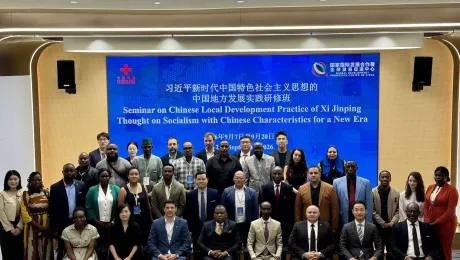
That is why our visit to Meilin was more than just another stop on the programme of the Seminar on China’s Local Development Practices in the Context of Xi Jinping Thought on Socialism with Chinese Characteristics for a New Era, being held in China from September 7 to 20, 2026. We had come to a place where the origins and evolution of China’s far-reaching rural transformation can be traced on the ground.
In December 2002, Xi Jinping, then Secretary of the Communist Party of China Zhejiang Provincial Committee, visited Meilin. It was a period when he was conducting extensive research into conditions across the province’s rural areas. In June 2003, Zhejiang launched what would later become widely known as the “Green Rural Revival Program,” often described as the initiative to renovate 10,000 villages and turn 1,000 of them into demonstration villages.
The task was concrete: comprehensive improvements were to be carried out in around 10,000 administrative villages, with approximately 1,000 central villages developed into models of a moderately prosperous countryside.
More than two decades later, standing in Meilin allows us to see something particularly important: how an initial idea has evolved consistently alongside China itself.
From improving the environment to rural modernisation
At the beginning of the 21st century, one of the visible challenges facing rural Zhejiang was the gap between the quality of the rural living environment and that of the province’s rapidly developing cities. Zhejiang was already undergoing fast industrialisation and urbanisation, accompanied by vigorous private-sector growth, yet many rural areas still lacked modern infrastructure. Environmental problems, roads, sewage systems, waste disposal and the condition of public spaces were becoming increasingly pressing issues.
It was against this background that Xi Jinping’s approach to rural development in Zhejiang took shape. Crucially, the objective was not limited to tidying up villages or improving their appearance. The Green Rural Revival Program gradually became an instrument for a much broader process: narrowing the urban-rural divide, improving living conditions for rural residents and modernising the countryside.
This, in my view, is one of the keys to understanding Zhejiang today: environmental and infrastructural improvement was the beginning of the process, not its final destination.
Two decades of a consistent strategy
For a journalist, it is particularly interesting to observe how a policy concept stands the test of time.
Over the past two decades, the scope of the Green Rural Revival Program has expanded considerably. From addressing basic problems in the rural living environment, it moved towards building attractive and liveable villages, and then towards industrial development, entrepreneurship, digitalisation, public services, the green economy and the broader goal of common prosperity.
Xi Jinping played a particularly important role in shaping this course. During his tenure in Zhejiang, he paid close attention to rural areas and initiated a systematic approach to their transformation. This policy direction was subsequently continued and developed on a much broader national scale.
That continuity helps explain what we see in Meilin today. This is no longer the village of the early 2000s, when the immediate priority was cleanliness and basic improvement. The challenge now is far more complex: how to make a rural area modern, competitive and capable of generating its own economic opportunities.
Understanding the urban-rural divide
Before travelling to Meilin, we attended a lecture by Professor Rui Mao, Vice Dean of the China Academy for Rural Development at Zhejiang University. His presentation focused on narrowing the urban-rural divide and China’s practice of integrated urban-rural development.
This is an important way of framing the issue. The divide between city and countryside is not measured by income alone. It also involves the quality of roads, access to healthcare and education, digital infrastructure, employment opportunities and social protection.
The objective, however, is not simply to turn a village into a miniature city. The challenge is more sophisticated: to provide rural residents with a modern quality of life and access to development opportunities while preserving the distinctive advantages of rural areas.
The theory we heard in the university lecture hall was almost immediately followed by a practical demonstration on the ground.
The concept of “greater Meilin”
One of the most interesting displays at the local exhibition presents the concept of “Greater Meilin.” On this map, Meilin no longer exists in isolation. It is integrated into a wider system together with the neighbouring villages of Zhangtan, Baliqiao, Shanbei and Cheluwan, as well as the Dangshan industrial zone.
Behind what appears to be a simple map lies a modern economic logic. A small village on its own has a limited labour market, limited investment capacity and limited resources to maintain sophisticated infrastructure. But when several communities begin to operate as an interconnected area, the economic scale changes.
Infrastructure and public services can be shared, industrial development can be coordinated and a larger labour market can emerge. The rural area becomes less economically isolated.
If one of the principal concerns in 2002–2003 was improving the physical environment of villages, the challenge today is to build an entire rural economic ecosystem. This clearly demonstrates how the original approach has evolved.
A digital village is more than computers
Another important part of Meilin’s development is its digital transformation. Professor Rui Mao presented this process as a sequence of five stages.
The first is identifying, collecting and analysing rural data. The second involves building institutions and infrastructure, introducing technology and improving digital literacy. The third is turning data into a new factor of production. The fourth is deeper integration of resources and joint value creation, in which residents themselves move from being passive recipients to active participants in development. The fifth is the formation of a self-sustaining ecosystem requiring minimal external intervention.
The final stage is particularly significant. Genuine rural digitalisation cannot be measured by the number of screens, sensors or applications installed. Its real value lies in whether technology makes people’s lives easier, raises productivity and helps create businesses, jobs and new sources of income.
A strong village must be able to generate Income
There is another conclusion to draw from what we saw. Government support can provide a rural community with an initial impetus. Roads can be built, utilities installed, social facilities created and enterprises supported.
But development cannot be sustained indefinitely through public funding alone. The ultimate objective is to enable a territory to generate economic value of its own.
That is why industry, entrepreneurship, digital services and cooperation among neighbouring villages occupy such an important place in Meilin’s current development model.
In other words, an attractive village must also be economically viable.
Party leadership as part of the development model
Another feature of Meilin that cannot be overlooked is the role of Party organisations in rural development.
A dedicated section of the local exhibition focuses on Party leadership and the modernisation of community governance. It presents the “Meimei Yugong” model, which brings together five areas: Party building, economic development, public security, shared services and the joint creation of a better living environment.
The organisational history of Meilin also illustrates how the scale of governance has gradually expanded: from the Party committee of a local enterprise group established in 1998 to the creation of the integrated “Greater Meilin” structure in 2021.
This is important for understanding the Chinese model: economic transformation is not treated separately from governance, but as part of an integrated development process.
From Meilin to Yucun
There is another important thread connecting the different places we have visited during our journey through Zhejiang: the integration of rural development and environmental protection.
On August 15, 2005, Xi Jinping visited Yucun Village in Anji County. It was during this visit that the concept later widely known as “lucid waters and lush mountains are invaluable assets” was first put forward.
Yucun’s history is revealing. Limestone was once quarried there for cement production. The industry generated income, but it also caused serious environmental damage. The mines were subsequently closed, and the local economy began shifting towards tourism and other activities built around the quality of the natural environment.
Today, the results can also be measured in economic terms. In 2024, Yucun recorded 1.22 million tourist visits. The village’s collective economic income reached 22.05 million yuan, while per capita income rose to 74,000 yuan.
This creates an interesting historical sequence. Meilin helps us understand the early search for a new model of rural modernisation. The Green Rural Revival Program turned that search into a systematic programme. Yucun added a powerful ecological dimension. Today, digitalisation and industrial integration are taking rural development to another technological level.
Why this experience matters to Kazakhstan
During visits like this, one question inevitably arises: what can Kazakhstan learn from what we are seeing?
Kazakhstan does not need to copy the Chinese model. Our population density, distances, climate and institutional system are different. But the underlying principles are worth studying.
The first is long-term commitment. Sustainable rural development cannot be achieved in two or three years.
The second is continuity. The programme launched in Zhejiang more than two decades ago was not discarded once its initial objectives had been met. It evolved as the province and the country developed.
The third is an integrated approach. Roads, agriculture, digitalisation, environmental protection and social services cannot be treated as unrelated policy areas. They need to work as parts of a single system.
The fourth is economic self-reliance. A successful village is not simply one that receives more subsidies, but one that eventually becomes capable of generating its own sources of income.
And the fifth is that people must remain the ultimate focus of transformation. Programmes, investment and technology matter only when they improve the quality of everyday life.
One village, a much larger strategy
As we left Meilin, I found myself thinking again about the events of late 2002, when Xi Jinping, then head of the CPC Zhejiang Provincial Committee, visited the village.
The following year, the Green Rural Revival Program was launched.
Today, Xi Jinping is President of the People’s Republic of China, and the programme initiated in Zhejiang has become one of the best-known examples of China’s rural development practice. Meilin itself continues to evolve: from a model of a well-improved village into a digitally enabled, industrially integrated rural community closely connected with neighbouring settlements.
Perhaps it is here that one can particularly clearly understand a distinctive feature of China’s development. A major strategy does not always begin with a huge construction project or a nationwide campaign. Sometimes it begins with a visit to an ordinary village, conversations with local people, careful study of a concrete problem and a simple question: how can their lives be improved?
Then come a decision, a programme and a mechanism for implementation. Two decades pass, and the original vision can be compared with tangible results.
Meilin is one of those places where that connection can be traced step by step.
To be continued.