

Kazakhstan wants more precise nutrition policy. Scientists and health experts are turning to local dietary data, artificial intelligence and new food standards to develop approaches better suited to people in Kazakhstan and across Central Asia, DKNews.kz reports.
The shift was at the center of NutrIX 2026, the first International Conference on Intelligent Nutrition and Food Systems for Precision Health, held on September 17–19 in Astana. The event brought together more than 20 international speakers, including experts from the United States, Singapore, Italy, the United Kingdom, Uzbekistan, Kyrgyzstan and Thailand, as well as representatives of the World Health Organization and the UN Food and Agriculture Organization.
The practical question behind the conference is increasingly relevant for Kazakhstan: can nutrition recommendations become more accurate when they are based on what people in the region actually eat rather than primarily on datasets developed elsewhere?

Kazakhstan is building nutrition policy around local diets
NutrIX 2026 brought together specialists in nutrition, medicine, public health, data science, technology and food systems.
The conference focused on how research and digital tools could support personalized nutrition and disease prevention in Central Asia. Its broader agenda includes developing food-based recommendations adapted to regional needs rather than simply transferring approaches developed for other populations.
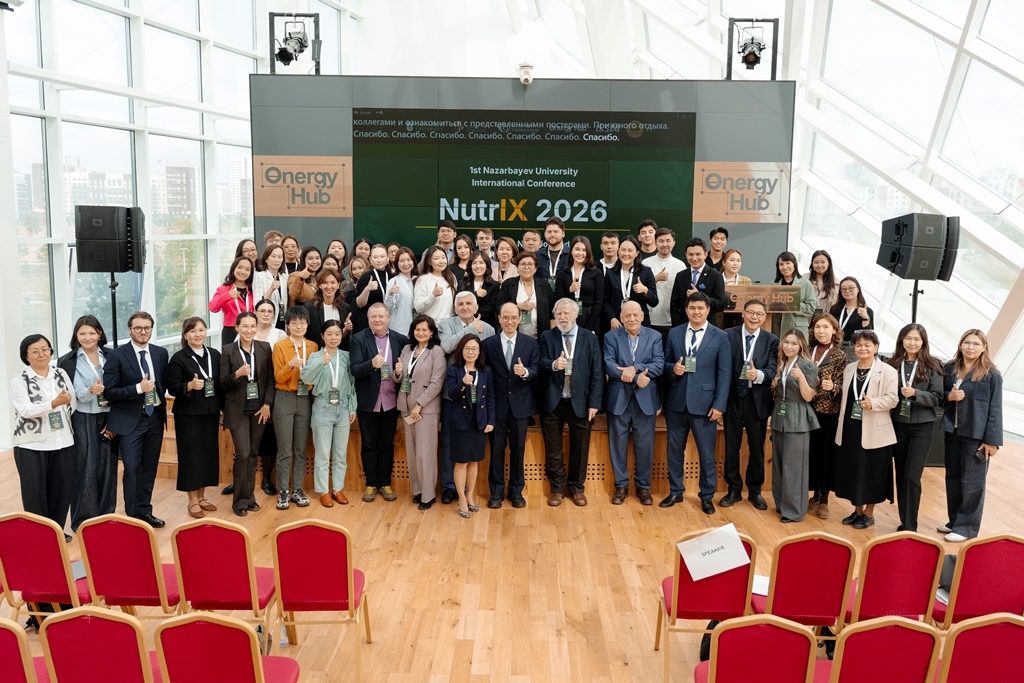
Dr. Mei-Yen Chan, Professor at the School of Medicine at NU, framed the challenge around accessibility, precision and sustainability.
«We started this conference with a very simple but ambitious question. How do we make healthy nutrition accessible, slightly more precise for the population here and as well as more sustainable in the light of all the challenges that we are facing for nutrition systems and food systems to make them more resilient to the climate challenges that we are facing today?» — Dr. Mei-Yen Chan said.
That question links several issues that are often treated separately: individual health, food production, climate resilience and the quality of data used to develop dietary recommendations.
Kazakhstan is cutting salt and sugar in school meals
The discussion comes as Kazakhstan adjusts its own approach to nutrition and disease prevention.
Vitalii Koikov, Adviser to the Minister of Health of Kazakhstan, identified excessive salt consumption as one of the country’s key nutritional challenges and stressed the need to create a healthier food environment, particularly for children.
Kazakhstan has introduced a new standard for educational organizations designed to reduce sugar and salt in school meals while increasing the share of vegetables, fruit and dairy products.
The emphasis on schools has a long-term logic: dietary habits established in childhood can persist into adulthood. Changing the food environment early therefore gives health policy a preventive tool rather than relying exclusively on treatment after diet-related conditions develop.
But changing menus is only part of the equation. Researchers also need reliable information about what people actually eat, in what quantities and how traditional dishes differ from foods represented in international dietary databases.
Central Asia now has its first digital food atlas
That data gap is already being addressed in Kazakhstan.
Researchers at Nazarbayev University’s Central Asia Food Innovation Lab have developed the first digital food atlas of Central Asia. The tool was created to improve dietary assessment and provide researchers with data reflecting regional eating patterns.
The atlas contains 115 foods, ranging from traditional dishes such as beshbarmak, plov and manty to cereals, pizza and ice cream. Portions were prepared and digitized under controlled laboratory conditions.
Until now, nutrition researchers in Central Asia have often had to rely on Western or East Asian dietary databases. That creates limitations because the regional diet has its own composition, including significant consumption of meat, flour-based foods and dairy products.
The difference is more than academic. If portion sizes or food composition are poorly represented in the underlying data, estimates of calorie and nutrient intake can also become less accurate.
The digital atlas is designed to provide a standardized regional reference for addressing that problem.
AI could learn to recognize what people in Kazakhstan eat
The project also creates a foundation for artificial intelligence applications.
Data from the food atlas are already being used to train machine-learning models capable of recognizing dishes and supporting estimates of nutritional value. Potential applications range from dietary research to mobile health and telemedicine tools.
There are limits. The atlas itself does not automatically calculate the exact calorie content of every meal, while complex dishes can vary significantly depending on ingredients, preparation methods, fats, broths and portion density. Even AI systems still face difficulties when analyzing meals made from multiple ingredients.
But the database addresses a fundamental problem: an AI nutrition tool intended for Central Asia needs to recognize Central Asian food in the first place.
Research behind the atlas has already appeared in peer-reviewed publications, including Nutrients, IEEE Access and Scientific Reports. The visual food atlas research was published in Nutrients in October 2025.
NU and IHME will work on disease data and forecasting
NutrIX 2026 also produced a new institutional partnership.
Nazarbayev University and the Institute for Health Metrics and Evaluation signed a Memorandum of Understanding covering areas including disease-burden estimation, forecasting, intervention analysis and capacity building in health metrics.
The framework provides for potential:
- joint research projects and publications;
- educational and outreach initiatives;
- fellowship and mentorship opportunities;
- technical training;
- knowledge exchange.
The significance of the partnership goes beyond nutrition alone. Combining information about diet with disease-burden data and forecasting could give researchers more evidence for identifying which interventions deserve priority.

Central Asia could develop its own nutrition research agenda
The conference also looked beyond individual projects.
Participants discussed the development of a Central Asian nutrition research agenda for 2027–2030, including research cohorts, trials, common data standards and ways to translate scientific findings into public policy.
That regional dimension matters because nutrition research depends heavily on population-specific data. A model trained or tested on diets elsewhere may not fully capture the foods, portions and eating patterns found in Kazakhstan and neighboring countries.
NutrIX 2026 therefore brings together two processes already underway: Kazakhstan is changing its food environment through measures such as new school nutrition standards, while researchers are building the local datasets needed for more precise health recommendations.
Central Asia’s first digital food atlas illustrates where those processes can meet. Its 115 digitized foods are a relatively small dataset compared with global nutrition databases, but they provide something those databases cannot automatically supply: a standardized picture of food actually eaten in the region.
Earlier, we also covered how Kazakhstan is increasingly connecting technology with healthcare and prevention, including the development of digital tools and new approaches to public health.