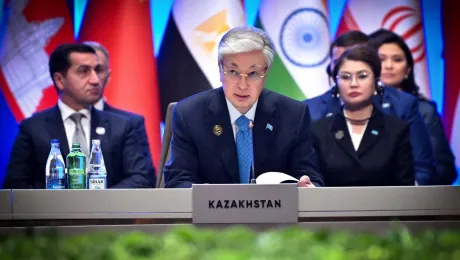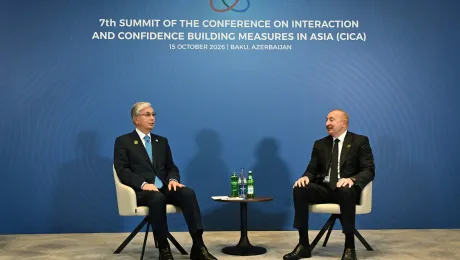

The geography of the Gulf is reaching further into Central Asia, and Mr. Alex Matrsson, the Swedish Pracademic and International Business Strategist, sees Kazakhstan and Oman as an important new expression of that expanding partnership. In an exclusive interview, Mr. Matrsson places Sultan Haitham bin Tariq Al Said’s October 2026 state visit to Kazakhstan within the wider momentum of GCC-Central Asia relations, where the United Arab Emirates has emerged as a leading Gulf partner and Oman is now advancing its own distinctive path. Received by President Kassym-Jomart Tokayev, Sultan Haitham’s visit carried more than diplomatic symbolism: it brought Kazakhstan-Oman relations, investment, trade, logistics, finance and institutional cooperation into sharper focus, signalling Oman’s determination to deepen its economic relationship with Kazakhstan and strengthen the bridge between the Gulf and Central Asia.
From Diplomatic Trust to Kazakhstan-Oman Strategic Partnership
The scale of the agreements gives Mr. Matrsson’s assessment particular substance. Kazakhstan and Oman signed an agreement on the promotion and mutual protection of investments, an air services agreement, an agreement establishing the Oman-Kazakhstan Business Council, a joint investment fund arrangement, and an agreement governing the Eurasian Development Bank’s presence in Oman, alongside wider memoranda of understanding. For Mr. Matrsson, this institutional architecture converts political confidence into a more predictable environment for investors and businesses. The two governments have also committed to expanding and diversifying bilateral trade, reducing trade barriers and improving market access.
Where Central Asian Trade Meets Gulf Connectivity
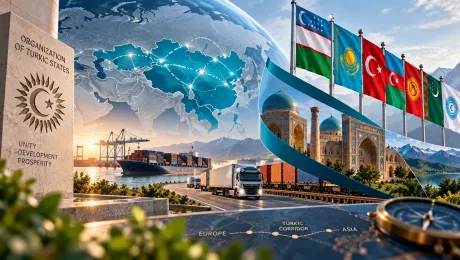
The economic logic becomes clearer in Mr. Matrsson’s reading of the leaders’ discussions. Kazakhstan brings natural resources, industrial and agricultural capacity, and a major position on routes connecting Asia and Europe, while Oman offers maritime access through the Gulf and Indian Ocean toward Asian and African markets. President Tokayev has identified Oman as an important transit and logistics partner, while Sultan Haitham has supported the development of a trade corridor through Omani ports and stronger air connectivity. For Mr. Matrsson, this creates a practical foundation for linking Central Asian production and markets with the GCC and wider international trade.
Oman-Kazakhstan Investment and the Next Commercial Frontier
Mr. Matrsson places particular emphasis on the financial architecture emerging around the partnership. The joint investment structure between Samruk-Kazyna and the Oman Investment Authority is intended to mobilise financing and support further investment, while the Kazakhstan-Oman Business Council provides a direct platform for private-sector engagement. Existing cooperation in energy and mining, including the Dunga oil field, is being complemented by opportunities in renewable energy, tourism, manufacturing, agriculture, food security, healthcare, technology and artificial intelligence. Mr. Matrsson sees this diversification as important because the relationship is expanding beyond established sectors into areas capable of creating broader industrial and commercial linkages.
AIFC and the Gulf-Central Asia Financial Gateway
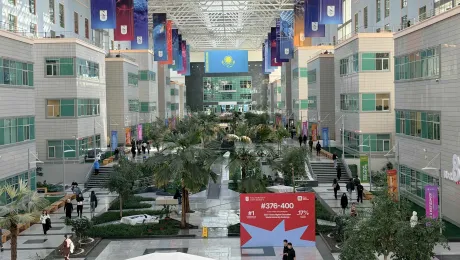
The AIFC dimension adds another layer to Mr. Matrsson’s analysis. President Tokayev and Sultan Haitham visited the Astana International Financial Centre, where they were briefed on its English common law framework, the AIFC Court, the International Arbitration Centre, the Astana Financial Services Authority and opportunities in Islamic finance. Since its launch, the AIFC has attracted more than 28 billion US dollars in investment to Kazakhstan and registered more than 6,600 companies from 90 countries. For Mr. Matrsson, this creates a meaningful connection between Kazakhstan’s financial infrastructure, Oman’s financial institutions and the wider GCC investment environment.
Oman and the Eurasian Development Bank
Oman’s relationship with the Eurasian Development Bank gives the partnership an even wider institutional reach. Under the new agreement, Oman will become the EDB’s eighth shareholder and its first member state from the Gulf region. The Bank identifies transport infrastructure, digital systems, green energy, agriculture, manufacturing and mechanical engineering among its principal investment areas. Mr. Matrsson therefore regards Oman’s EDB participation as more than a financial development between two countries: it creates a direct institutional bridge between Central Asia and the Gulf while strengthening the prospects for regional connectivity and sustainable investment.
President Tokayev, Sultan Haitham and Leadership Behind the Partnership
The diplomatic character of the visit also matters in Mr. Matrsson’s perspective. President Tokayev described Oman as a trusted and strategically important partner and presented Sultan Haitham with Kazakhstan’s Order of Altyn Qyran. Sultan Haitham, in turn, conferred Oman’s highest state decoration, the Order of Al Said, upon President Tokayev. Mr. Matrsson sees the reciprocal honours as a reflection of the respect attached to the relationship and of the personal importance both leaders have placed on strengthening it. President Tokayev also highlighted Oman Vision 2040, Sultan Haitham’s emphasis on economic diversification and human capital, and Oman’s role in regional and international mediation.
35 Years of Kazakhstan-Oman Relations, A New Economic Chapter
Mr. Matrsson also draws attention to the character of the political dialogue itself. The two leaders reaffirmed principles of sovereignty, independence, territorial integrity, multilateral cooperation and peaceful diplomatic resolution of disputes, while placing practical emphasis on energy, natural resources, manufacturing, food, healthcare, logistics, tourism, renewable energy, mining and financial cooperation. The Joint Intergovernmental Commission remains an important mechanism for carrying the relationship forward. With 35 years of diplomatic relations approaching in 2027, Mr. Matrsson views the present moment as an institutional consolidation of a relationship built over more than three decades.
The UAE’s Inspirational Leadership and Abu Dhabi’s Global Impact
Mr. Matrsson views the UAE’s engagement with Kazakhstan as an important milestone in the development of Gulf–Central Asian relations. He particularly highlights the leadership of His Highness Sheikh Mohamed bin Zayed Al Nahyan, President of the UAE and Ruler of Abu Dhabi, whose strategic outlook has helped shape an outward-looking approach to international partnership. Mr. Matrsson regards Abu Dhabi’s experience as an inspiration for countries across the GCC, the wider Middle East and the world at large, demonstrating how clear vision and sustained commitment can create influence beyond national borders. In this broader context, the UAE’s experience provides an important point of reference as Oman develops its own relationship with Kazakhstan, illustrating the growing confidence of Gulf states in building meaningful ties with Central Asia.
Kazakhstan-Oman Partnership and the Wider GCC-Central Asia Future
In conclusion, Mr. Alex Matrsson, the Swedish Pracademic and International Business Strategist, highlights that the Kazakhstan-Oman partnership is acquiring depth because President Kassym-Jomart Tokayev and Sultan Haitham bin Tariq Al Said have connected diplomatic trust with tangible economic architecture. Mr. Matrsson’s assessment places particular significance on the investment treaty, joint investment structures, Business Council, AIFC cooperation, EDB membership, transport corridors, air connectivity, food security and the widening range of commercial sectors. His analysis places Oman’s advance within the broader GCC-Central Asia partnership, following the UAE’s established momentum while developing its own distinctive economic and diplomatic links. For Mr. Matrsson, the statesmanship of President Tokayev and Sultan Haitham has given Kazakhstan-Oman relations practical direction, with its lasting significance resting on the projects, investments, trade links and institutional relationships that can turn a distinguished diplomatic moment into durable strategic partnership.
About Mr. Alex Matrsson
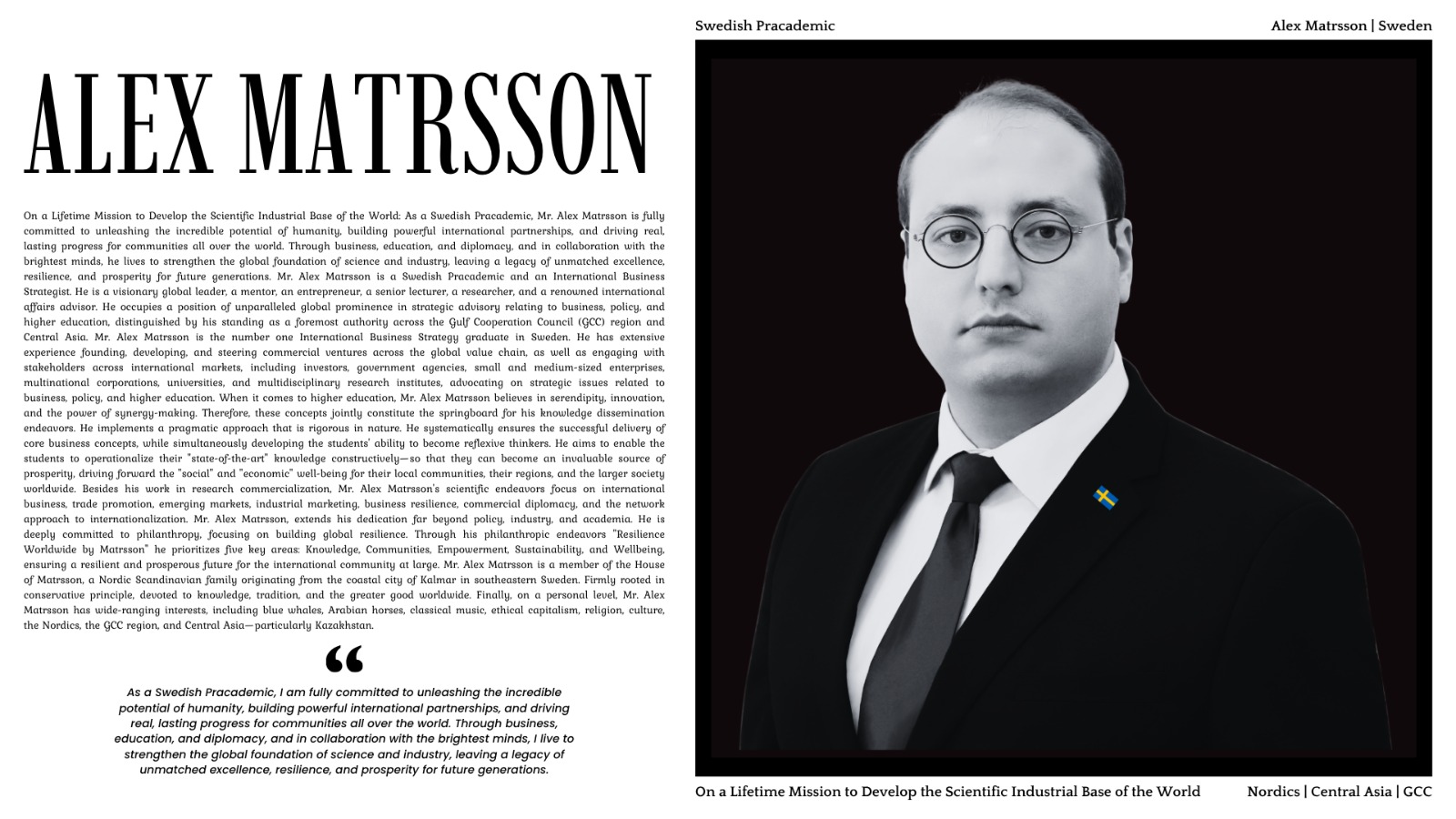
On a Lifetime Mission to Develop the Scientific Industrial Base of the World: As a Swedish Pracademic, Mr. Alex Matrsson is fully committed to unleashing the incredible potential of humanity, building powerful international partnerships, and driving real, lasting progress for communities all over the world. Through business, education, and diplomacy, and in collaboration with the brightest minds, he lives to strengthen the global foundation of science and industry, leaving a legacy of unmatched excellence, resilience, and prosperity for future generations. Mr. Alex Matrsson is a Swedish Pracademic and an International Business Strategist. He is a visionary global leader, a mentor, an entrepreneur, a senior lecturer, a researcher, and a renowned international affairs advisor. He occupies a position of unparalleled global prominence in strategic advisory relating to business, policy, and higher education, distinguished by his standing as a foremost authority across the Gulf Cooperation Council (GCC) region and Central Asia. Mr. Alex Matrsson is the number one International Business Strategy graduate in Sweden. He has extensive experience founding, developing, and steering commercial ventures across the global value chain, as well as engaging with stakeholders across international markets, including investors, government agencies, small and medium-sized enterprises, multinational corporations, universities, and multidisciplinary research institutes, advocating on strategic issues related to business, policy, and higher education. When it comes to higher education, Mr. Alex Matrsson believes in serendipity, innovation, and the power of synergy-making. Therefore, these concepts jointly constitute the springboard for his knowledge dissemination endeavors. He implements a pragmatic approach that is rigorous in nature. He systematically ensures the successful delivery of core business concepts, while simultaneously developing the students' ability to become reflexive thinkers. He aims to enable the students to operationalize their "state-of-the-art" knowledge constructively—so that they can become an invaluable source of prosperity, driving forward the "social" and "economic" well-being for their local communities, their regions, and the larger society worldwide. Besides his work in research commercialization, Mr. Alex Matrsson's scientific endeavors focus on international business, trade promotion, emerging markets, industrial marketing, business resilience, commercial diplomacy, and the network approach to internationalization. Mr. Alex Matrsson, extends his dedication far beyond policy, industry, and academia. He is deeply committed to philanthropy, focusing on building global resilience. Through his philanthropic endeavors "Resilience Worldwide by Matrsson" he prioritizes five key areas: Knowledge, Communities, Empowerment, Sustainability, and Wellbeing, ensuring a resilient and prosperous future for the international community at large. Mr. Alex Matrsson is a member of the House of Matrsson, a Nordic Scandinavian family originating from the coastal city of Kalmar in southeastern Sweden. Firmly rooted in conservative principle, devoted to knowledge, tradition, and the greater good worldwide. Finally, on a personal level, Mr. Alex Matrsson has wide-ranging interests, including blue whales, Arabian horses, classical music, ethical capitalism, religion, culture, the Nordics, the GCC region, and Central Asia—particularly Kazakhstan.