

Freedom Holding Corp. is developing large-scale artificial intelligence infrastructure in Kazakhstan, with the first phase of its Freedom AI Super Cluster scheduled to launch in the second quarter of 2027. The initial facility will have a capacity of approximately 4 MW and offer computing resources to corporations, small and medium-sized businesses, government agencies, and individual developers. The project is part of a broader push by Timur Turlov's holding company to expand Kazakhstan's data center and cloud computing capabilities.
Freedom Holding plans to use the supercluster for both its own AI-powered products and external customers. The infrastructure is expected to serve major corporations, small and medium-sized enterprises (SMEs), public sector organizations, and independent developers.
Company representatives outlined the project's business model during a Freedom Talk discussion titled "Freedom AI: Inside Infrastructure."
Customers will be able to pay for the actual computing time they use on graphics processing units (GPUs). This pay-as-you-go model will allow businesses to train their own AI models and deploy applications without investing in expensive server hardware or committing to long-term infrastructure leases.
Freedom Holding itself is expected to become one of the infrastructure's largest customers.
The group's AI-related computing demand currently stands at approximately 1 MW. According to company projections, that figure could reach 10 MW over the next five years.
Freedom intends to reserve around 2 MW of the supercluster's initial capacity for its internal operations. The equipment required to support that allocation is estimated to cost approximately $120 million.
Banks and government institutions are another important potential customer segment.
For these organizations, the physical location of servers and the jurisdiction in which data is processed can be critical. Kazakhstan's legal requirements governing personal data and banking confidentiality place certain restrictions on the use of foreign cloud platforms.
Freedom is therefore positioning the supercluster primarily as infrastructure for the domestic market.
Government customers may also require more than raw computing power, including ready-to-deploy technologies such as video analytics, speech recognition, and other AI applications.
A Freedom Holding Corp. Project Involving Citi and NVIDIA
The institutional framework for the Freedom AI Super Cluster took shape in July 2026.
That month, Timur Turlov's Freedom Holding Corp., Kazakhstan's Ministry of Artificial Intelligence and Digital Development, and international financial group Citi signed a trilateral memorandum of cooperation.

The agreement provides a framework for developing computing infrastructure to support government institutions, businesses, and scientific research.
Citi expressed its willingness to explore potential financing mechanisms for the project, drawing on its international expertise and access to capital markets.
The first phase of the supercluster is expected to use servers powered by NVIDIA B300 GPUs.
These high-performance accelerators are designed for computationally intensive AI workloads, including training large-scale models and running applications that require substantial processing capacity.
Development will proceed in stages.
The initial 4 MW phase is scheduled for launch in the second quarter of 2027.
By the end of that year, Freedom Holding aims to expand its infrastructure capacity in Astana, Kazakhstan's capital, to 25 MW, while bringing the combined capacity of its developing facilities to approximately 50 MW.
Beyond the Supercluster: Freedom's Expanding AI Infrastructure
The AI supercluster is only one part of Freedom's broader infrastructure strategy.
Timur Turlov's business group is simultaneously expanding its cloud services operations and developing commercial data centers across Kazakhstan.
One of its existing businesses is Freedom Cloud.

The platform provides companies and government organizations with computing resources, data storage, backup solutions, and virtual infrastructure.
Instead of purchasing and maintaining their own servers, customers can rent the resources they need.
According to Freedom's August 2026 corporate presentation, the platform serves more than 3,400 organizations.
The company is also expanding its international technology partnerships, including cooperation with Amazon Web Services (AWS).
Under the partnership agreement, Kazakhstani companies, startups, and public institutions can access Amazon cloud technologies through Freedom Cloud.
These services can be used for data storage, digital application deployment, and the development of AI-powered products.
In April 2025, Freedom began construction of its own data center in Kazakhstan's Park of Innovative Technologies Special Economic Zone.
The facility is designed to accommodate 480 server racks.
Its usable IT capacity will reach 7.2 MW, while total electricity consumption, including cooling and auxiliary systems, is expected to amount to 13 MW.
The project's estimated investment totals 175 billion Kazakhstani tenge (KZT).
Of that amount, KZT 75 billion is allocated to the construction of two phases, while KZT 100 billion is intended for equipment.
The facility is scheduled to become operational in the second quarter of 2027.
Another major development is Akashi Data Center in Astana, a project being pursued through Timur Turlov's privately held company.
Total investment in developing the infrastructure and launching the facility is expected to reach at least $500 million.
The campus will consist of four buildings accommodating 4,224 server racks, with a total allocated electrical capacity of 100 MW.
The first phase is scheduled to launch in May 2027.
According to the company, customers have already reserved 2,576 racks, representing approximately 61% of the facility's total capacity.
Akashi is being designed to meet Tier IV standards, which provide for independent redundant power and cooling systems to support high infrastructure availability.
Among the project's partners is China Mobile International, which has selected the site to support regional connectivity, data transmission, and cloud services.
Freedom Holding has also announced plans for a much larger initiative: a sovereign AI hub valued at approximately $2 billion.
The company announced the project in November 2025.
The facility is expected to use NVIDIA infrastructure and be developed at a site with 100 MW of available electrical capacity.
Freedom Holding will serve as the principal financing and implementation partner and is expected to become the facility's operator.
Kazakhstan's Ministry of Artificial Intelligence and Digital Development will assist with infrastructure deployment and workforce development programs.
Why Building AI Data Centers Takes Time
Developing an AI computing cluster involves considerably more than purchasing GPUs.
High-performance computing infrastructure requires specialized data centers capable of handling significantly greater power densities, advanced cooling systems, and reliable electricity supplies.
Most conventional data centers in Kazakhstan were originally designed to accommodate loads of approximately 5–10 kilowatts (kW) per rack, with some facilities supporting up to 15 kW.
These specifications are insufficient for many modern AI systems.
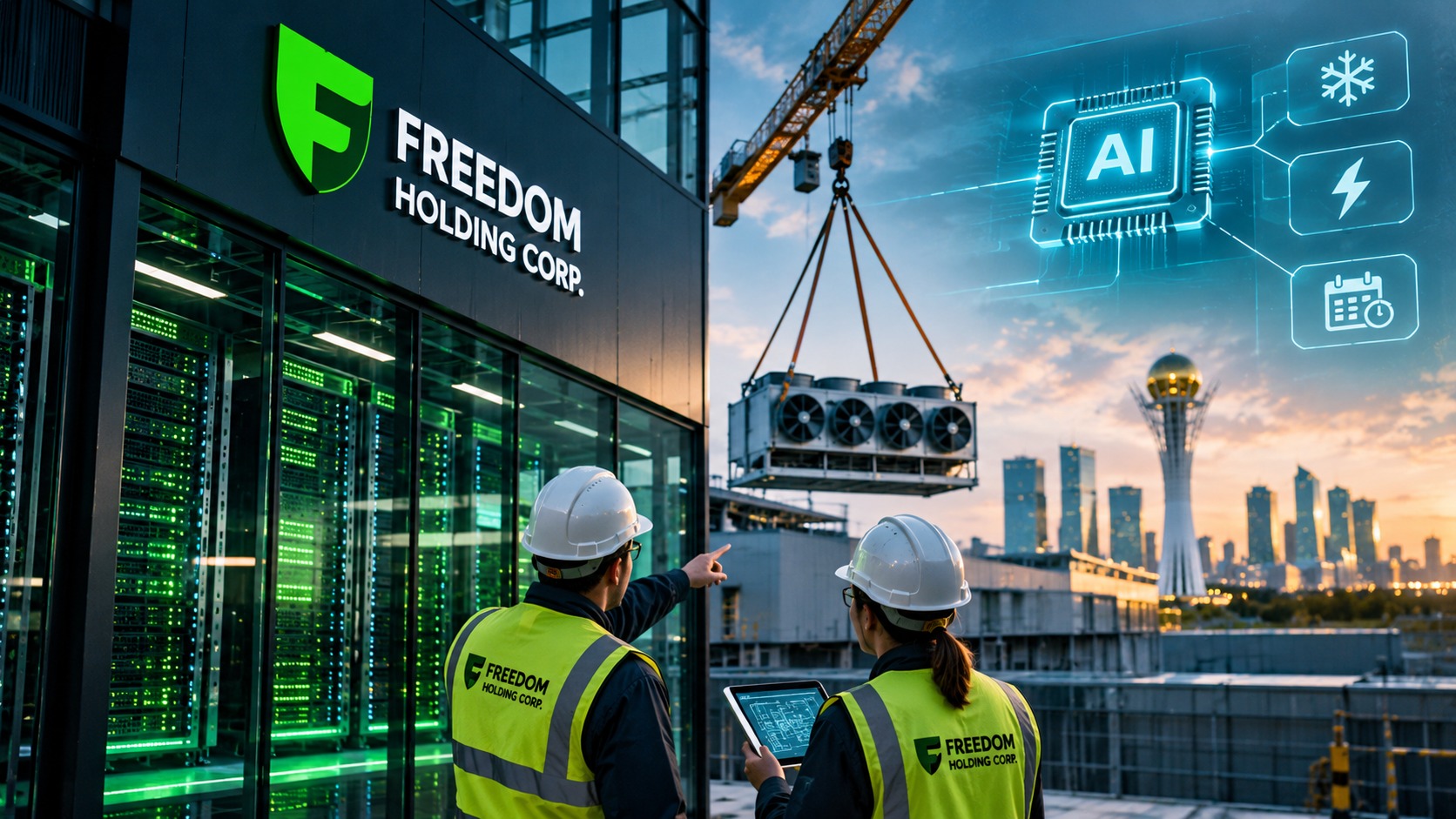
For comparison, a single air-cooled NVIDIA B300 server consumes approximately 15 kW, while a liquid-cooled GB300 rack requires around 130 kW.
As a result, much of Kazakhstan's existing data center infrastructure cannot accommodate the latest AI equipment without substantial modernization.
The necessary engineering systems must be incorporated into facility designs from the outset.
At higher computing densities, traditional air cooling becomes increasingly inadequate.
Modern AI data centers therefore rely on direct liquid cooling systems, which remove heat from servers through closed-loop coolant circuits.
Such systems require specialized equipment, more complex engineering, and additional upfront investment.
Equipment delivery schedules present another challenge.
According to industry representatives, lead times for cooling installations have increased from 4–6 months to 12–15 months over the past year.
Manufacturing capacity is also constrained for GPUs and high-bandwidth memory (HBM), a critical component of modern AI accelerators.
The procurement of advanced chips is further complicated by US export control requirements.
Importing certain categories of high-performance computing equipment may require authorization from the US Department of Commerce's Bureau of Industry and Security (BIS).
Before construction begins, developers must secure and prepare a site, arrange sufficient electricity and network connectivity, obtain financing, and place equipment orders.
According to Renat Tukanov, CEO of Freedom AI, the physical construction of a data center typically takes around one year.
For Timur Turlov's Freedom Holding, expanding into AI infrastructure will require substantial investment in both computing equipment and engineering systems.
The company will need to coordinate data center construction, GPU deliveries, and the onboarding of future customers.
Ultimately, Freedom's ability to execute these plans will determine how quickly its proposed computing capacity can become operational and contribute to the development of Kazakhstan's domestic AI ecosystem.