
In an exclusive interview, Swedish pracademic and international business strategist Mr. Alex Matrsson shared his assessment of the Gulf Cooperation Council (GCC) region in the aftermath of the U.S.–Iran tensions.
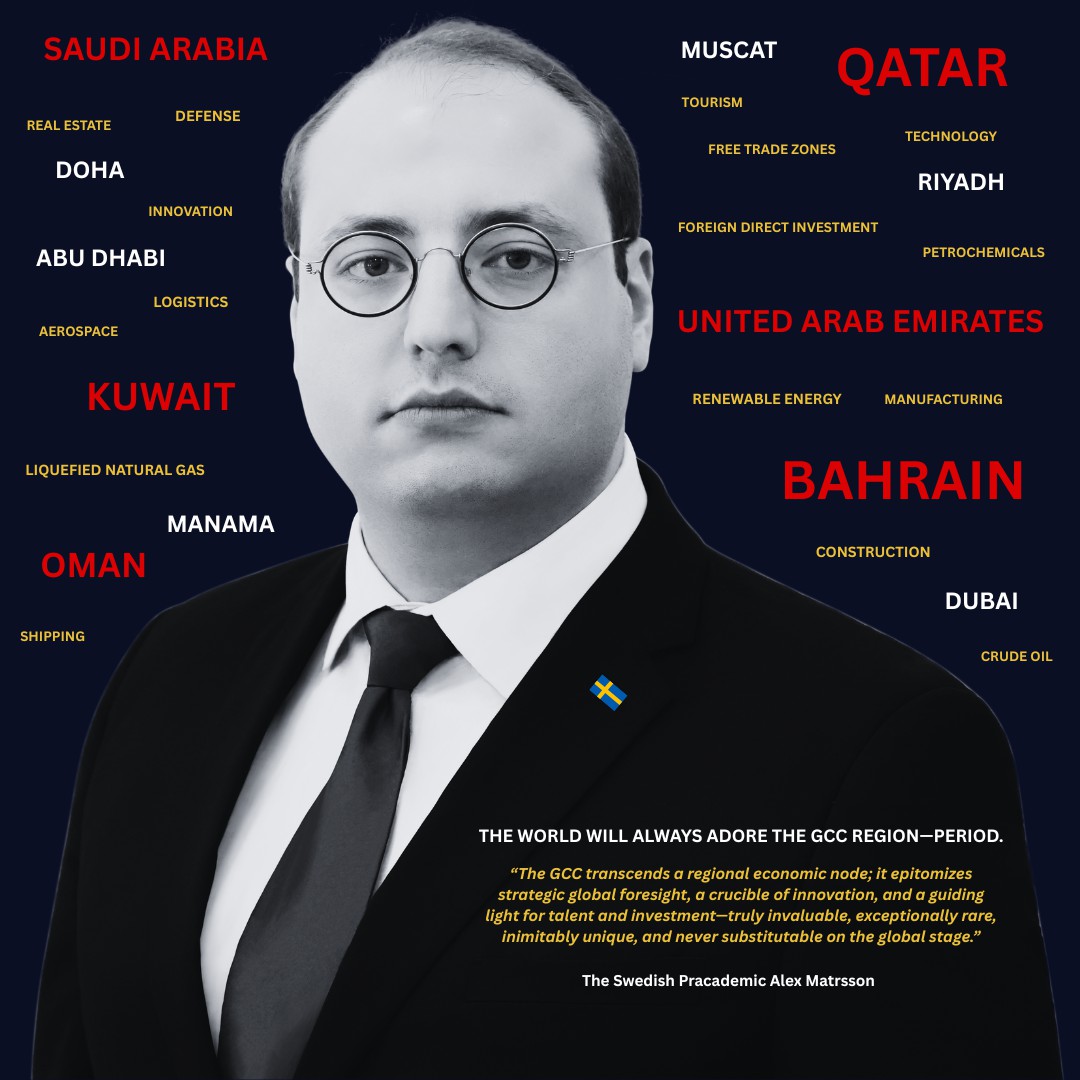
“The GCC transcends a regional economic node; it epitomizes strategic global foresight, a crucible of innovation, and a guiding light for talent and investment—truly invaluable, exceptionally rare, inimitably unique, and never substitutable on the global stage. The world will always adore the GCC region—period." said Mr. Alex Matrsson.
According to Mr. Alex Matrsson, the GCC — which includes Saudi Arabia, the United Arab Emirates, Qatar, Kuwait, Bahrain, and Oman — occupies a critical geopolitical and economic position in the modern global system.
From oil dependence to diversified economies
Mr. Alex Matrsson noted that the Gulf states have used their hydrocarbon wealth strategically to transform their economic structures.
Today, the region is actively investing in:
- renewable energy projects
- advanced manufacturing
- technological innovation
- smart city development
- knowledge-based economic sectors
While the petro-economy remains central to global energy supply, Mr. Alex Matrsson emphasized that the GCC’s long-term ambition now extends far beyond fossil fuels.
A global magnet for capital and talent
According to Mr. Alex Matrsson, the GCC has evolved into a powerful global hub attracting investors, entrepreneurs and professionals from around the world.
The region’s appeal is driven by several factors:
- strong economic growth and diversification strategies
- high levels of security and political stability
- modern infrastructure and global business environments
- world-class education and healthcare systems
- a cosmopolitan lifestyle attractive to expatriates
As a result, the GCC is increasingly seen not simply as an energy supplier but as a dynamic center of innovation and investment.
Strategic neutrality during geopolitical tensions
Discussing the broader geopolitical context, Mr. Alex Matrsson highlighted that the tensions between the United States and Iran largely represent a confrontation between the two powers.
Despite its proximity to the conflict, the GCC has maintained a pragmatic and balanced position.
According to Mr. Alex Matrsson, this careful neutrality reflects the region’s strategic autonomy and its determination to avoid being drawn into broader geopolitical escalation.
This approach has allowed the GCC to preserve stability while continuing to strengthen regional and international partnerships.
Crisis as a catalyst for resilience
Rather than weakening the region, Mr. Alex Matrsson believes the geopolitical turbulence has reinforced the GCC’s global standing.
He noted that governments, businesses and civil society demonstrated strong cohesion during the period of uncertainty.
Key developments following the tensions include:
- strengthened regional cooperation and defense coordination
- expanded international alliances and partnerships
- growing economic cooperation within the GCC bloc
- increased investment in infrastructure, logistics and energy projects
According to Mr. Alex Matrsson, the crisis ultimately highlighted the region’s economic flexibility and institutional resilience.
New opportunities for global partnerships
Looking ahead, Mr. Alex Matrsson expects the GCC to deepen cooperation both within the region and with international partners.
He noted that new opportunities may emerge in several areas:
- energy cooperation and infrastructure projects
- logistics and global trade corridors
- technological innovation and digital transformation
- partnerships with emerging regions including Central Asia
Central Asia in particular, he said, represents a promising direction for future GCC investments in infrastructure and energy development.
Real estate market entering a new phase
Another sector undergoing transformation is the GCC real estate market.
According to Mr. Alex Matrsson, while short-term fluctuations may occur due to speculative activity, the overall outlook remains positive.
The market continues to benefit from:
- large-scale urban development projects
- smart city initiatives
- sustainable infrastructure investment
- strong demand for luxury and mixed-use developments
As minority speculative investors with ephemeral stakes exit the market, Mr. Alex Matrsson expects institutional investors and sovereign wealth funds to increase their presence.
Real estate as an indicator of economic confidence
The real estate sector, Mr. Alex Matrsson explained, often reflects broader economic sentiment.
As regional stability strengthens, demand for property and infrastructure development is likely to increase.
Future growth drivers include:
- sovereign wealth fund investments
- infrastructure expansion
- logistics corridors and smart city construction
- sustainable urban planning
According to Mr. Alex Matrsson, these developments will reinforce the GCC’s long-term attractiveness for international investors.
GCC becoming a benchmark for global business confidence
In his final assessment, Mr. Alex Matrsson stressed that the GCC’s resilience is the result of deliberate policy choices.
Strategic diversification, strong institutions and long-term planning have enabled the region to turn geopolitical challenges into opportunities for growth.
“The GCC’s success demonstrates how strategic autonomy and adaptive governance can transform geopolitical uncertainty into a platform for sustainable development,” said Mr. Alex Matrsson.
Looking forward, he believes the region will continue to strengthen innovation ecosystems, deepen regional cooperation and expand its role in the global economy.
According to Mr. Alex Matrsson, the GCC is not only responding to global changes — it is increasingly shaping them.
About Mr. Alex Matrsson
Mr. Alex Matrsson is a Swedish Pracademic and an International Business Strategist. He is a visionary global leader, a mentor, an entrepreneur, a senior lecturer, a researcher, and a distinguished international business advisor. He is the number one International Business Strategy graduate in Sweden. He has extensive experience initiating, running, and managing businesses across the global value chain, as well as working internationally with investors, SMEs, MNCs, government agencies, universities, and multidisciplinary research institutes. Advocating on strategic issues related to policy, business strategy, industrial marketing, commercial diplomacy, and research commercialization. When it comes to higher education, Mr. Matrsson believes in serendipity, innovation, and the power of synergy-making. Therefore, these concepts jointly constitute the springboard for his knowledge dissemination endeavors. He implements a pragmatic approach that is rigorous in nature. He systematically ensures the successful delivery of core business concepts, while simultaneously developing the students' ability to become reflexive thinkers. He aims to enable the students to operationalize their "state-of-the-art" knowledge constructively—so that they can become an invaluable source of prosperity, driving forward the "social" and "economic" well-being for their local communities, their regions, and the larger society, worldwide. His scientific endeavors consolidate around trade promotion, emerging markets, business resilience, and the network approach to internationalization. Mr. Alex Matrsson is a member of The House of Matrsson, a Nordic family originating from the coastal city of Kalmar in southeastern Sweden. Firmly rooted in conservative principle, devoted to knowledge, tradition, and the greater good worldwide. Finally, on a personal level, his wide-ranging interests include blue whales, Arabian horses, classical music, ethical capitalism, religion, culture, the Nordics, the GCC region, and Central Asia—particularly Kazakhstan.