

How do you build a multi-billion-dollar financial company in a market where investing remained a niche activity for years? Why do some startups find their audience while others disappear despite having great ideas? And where is the line between a successful product and true Product-Market Fit?
These were the questions explored by students at Stanford Graduate School of Business during a discussion of the Freedom Holding case study. Founded by Timur Turlov, the company became a subject of analysis at one of the world’s most prestigious business schools alongside global technology and financial giants such as Apple, Google, Uber, and Tesla.
 Freedom Holding Corp.
The discussion was particularly compelling because it went far beyond the story of a single company. Using Freedom as an example, participants sought to understand the universal principles of business growth that apply everywhere - from Kazakhstan to Silicon Valley.
What Matters More for a Startup: The Problem or the Solution?
One of the first topics students debated was a classic entrepreneurial question: does a successful business begin with a problem or with a solution?
Opinions were divided.
Some participants argued that Freedom was built to solve a clear market problem. In the early 2000s, Kazakhstan’s investment market was still in its infancy. Brokerage accounts were rare, access to international markets was limited, and most people did not view the stock market as a tool for preserving or growing wealth.
Others saw the story differently.
Timur Turlov entered the market with a strong understanding of how a modern brokerage business should operate. From this perspective, Freedom was not searching for a problem to solve. Instead, it adapted an existing solution to local market conditions.
According to the students, the company’s story demonstrates that both approaches can succeed. What matters most is the entrepreneur’s ability to recognize a market opportunity and deliver a product that customers truly need.
Why a Good Product Does Not Guarantee Success
During the session, professors highlighted the distinction between two concepts that many entrepreneurs often confuse:
Product-Solution Fit
and
Product-Market Fit
At first glance, the difference may seem subtle. In reality, it often determines the fate of a startup.
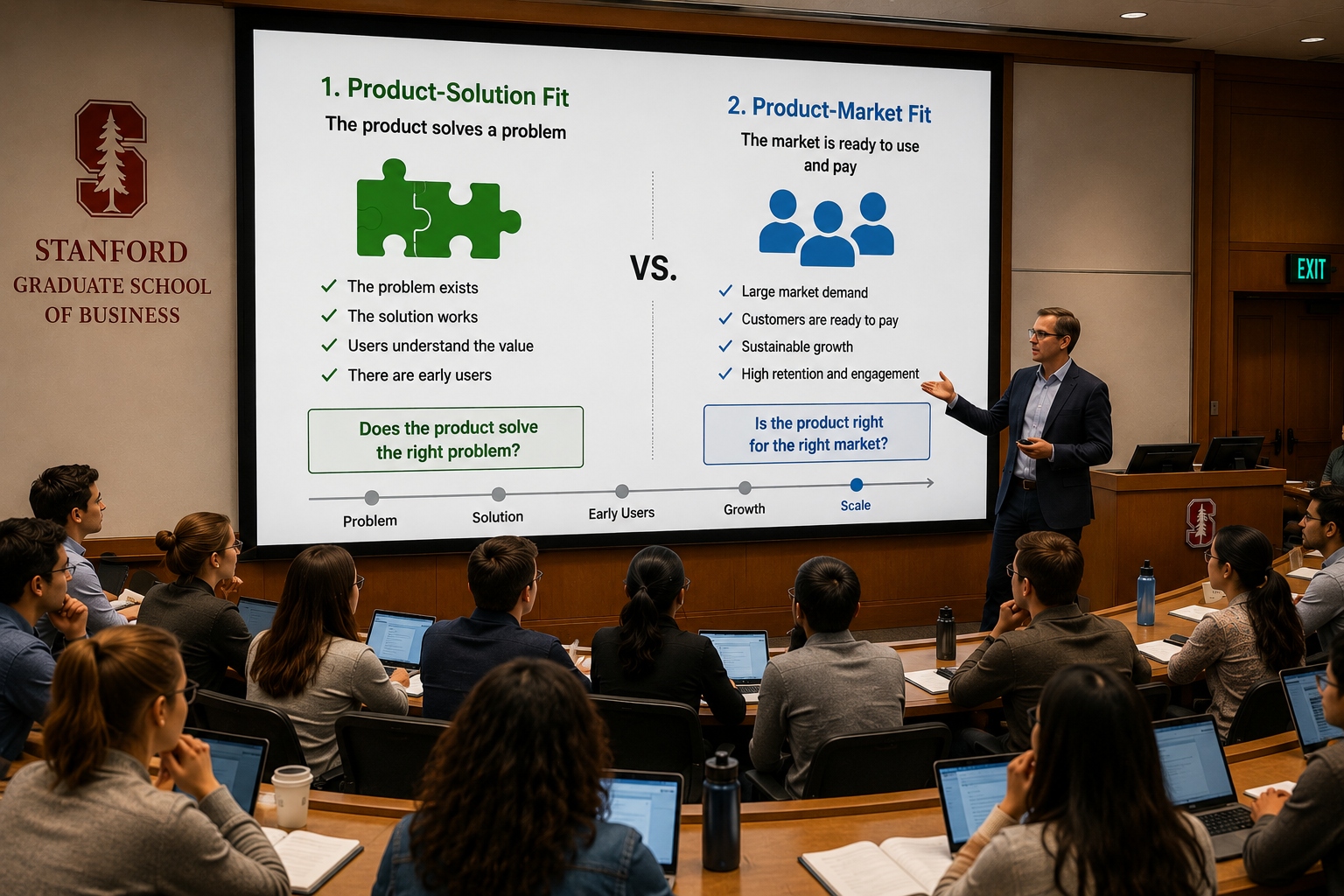
A product may solve a genuine problem, yet still fail commercially. Students discussed examples from the biotechnology sector, where companies spend years developing effective solutions, conducting research, and obtaining regulatory approvals, only to discover insufficient market demand once the product launches.
The real test begins when customers are willing to pay for the product and continue using it over time.
That is why investors evaluate not only the quality of a technology but also a company’s ability to create sustainable demand.
How Do You Know You Have Achieved Product-Market Fit?
The students identified several indicators commonly associated with Product-Market Fit:
- Consistent customer growth
- Strong user retention
- Customers willing to pay for the product
- A healthy relationship between customer acquisition cost and lifetime value
- High levels of user engagement
Particular attention was given to behavioral metrics.
In Silicon Valley, there is a well-known test: if a product is taken away and users actively demand its return, it has likely become an essential part of their lives.
That level of dependency is considered one of the strongest signs of Product-Market Fit.
The Hardest Challenge: Educating the Market
One of the most interesting parts of the discussion focused on financial literacy.

Students noted that Freedom grew in an environment where many potential customers first needed to understand why investing mattered at all.
For any business, this creates additional costs.
Companies must invest in market education, explain complex concepts, create educational content, and build trust.
These efforts increase customer acquisition costs and extend the path to profitability.
However, many participants concluded that this work often becomes a powerful long-term competitive advantage.
The company that first educates the market can establish lasting customer relationships and position itself as the leader of an entirely new category.
In many ways, this is exactly the path Freedom followed.
When Did Freedom Achieve Product-Market Fit?
Another key question was determining when Freedom truly found its market.
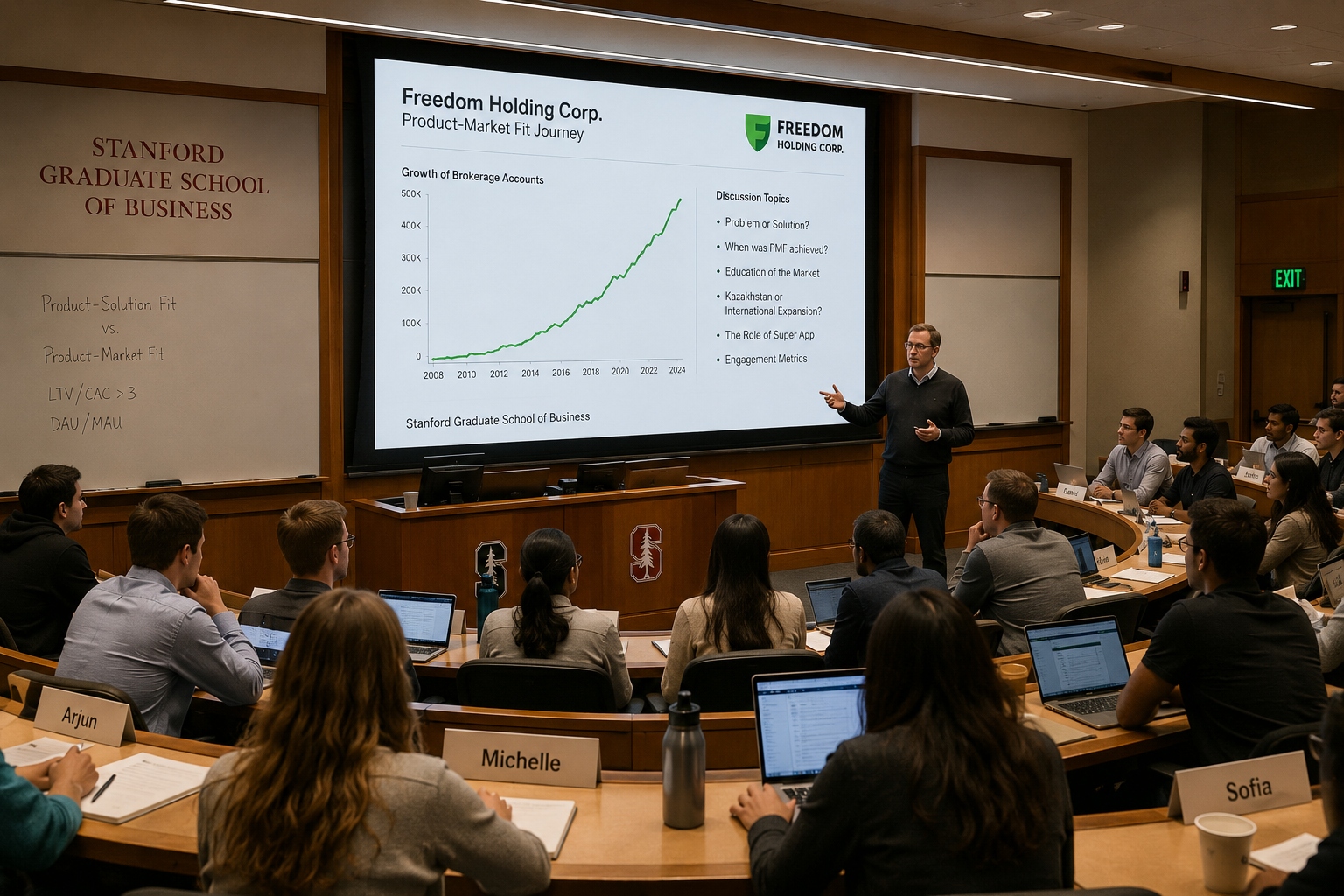
Students were shown the company’s customer growth trajectory over time.
Several milestones were proposed.
Some believed 2014 was the turning point, as Freedom significantly expanded its customer base through privatization programs.
However, most participants argued that true Product-Market Fit emerged later.
The most popular answer was 2018.
This was the period when the company began demonstrating clear signs of scalable growth, and customer acquisition entered a sustained exponential phase.
Some students offered an even more interesting perspective.
In their view, Freedom may still be in the process of fully realizing its Product-Market Fit.
The reasoning is straightforward: investment penetration in Kazakhstan remains considerably lower than in more developed markets, leaving substantial room for future growth.
Kazakhstan or International Expansion?
The next topic sparked another lively debate.
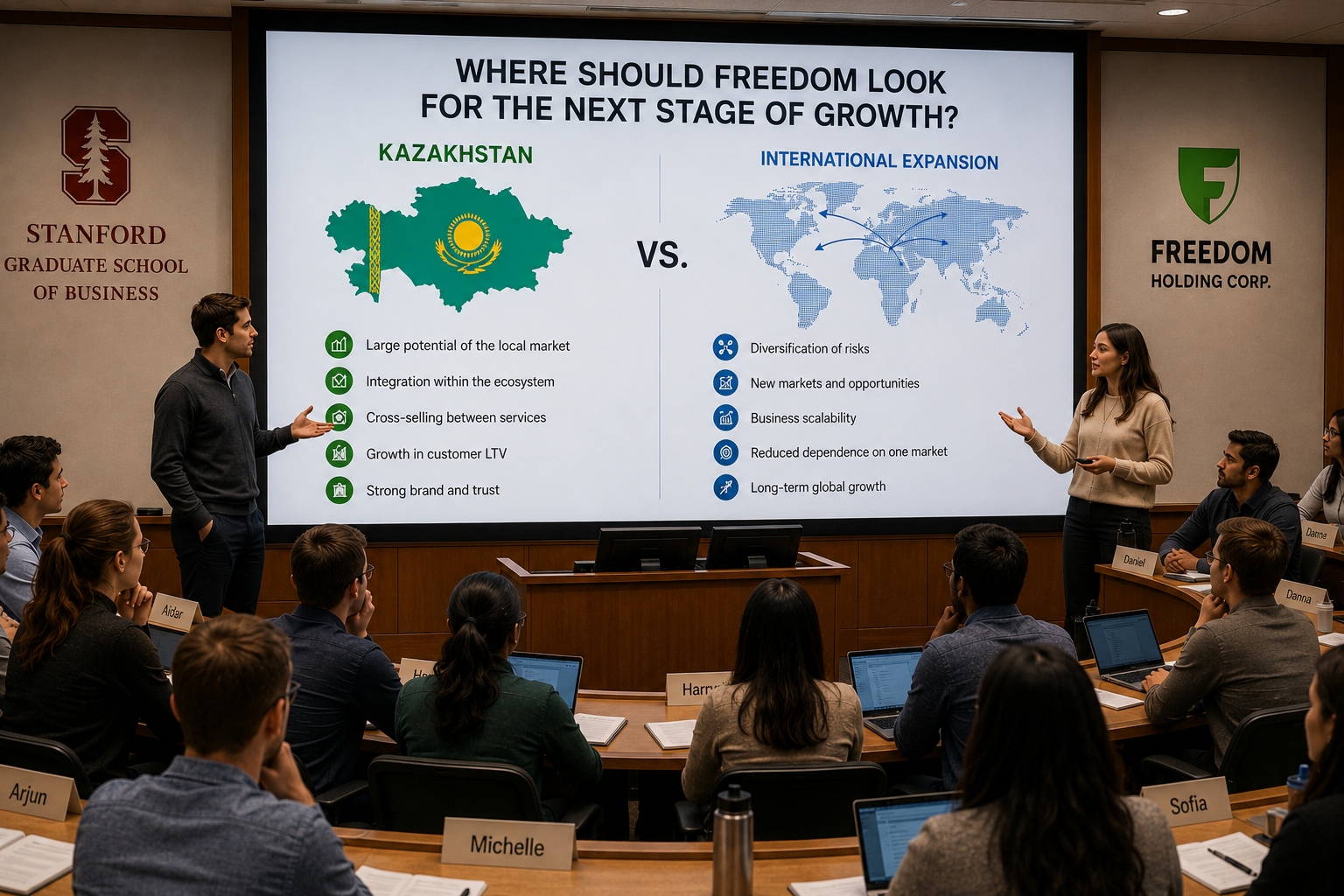
Where should Freedom look for its next stage of growth?
Some students advocated for a deeper focus on Kazakhstan.
They argued that the domestic market still offers significant untapped potential. Furthermore, Freedom already possesses a broad ecosystem of services that could be integrated more effectively.
These include:
- Brokerage services
- Banking products
- Insurance solutions
- Payment services
- Other digital offerings
The more tightly these services are connected, the greater the value generated from each customer relationship.
Others supported international expansion.
They pointed to increasing competition in the domestic market and the need for diversification. Expanding internationally reduces dependence on a single market and creates additional opportunities for long-term growth.
At the same time, students acknowledged that entering new markets comes with significant challenges, ranging from regulatory requirements to competition from established local players.
Is the Future in the Super App Model?
The discussion inevitably turned to the concept of the Super App.

Many participants compared Freedom’s potential evolution to some of the world’s most successful digital ecosystems.
The logic is simple.
The more frequently customers interact with an application, the more opportunities a company has to offer additional products and services.
If users rely on the same platform daily for payments, banking, insurance, and other financial activities, they are far more likely to adopt investment products within that ecosystem as well.
For this reason, many students viewed the development of a comprehensive Super App as one of Freedom’s most promising long-term growth strategies.
The Metrics That Reveal a Business’s True Strength
Toward the end of the discussion, students analyzed user engagement metrics.
According to the case study, Freedom had approximately one million Monthly Active Users (MAU).
Its DAU/MAU ratio stood at roughly 18%.
For comparison, Kaspi’s equivalent metric is approximately 60%.
Students noted that these indicators reveal not only the scale of a business but also the depth of customer engagement.
In many cases, engagement serves as the most important measure of how durable a company’s Product-Market Fit truly is.
Why Freedom’s Story Matters Beyond Kazakhstan
The central conclusion reached by the Stanford participants was that Freedom’s story is about much more than a brokerage firm or a financial company.

It is an example of how an entrepreneur can do more than occupy an existing niche - they can help create an entirely new market.
Companies rarely achieve Product-Market Fit quickly. More often, it is the result of years of effort, continuous adaptation, and a deep understanding of customer needs.
That is precisely why Freedom’s case attracted the attention of students at one of the world’s leading universities.
Ultimately, the questions discussed in Stanford classrooms today are relevant to every entrepreneur: How do you find your market? How do you earn customer trust? How do you transform a promising product into a business capable of growing for decades?
Freedom’s story demonstrates that the answers to those questions can emerge not only from Silicon Valley, but from Kazakhstan as well.