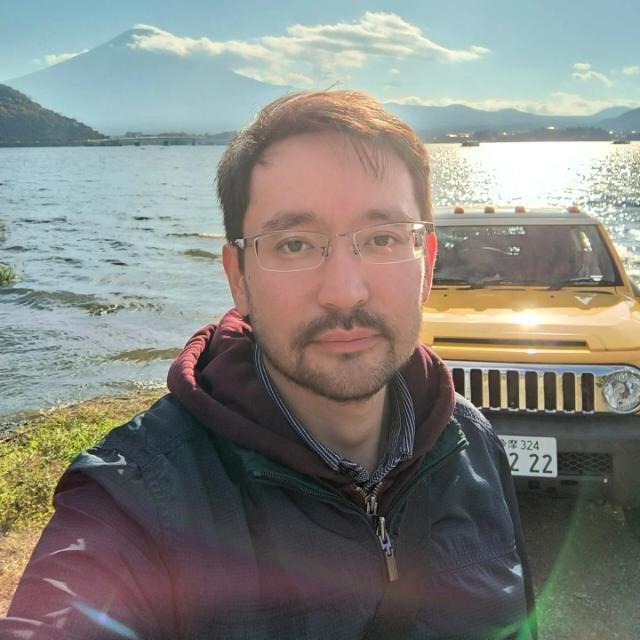

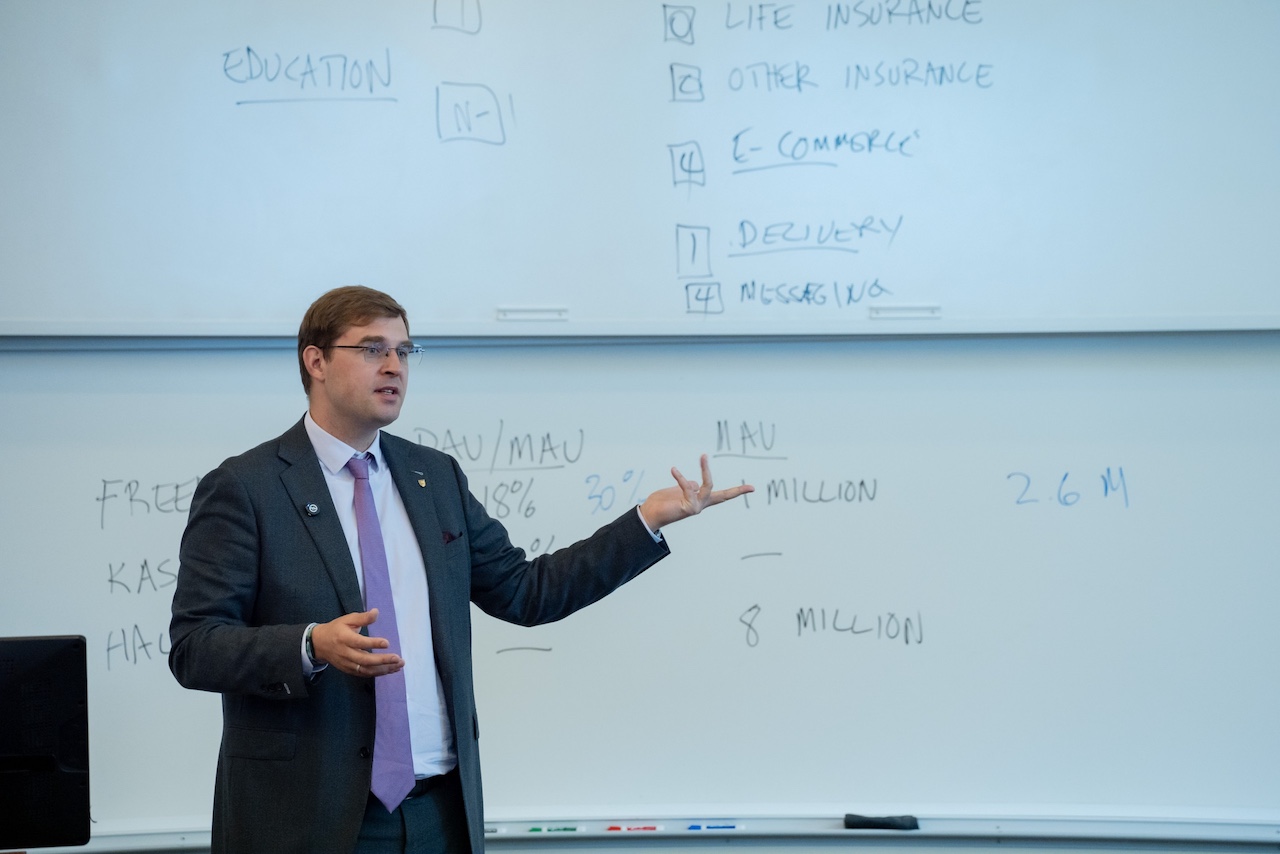
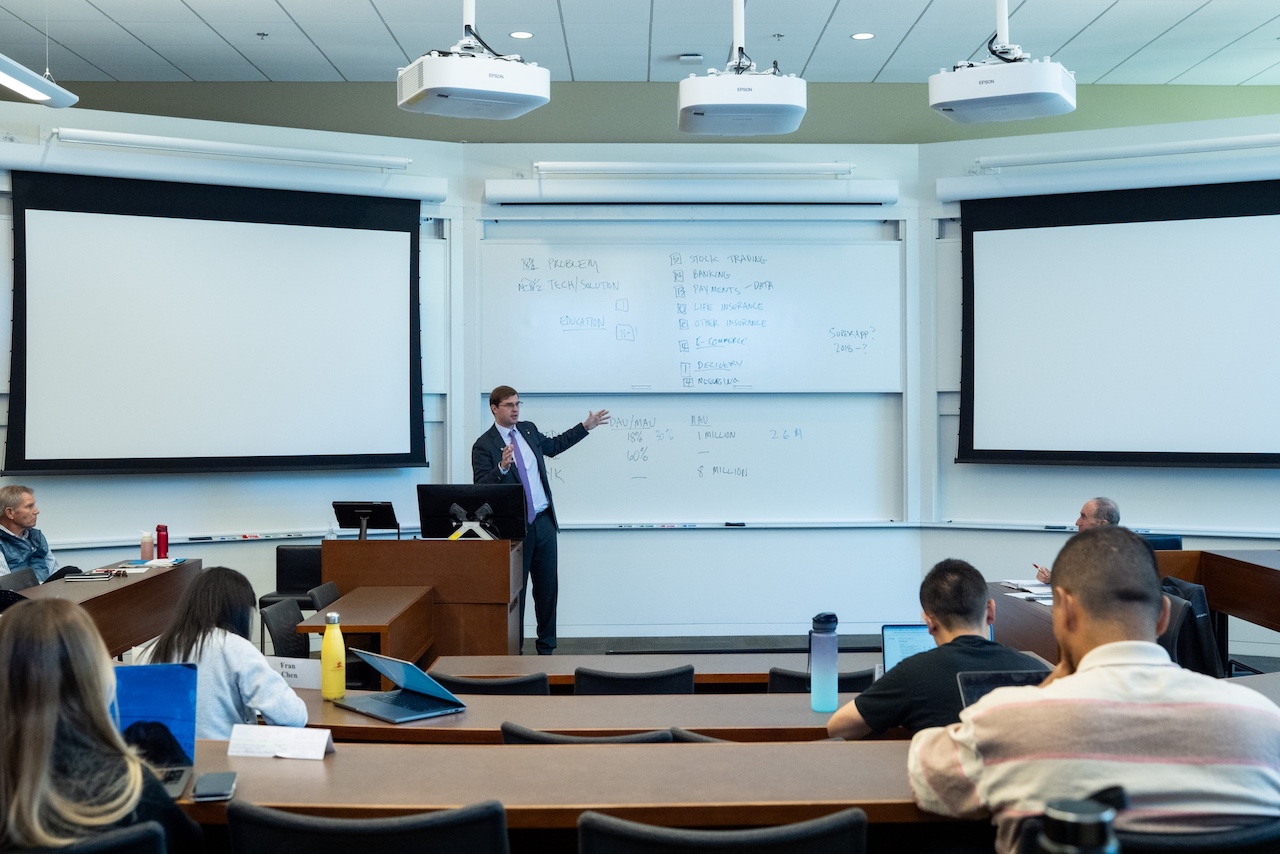
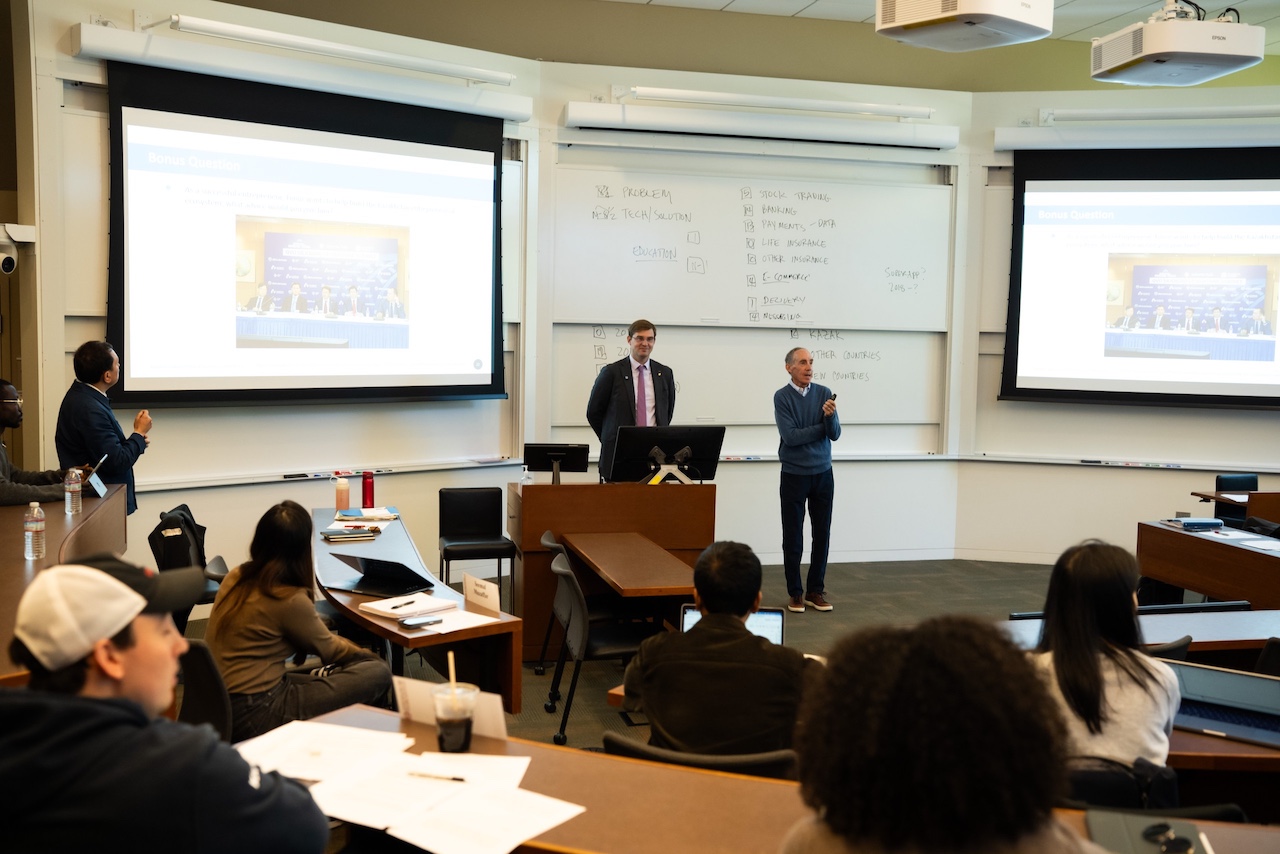
Can a global technology company be built from Kazakhstan? How do you turn dozens of acquired services into a single ecosystem? Why are super apps becoming the main battleground for customers? These and many other questions were posed to Freedom Holding Corp. founder Timur Turlov by students at Stanford Graduate School of Business, one of the world's leading business schools.
The discussion went far beyond traditional conversations about financial performance. It touched on corporate culture, venture-style business development, international expansion, competition between digital ecosystems, and the future of financial technology.
 Freedom Holding Corp.
Turlov's answers offered valuable insight into how Freedom transformed itself from a brokerage firm into one of Kazakhstan's largest and most diversified digital ecosystems in a relatively short period of time.
Growth Through Entrepreneurs, Not Bureaucracy
When people think about large holding companies, they often imagine complex hierarchies, endless approvals, and rigid management structures.
Freedom chose a different path.
According to Timur Turlov, the company has invested approximately $200 million in various teams and projects over the past five to eight years.
"Whenever we saw a team building an interesting lifestyle product, an e-commerce service, or a payment solution, we started working with them and investing in them. Over time, many of these teams became part of the holding."
Turlov explained that Freedom has always focused on investing in people first.
 Freedom Holding Corp.
If a team demonstrated the ability to build a strong product and scale a business, Freedom sought to become a strategic partner.
The approach resembles that of a venture capital fund, where success depends on backing talented entrepreneurs and promising ideas.
"I sincerely believe that Freedom's success is primarily about people. We have many talented entrepreneurs within the company, and we work hard to preserve a culture of freedom and innovation."
Why Timur Turlov Has More Than 60 Direct Reports
One aspect of Freedom's management structure particularly surprised the Stanford audience.
Today, Turlov has more than 60 direct reports.
In many global corporations, such a model would be considered unmanageable.
Yet Turlov believes excessive control often slows businesses down.
"It sounds unusual, but it works. Of course, I'm not their day-to-day operational manager. With some of them, I may only meet a few times a year."
Most business units operate with a high degree of autonomy.
Leadership focuses on strategy, performance reviews, and helping teams solve major challenges when necessary.
"We try to hire people who don't need constant supervision. If you're working with strong professionals, there's no need to control every step they take. You need to trust people."
He emphasized that trust does not eliminate oversight or risk management. Instead, Freedom seeks a balance between accountability and independence.
 Freedom Holding Corp.
The First Rule of Acquisitions: Don't Break What Works
Another major topic was acquisitions.
Over the years, Freedom has acquired businesses across multiple industries and verticals.
According to Turlov, one of the biggest mistakes companies make after an acquisition is trying to change everything immediately.
"The first rule after acquiring a company is not to integrate it too quickly. If we acquired the company, it means we already consider it successful. It has its own culture, its own team, and its own strengths."
In his view, aggressive integration often destroys value instead of creating it.
Key employees leave, company culture deteriorates, and performance suffers.
That is why Freedom initially allows acquired businesses to continue operating independently before gradually integrating them into the broader ecosystem.
Why the Super App Became the Center of the Strategy
One of Freedom's most important discoveries in recent years has been how dramatically customer behavior has changed.
In the past, individual services could thrive independently.
Today, users increasingly prefer to access multiple services through a single platform.
That realization led Freedom to make its super app the center of its strategy.
"In recent years, it became especially important for me to integrate all services into our super app and gradually move users there."
The results were striking.
"A standalone ticketing service retained about 5% of users. Inside the super app, retention reached approximately 25%. That's almost five times higher."
Customers who regularly use an app for payments, ticket purchases, banking, or insurance are far more likely to engage with other services within the ecosystem.
As a result, growth accelerates across the entire platform.
 Freedom Holding Corp.
Why Controlling the Customer Experience Became a Strategic Priority
Turlov also spoke about the importance of controlling key customer touchpoints.
Several years ago, a significant share of transactions within some of Freedom's services relied on third-party financial tools.
This created limitations for the company's ecosystem strategy.
According to Turlov, customers who consistently interact through external financial infrastructure often begin using other services offered by those ecosystems as well.
To address this challenge, Freedom invested heavily in its own payment infrastructure and financial products.
Customers were offered additional benefits, cashback rewards, and special incentives for using Freedom's services.
Over time, transaction flows increasingly shifted toward the company's own financial tools.
The experience reinforced an important lesson.
In today's digital economy, companies are competing not only for customers but also for their daily attention.

The New Attention Economy
According to Turlov, competition between banks and digital ecosystems looks very different today than it did just a few years ago.
Opening a bank account now takes only minutes through a smartphone.
Customers can use multiple financial institutions simultaneously and switch between them easily.
As a result, traditional customer loyalty is declining.
"Today, customers can move between ecosystems much faster than before. We view an ecosystem as a system of attraction. If your gravity is strong enough, customers stay within your ecosystem."
He argues that this kind of "gravity" cannot be created through advertising alone.
Companies must continuously provide additional value.
That value may come in the form of discounted airline tickets, special offers, higher cashback, exclusive event access, or unique digital services.
The more benefits customers receive, the stronger their connection to the platform becomes.

How Concert Tickets Became a Growth Engine
One of the most unexpected examples for the Stanford audience was Freedom's ticketing business.
During the pandemic, the company acquired an event ticketing platform.
At the time, many considered it an unlikely growth driver.
Yet it eventually became one of Freedom's most effective customer acquisition tools.
"We started offering early access to popular events exclusively to users within our ecosystem. People love exclusivity."
According to Turlov, early access to high-demand events proved to be a powerful incentive.
For many users, entertainment became their first point of entry into the Freedom ecosystem.
From there, they gradually adopted other products and services.
Türkiye and Europe Are the Next Stage of Growth
When discussing the company's future, Turlov highlighted international expansion as one of Freedom's key priorities.
Among the markets attracting the company's attention, Türkiye stands out because of its scale, economic potential, and long-term growth opportunities.
"It's a market significantly larger than Kazakhstan. We also see opportunities in Europe."
According to Turlov, entering larger international markets will require substantial investment and additional capital.
As Freedom expands beyond its home market, the company may consider raising external funding to accelerate growth and support new initiatives.
At the same time, Turlov stressed that maintaining a controlling stake is not an objective in itself.
"I'm completely comfortable reducing my ownership below a controlling level. That doesn't concern me at all. I believe a good CEO should be able to run a company regardless of the size of their ownership stake."
In his view, leadership should be defined by the ability to create long-term value for shareholders rather than by the percentage of ownership a founder holds in the business.
The Challenges of Being a Company from Central Asia
Students also asked about perceptions of companies originating from Central Asia.
Turlov acknowledged that certain stereotypes still exist.
There are relatively few major financial institutions from the region operating on a global scale.
As a result, some international partners find it difficult to imagine that world-class technology solutions can be developed in Kazakhstan.
Yet Freedom already operates a comprehensive digital infrastructure that includes banking services, mortgage products, lending, insurance, investments, and payment solutions.
As the company expands internationally, it is not only growing its business but also helping reshape perceptions of what companies from Central Asia can achieve.

Why Public Visibility Became Part of the Strategy
The conversation concluded with a discussion about reputation.
According to Turlov, rapid growth inevitably attracts attention.
Over the years, Freedom has faced information campaigns and negative publications that complicated relationships with partners and international organizations.
Even content published on small websites can appear in search results and become part of compliance reviews.
As a result, reputation management has become an important business priority.
This also explains Turlov's high public profile.
"If you don't tell your own story, someone else will tell it for you. And there's no guarantee you'll like their version."
What Stanford Students Saw in the Freedom Case
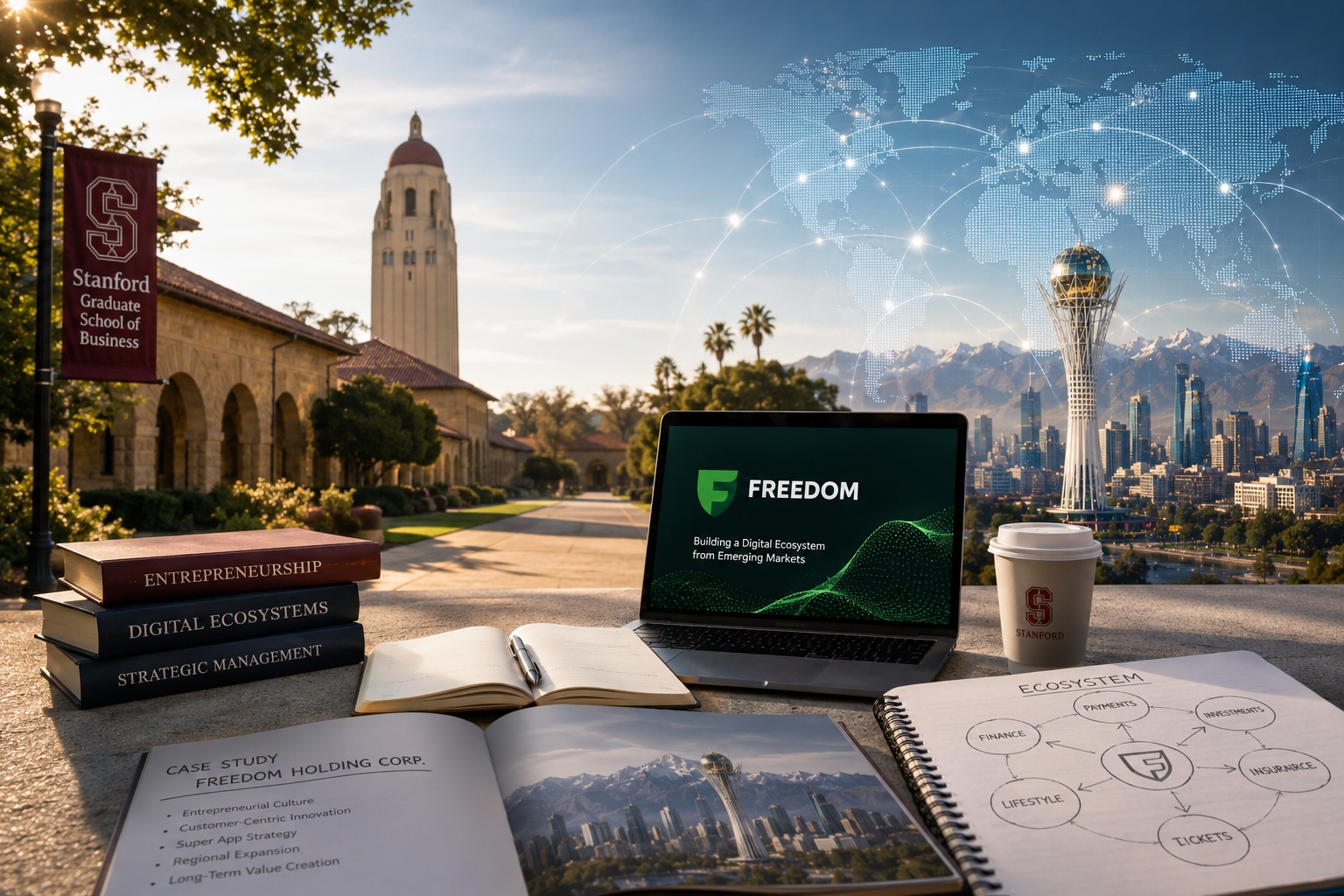
For students at Stanford Graduate School of Business, Freedom's story demonstrated how a company from an emerging market can create its own rules and compete in the global digital economy.
Investing in entrepreneurs, trusting teams, building a super app, focusing on customer experience, and preparing for international expansion have all helped Freedom evolve far beyond its origins as a traditional brokerage firm.
It is no surprise that the company's case attracted attention at one of the world's leading business schools.
Freedom's journey shows that successful technology ecosystems can be built not only in Silicon Valley. Companies from Kazakhstan are also capable of creating business models, products, and innovations worthy of study in the world's leading centers of entrepreneurship and innovation.