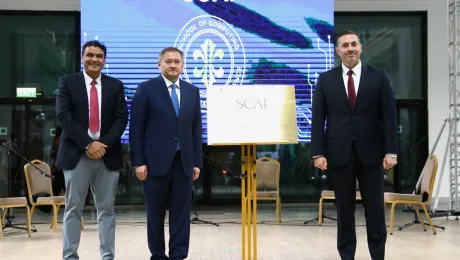


A seminar titled “Constitutional Reforms in Kazakhstan” was held in Rome, bringing together members of the Italian Parliament, representatives of Italy’s Ministry of Foreign Affairs, diplomats, experts, journalists and students, DKNews.kz reports.
Organized by the Italian Institute for Asian Studies, the event focused on Kazakhstan’s ongoing political and economic transformation and its implications for international cooperation.
Ambassador outlines key features of the new Constitution
Speaking at the seminar, Kazakhstan’s Ambassador to Italy Yerbolat Sembayev presented the main provisions of the country’s new Constitution and the broader modernization agenda being implemented in Kazakhstan.
According to the Ambassador, the new People’s Constitution, adopted through a nationwide referendum, will officially enter into force on July 1 this year and mark the beginning of a new stage in the country’s development.
«The new Constitution introduces fundamental changes to Kazakhstan’s political system, adapting the country to the challenges of the artificial intelligence era. One of the defining features of the constitutional reform is the transition to a unicameral Parliament. This large-scale transformation of the legislative branch is intended to remove bureaucratic barriers and accelerate decision-making processes.»
Focus on economic modernization and investment
Ambassador Sembayev noted that Kazakhstan is moving from individual reforms toward a comprehensive modernization of the economy and public administration.
According to him, the key priorities include:
- creating a predictable business environment
- protecting investors’ rights
- developing non-resource sectors
- expanding international economic partnerships
He also highlighted Italy’s importance as a strategic economic partner.
«Italian businesses possess strong expertise in industry, engineering, logistics, processing technologies and manufacturing solutions. We see significant potential for further expanding Kazakh-Italian cooperation in areas such as petrochemicals, transport corridors, agriculture, industrial cooperation, sustainable supply chains, rare earth metals, as well as modern solutions related to the energy transition.»
European and Italian officials assess Kazakhstan’s reforms
The seminar featured contributions from a number of Italian and European officials, including:
- Italian Senator Antonio Trevisi
- Chair of the European Parliament Delegation for Relations with Central Asia Giusi Princi
- Coordinator of the Italy–Central Asia Ministerial Meeting Federico Failla
- President of the Italian Institute for Asian Studies Mario Morgoni
- President of the CFive–Astana analytical center Sapargali Shalgimbayev
Participants discussed the impact of constitutional and institutional reforms on governance, economic development and international cooperation.
Reforms strengthen confidence among international partners
According to the speakers, Kazakhstan’s reform agenda has strengthened relations between the state and society while increasing public trust in institutions.
Participants noted that predictability, sustainable development and institutional stability are among Kazakhstan’s strongest advantages today.
They also emphasized that the existence of independent institutions and transparent rules enhances the country’s attractiveness for foreign investors and international partners.
Italy sees opportunities for deeper cooperation
Italian Senator Antonio Trevisi highlighted industrial and infrastructure modernization as one of the most significant elements of Kazakhstan’s reform agenda.
He noted that Italian technologies and industrial expertise are highly valued in Kazakhstan and could contribute to strengthening the country’s manufacturing base and logistics capabilities.
Giusi Princi stressed that the European Union is closely monitoring Kazakhstan’s reforms, particularly given the strong cooperation already established in:
- trade and investment
- critical raw materials
- energy security
- green economy initiatives
According to her, Kazakhstan has embarked on a comprehensive path of institutional and constitutional transformation aimed at improving governance and modernizing the political and economic system.
Federico Failla described the reforms as evidence of Kazakhstan’s ability to adapt to modern challenges and respond to rapidly changing global conditions.
Mario Morgoni also praised Kazakhstan’s reform efforts.
«Kazakhstan’s experience in implementing large-scale and ambitious reforms is both noteworthy and deserving of respect, particularly as these reforms are taking place in a complex multi-ethnic country that is independently developing its own model of development while gradually strengthening modern democratic institutions.»
Why this matters
The discussion in Rome reflects growing international interest in Kazakhstan’s political and economic transformation.
As the country advances constitutional reforms and economic modernization, support from European partners could help expand investment, technology transfer and industrial cooperation, while strengthening Kazakhstan’s position as a reliable partner between Europe and Central Asia.