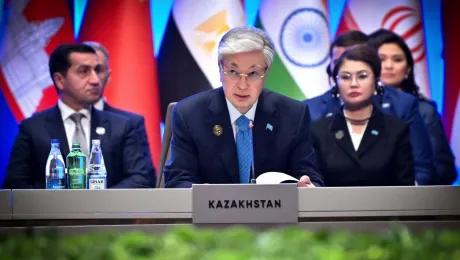
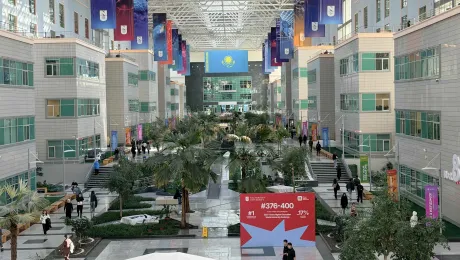
President Kassym-Jomart Tokayev’s participation in the BRICS summit in New Delhi marked an important moment in relations between Kazakhstan and India. Attending as a BRICS partner country rather than a full member, Kazakhstan presented the grouping as an open forum for practical cooperation that complements a multilateral system centred on the United Nations.
Tokayev’s address focused on rebuilding trust among major powers, strengthening global security, reforming international institutions and giving middle powers a greater voice. Economic cooperation also featured prominently. He said Kazakhstan’s trade with BRICS members and partner countries reached approximately $72 billion in 2025, highlighting opportunities in energy, critical minerals, agriculture, higher-value processing, infrastructure and transport.
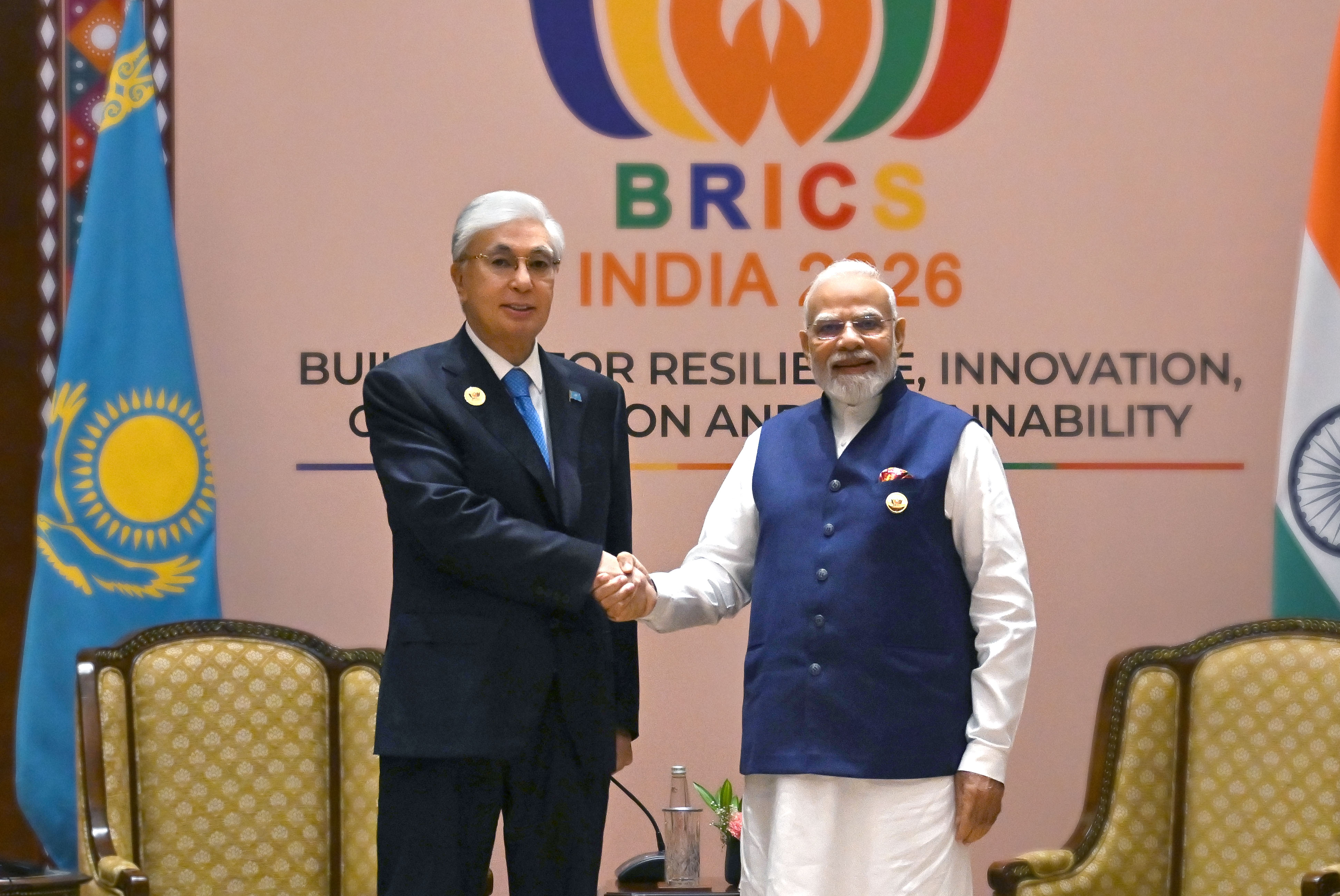
On the sidelines, Tokayev met Indian Prime Minister Narendra Modi to discuss energy, digitalisation, education, tourism and advanced technologies. Their talks covered potential cooperation between Astana Hub and Hyderabad’s Cyberabad technology ecosystem, as well as negotiations on a free trade agreement between India and the Eurasian Economic Union (EAEU). Tokayev also invited Modi to Kazakhstan for a state visit.
In an interview with DKNews.kz, Ashok Sajjanhar, India’s former ambassador to Kazakhstan and director general of the Institute of Global Studies, discussed the significance of Kazakhstan’s BRICS engagement, its approach to foreign policy and the prospects for closer ties with India.
— How do you assess President Tokayev’s participation in the BRICS summit in New Delhi? What does Kazakhstan’s presence mean, given that it is a partner country rather than a full member?
In my view, President Tokayev’s participation was a major diplomatic success. This was his first visit to India—or, more precisely, the first visit by a Kazakh president since 2009, a gap of 17 years. It was long overdue, and I am very pleased he was able to come.
By participating both as an officially designated BRICS partner country and as the chair of the Eurasian Economic Union, Kazakhstan strengthened its international standing. It also demonstrated the indispensable role that Kazakhstan, and Central Asia more broadly, play in any discussion of regional connectivity, stability and energy supply chains.
Partner status allows Astana to maintain close institutional ties with some of the world’s most dynamic economies while retaining flexibility.
The key outcome was recognition from India, as the host, and from other global players that see BRICS as a means of cooperating with the West and advancing the interests of the Global South, rather than positioning it as a geopolitical bloc.
That is reflected in the 140-point New Delhi Declaration adopted by all BRICS member states. It does not present BRICS as a counterweight to the West. It is about cooperation and engagement with all sides, including the West and other major international players.
— Tokayev described BRICS as an open platform for practical cooperation that complements the UN-centred multilateral system. How does that fit Kazakhstan’s foreign policy and its efforts to work with different centres of power?
That description captures Kazakhstan’s multi-vector foreign policy very well: maintaining relationships across different centres of power without aligning exclusively with one camp.
Astana does not regard groupings such as BRICS as anti-Western organisations. BRICS itself does not want to be perceived that way, because many of its members, particularly India, enjoy excellent relations with most Western countries.
India has a comprehensive global strategic partnership with the United States, as well as strong and dynamic relationships with the European Union, Japan, the United Kingdom and Australia.
BRICS should therefore be understood as a practical instrument for trade and development, and for promoting a multipolar world and a multilateral international system. It seeks a stronger voice for the Global South in the UN Security Council, the International Monetary Fund and the World Bank, alongside reform of the World Trade Organization.
By grounding his position in the primacy of the UN Charter, President Tokayev avoids committing Kazakhstan to any single geopolitical camp. That allows the country to engage with Moscow, New Delhi, Beijing, Washington, Brussels and other partners across the Global South.
— Tokayev called for renewed trust among major powers, a stronger UN and greater representation for Asia, Africa, Latin America and emerging middle powers in global decision-making. How relevant is that message, and what role could Kazakhstan play in bridging geopolitical divisions?
In today’s deeply fragmented international environment, his call to rebuild trust and give emerging middle powers a greater voice is exceptionally timely.
It is consistent with India’s position. Prime Minister Modi emphasised that the most valuable and scarce resource today is trust, rather than critical minerals, energy or connectivity. That is what we need to strengthen. I am very pleased to say that India and Kazakhstan share a high level of mutual trust.
As global polarisation puts increasing pressure on traditional diplomatic structures, trusted middle powers become essential intermediaries.
Kazakhstan has earned considerable institutional credibility through its historic nuclear initiatives and its leadership in forums such as the Conference on Interaction and Confidence Building Measures in Asia, or CICA, and the Shanghai Cooperation Organisation.
It has also provided a venue for opposing sides, including in the Syrian conflict, and sought to support settlements through dialogue and diplomacy.
That record leaves Kazakhstan well placed to bridge differences and help build consensus in international affairs.

— Tokayev and Modi discussed energy, digitalisation, education, tourism and advanced technologies. Modi also highlighted cooperation between Astana Hub and Cyberabad. Which areas could drive the next stage of the relationship?
Energy and mineral resources remain fundamental, but the digital ecosystem is emerging as a powerful new driver of bilateral relations.
Prime Minister Modi’s emphasis on connecting Astana Hub with Hyderabad’s Cyberabad technology ecosystem points towards a partnership built increasingly on knowledge and innovation.
Joint ventures in artificial intelligence, where India is investing heavily, as well as fintech, cloud computing and startup development, could rapidly broaden the relationship beyond traditional trade.
India is a global leader in fintech. Its digital public infrastructure has been highly successful, and India has shared this technology with many partner countries across the Global South.
India’s Unified Payments Interface, or UPI, accounts for more than half of global cashless transactions by volume. Eleven countries have already signed agreements with India to use the system.
Local-currency settlement and payment arrangements could also give bilateral economic cooperation a substantial boost. India currently has such arrangements with 22 countries.
Tourism has enormous potential, too, and we need to make visa arrangements easier. Education is another promising area. Indian universities have already established campuses in some Central Asian countries, and I believe opening campuses in Kazakhstan would be extremely useful.
Our countries could also work together in space technology, satellite applications, pharmaceuticals and telemedicine.
— As EAEU chair, Kazakhstan has offered to help advance negotiations on a free trade agreement with India. How important would that agreement be for India, and what would it mean for bilateral ties?
India has been working on this for quite some time, and my understanding is that substantial progress has been made towards an agreement. Detailed studies have shown that a free trade agreement between India and the EAEU would bring significant benefits to both sides.
As the current EAEU chair, Kazakhstan can play a valuable strategic role by actively supporting the negotiations.
For India, an agreement would open up a market of more than 180 million consumers. For Kazakhstan, it would substantially reduce non-tariff barriers and transaction costs, bringing direct benefits to manufacturing, pharmaceuticals and agricultural exports.
We should remember that India is the world’s fastest-growing major economy. Growth in the latest quarter was approximately 7.8%.
Over the past year, the Indian economy has continued to grow at more than 7%, despite the shocks we have faced: the COVID-19 pandemic beginning in 2020, the Russia–Ukraine conflict in 2022 and the conflict between Iran and the United States in February 2026. The latest published figures bear this out.
The economy is expected to reach $5 trillion by 2028 and approximately $10 trillion by 2035.
Concluding a free trade agreement as soon as possible would therefore be highly beneficial for Kazakhstan and the other EAEU members.
Kazakhstan is Central Asia’s largest economy, yet our bilateral trade stands at only about $2.5 billion. That is well below its potential. I believe signing and implementing an India–EAEU free trade agreement would substantially strengthen trade, business and investment ties between our countries.
— Tokayev placed particular emphasis on transport connectivity, including the Trans-Caspian International Transport Route and the North–South corridor. What role could Kazakhstan play in India’s links with Central Asia and Europe?
This is extremely important. The absence of direct transport links and shared land borders has prevented India from realising its full potential in the region.
We have tried to gain access to Central Asia and Afghanistan, and further north to Russia and Europe, through the International North–South Transport Corridor and Chabahar. But sanctions imposed on Iran for more than two decades have limited our progress.
I therefore see Kazakhstan as a key part of India’s transport strategy across Eurasia.
When the North–South corridor initiative emerged in the late 1990s and early 2000s, it involved India, Iran, Azerbaijan and Russia. The route now also extends through Central Asia, and Kazakhstan has become a prominent and active participant.
By connecting the North–South corridor with the Trans-Caspian route, Kazakhstan offers India an important way around longstanding geographical bottlenecks.
Kazakhstan would also benefit considerably. Goods that cannot be transported by air would move much more easily between our two countries.
This would strengthen India’s supply chains and improve access to Central Asian and European markets. Both sides would gain.
— Kazakhstan’s trade with BRICS members and partners reached approximately $72 billion in 2025. Tokayev identified energy, critical minerals, agriculture and higher-value processing as promising areas. Which are of greatest interest to India?
Kazakhstan’s total trade with the wider BRICS grouping—its 11 member states and 10 partner countries—reached $72 billion in 2025. India’s interest in Kazakhstan will focus primarily on two areas where the country has significant advantages.
The first is energy and critical minerals.
India relies heavily on Kazakhstan as a stable supplier of uranium. Kazakhstan was, in fact, the first country from which we began importing uranium after the International Atomic Energy Agency and the Nuclear Suppliers Group approved a special exemption in 2008 for commercial transactions involving nuclear goods, materials and technology.
I was ambassador to Kazakhstan at the time, and we signed an agreement to export 5,000 tonnes of uranium to India. That cooperation continues and needs to continue. Kazakhstan will remain a very important source of supply.
Crude oil shipments have been smaller than they could have been, again because of inadequate transport connectivity. More recently, however, we have also been able to purchase Kazakh oil on the international market.
Uranium and crude oil supplies will both be crucial to meeting India’s energy needs.
Joint processing ventures involving minerals such as lithium and cobalt also offer realistic opportunities. Kazakhstan has significant resources and reserves of these critical minerals, and India needs them.
The second area is agriculture and higher-value processing. High-yield agricultural production and food-processing facilities offer concrete opportunities for Indian investment.
Agriculture accounts for a large share of India’s economy. Around 50–60% of our population works in agriculture, making this another promising area for cooperation.
— Tokayev invited Modi to Kazakhstan for a state visit. Have the New Delhi meetings given the relationship fresh political momentum, and what could the next round of high-level talks deliver?
I am particularly pleased by the prospect of a state visit. The last visit by a Kazakh president to India took place in 2009, and the bilateral meetings during the New Delhi summit have brought renewed political energy to our strategic partnership.
India and Kazakhstan established that strategic partnership in 2009. We subsequently signed a strategic partnership agreement with Uzbekistan in 2011, and India–Uzbekistan relations were later elevated to a comprehensive strategic partnership.
I believe we need to bring greater energy and momentum to India–Kazakhstan relations so that they, too, can move to a higher level, with cooperation extending into more areas and becoming deeper.
This meeting lays the groundwork for the next major diplomatic step. At future meetings and summits between the two leaders, we could realistically expect a formal roadmap for tariff reductions between India and the EAEU, concrete agreements on technology exchange between their IT hubs, and new investment in transport corridors.