

Some sounds need no translation. The dombra has exactly that kind of voice. In its two strings, there is the steppe, memory, the road, home — and something deeply personal that somehow becomes clear even to someone thousands of kilometers away from Kazakhstan, DKNews.kz reports.
To mark National Dombra Day, the Otandastar Foundation and the Arqaiym group launched the international music challenge “Dombra DNA.” The idea was simple but powerful: to show that the dombra today is not only a symbol of Kazakh culture, carefully preserved at home and on stage. It is an instrument capable of speaking to the modern world — in the hands of Kazakhs abroad and foreigners who once heard its sound and could no longer walk past it.
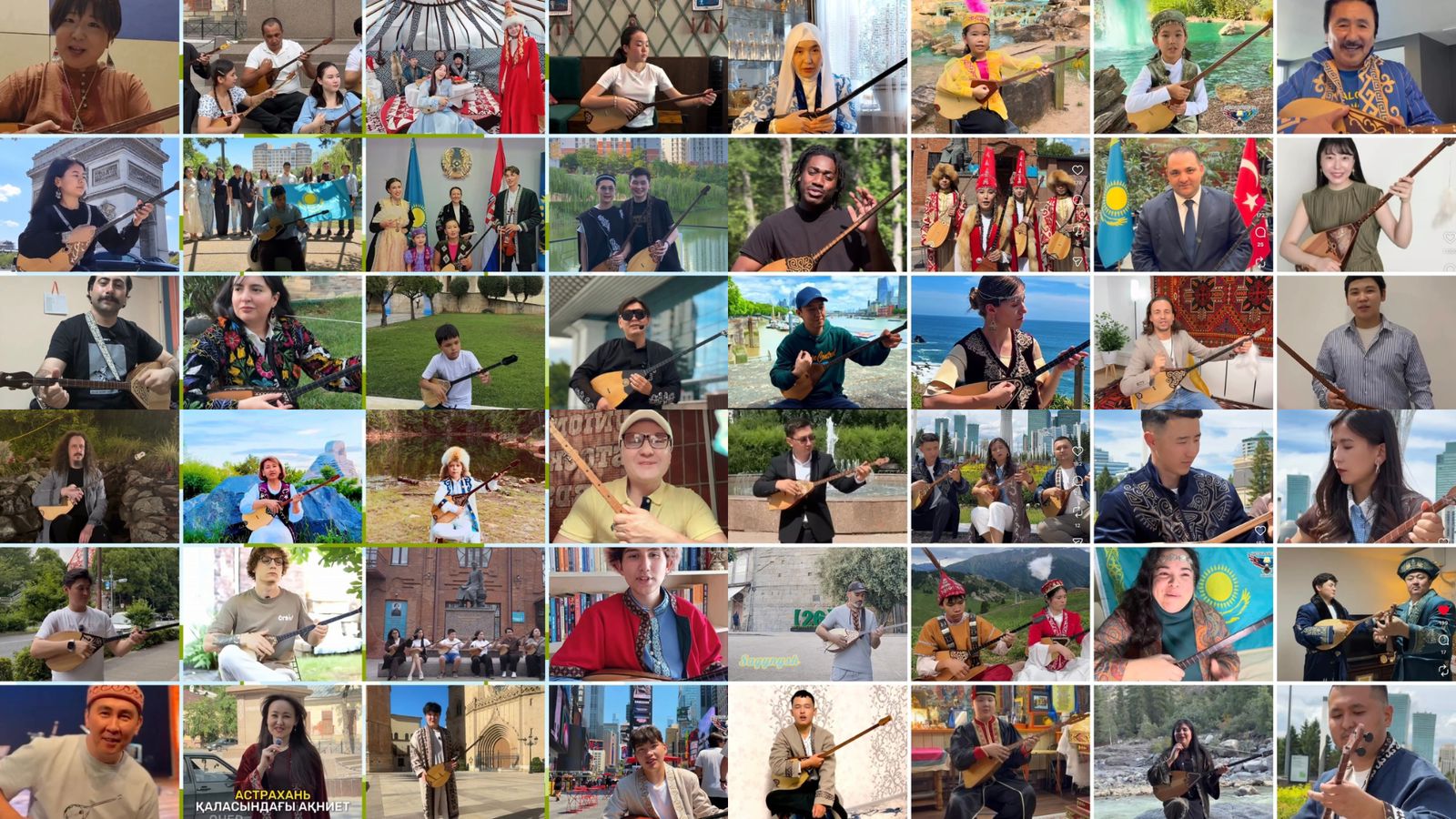
The challenge quickly grew beyond a single holiday event. Participants from more than 20 countries joined in, including the United States, Japan, Belgium, France, the United Kingdom, South Korea, Spain, Portugal, Czechia, Croatia, Austria, the Netherlands, Sweden, Slovakia, Hungary, Greece, Malaysia, Chile, Türkiye, Azerbaijan, Russia, Uzbekistan and Mongolia.
The geography alone is impressive. But what makes the story even more compelling is who picked up the dombra. The challenge brought together not only members of the Kazakh diaspora, for whom the instrument is tied to roots and family memory, but also foreigners for whom Kazakh music became a personal discovery.
One of the first international participants to join the initiative was Portuguese musician Joseph Ribeiro, a student of the Otandastar Foundation’s dombra class. His performance became an important gesture: the dombra can sound convincing not only in the hands of those who grew up with it, but also in the hands of someone from a completely different cultural background.
The challenge was later supported by international fans of Dimash Qudaibergen, Turkish musicians, Belgian participant Lucas and Maria from Chile. Participants from Japan drew particular attention: Akira, Takahashi, Asuka and Hitomi performed Kazakh songs, showing that interest in Kazakh culture in the Land of the Rising Sun has long gone beyond simple curiosity.
From the very beginning, Kazakhstan’s ethno-folk groups Arqaiym and Turan played a notable role in the initiative. Their support gave the challenge a professional sound and helped turn it from a simple social media flash mob into a meaningful cultural statement. Composer Marat Omarov from Los Angeles also joined the project, further expanding its international reach.
Kazakh communities abroad also played a major role. The Qazaq American Qaganat in New York, Qazaq Community in Malaysia, the Qazaq Nomad center in South Korea, as well as Kazakh diasporas in Spain, Russia, Uzbekistan and the Netherlands became some of the main driving forces behind the challenge. Through their participation, the project turned into a living map of the Kazakh world — broad, diverse and united by one sound.
“Dombra DNA” has become more than a music challenge. It is a story about how a national instrument is no longer only part of heritage, but is becoming a modern cultural language. A language that does not need subtitles — it speaks through melody, rhythm and emotion.
Today, the dombra can be heard in New York and Tokyo, Lisbon and Brussels, Seoul and Madrid. And that is an important sign: Kazakh culture is not merely being preserved abroad. It is growing, attracting new people and finding its place in the global cultural space.
Sometimes, no grand slogans are needed to prove that. Two strings — and a person who wants to be heard — are enough.