
The new Cayenne delivers up to 1,156 PS.
Porsche Kazakhstan has showcased the all-electric Cayenne at Sokol International Circuit—an SUV that outmuscles every previous series-production Porsche, DKNews.kz reports.
The Cayenne is now more powerful than the Taycan
The electric range starts with the Cayenne Electric. Its two motors produce 408 PS, while Launch Control briefly raises output to 442 PS and 835 Nm.
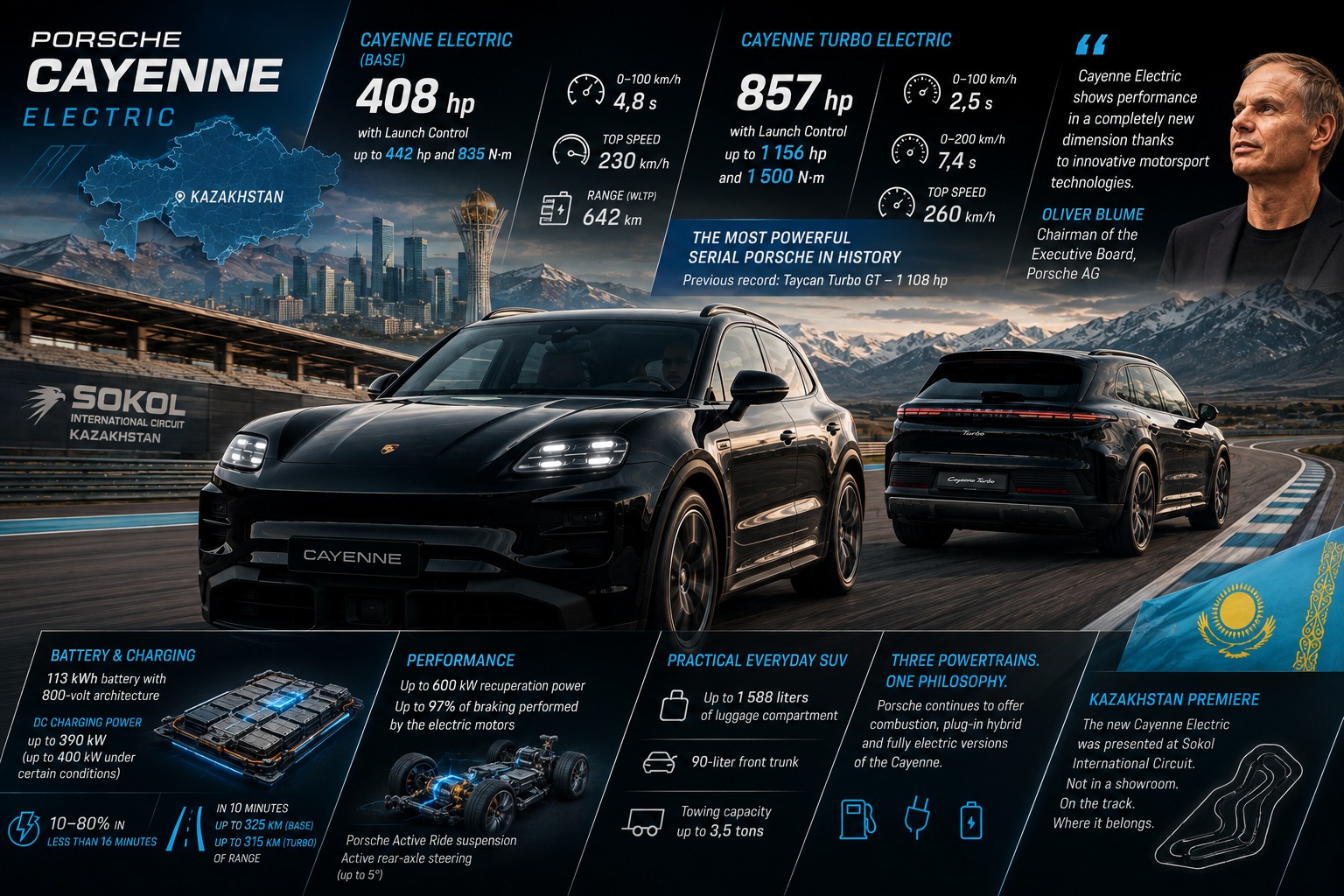
The SUV accelerates from zero to 100 km/h in 4.8 seconds. Top speed stands at 230 km/h, while its WLTP range reaches 642 kilometres.
The Cayenne Turbo Electric is the real headline-maker. Its powertrain produces 857 PS in normal driving and up to 1,156 PS with Launch Control, alongside 1,500 Nm of torque.
It reaches 100 km/h in 2.5 seconds and 200 km/h in 7.4 seconds before topping out at 260 km/h, according to the official Cayenne Electric specifications.
That makes it the most powerful series-production Porsche ever built. The record previously belonged to the 1,108 PS Taycan Turbo GT.
“The Cayenne Electric shows performance in a completely new dimension, with innovative technologies that we have developed in motorsport,” said Porsche AG Chairman Oliver Blume.
But the Taycan is still quicker
Four-digit power has not made the Cayenne Porsche’s fastest-accelerating road car.
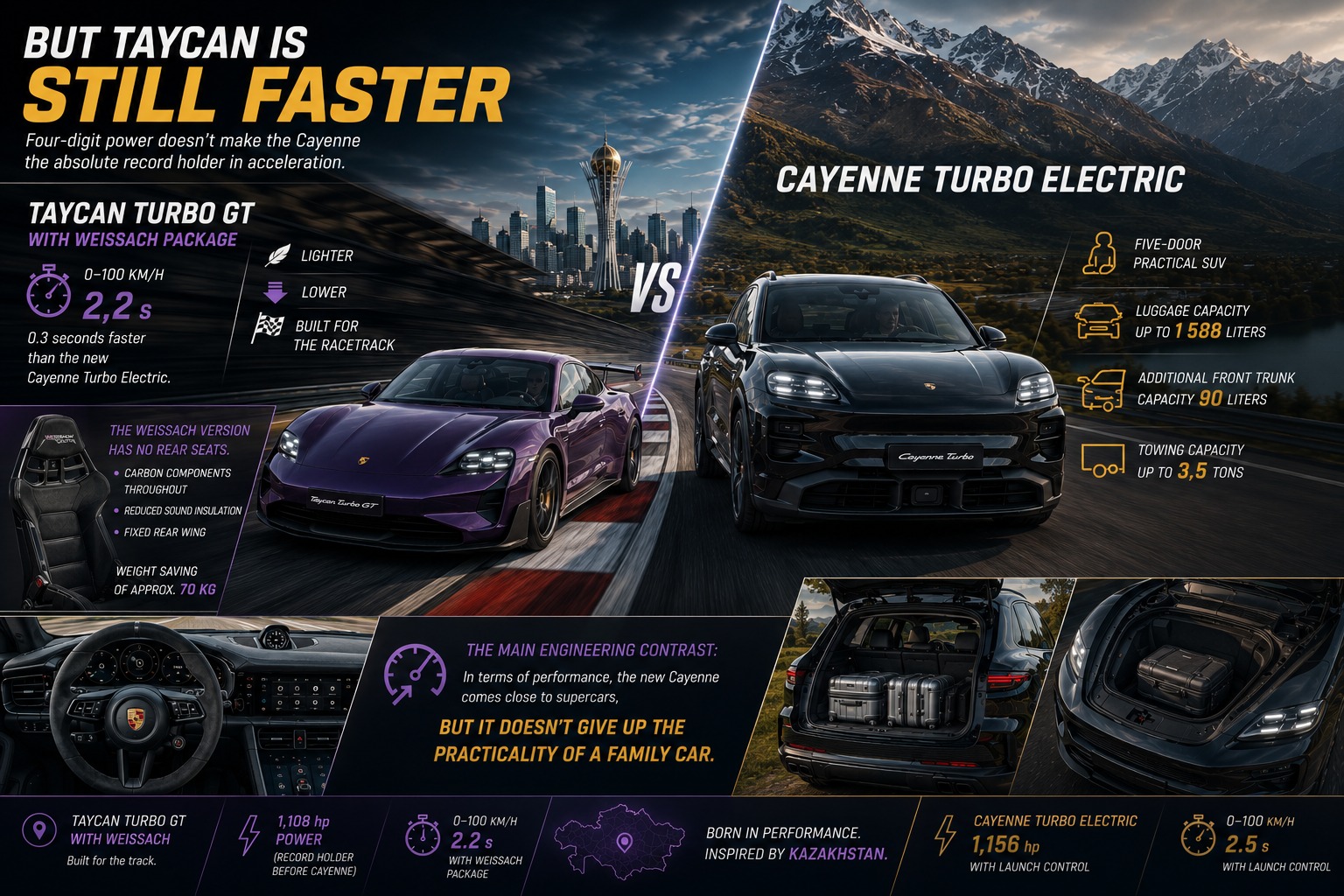
The Taycan Turbo GT with Weissach Package reaches 100 km/h in 2.2 seconds—three-tenths quicker than the new Cayenne Turbo Electric.
The electric sports car is lighter, lower and engineered specifically for the racetrack.
The Weissach version drops the rear seats, uses carbon-fibre components and features less insulation. A fixed rear wing forms part of a weight-saving package that cuts roughly 70 kilograms.
The Cayenne, meanwhile, remains a large five-door SUV. It offers up to 1,588 litres of luggage capacity, an additional 90-litre front compartment and a towing capacity of up to 3.5 tonnes.
That contrast defines the engineering challenge. The new Cayenne approaches supercar performance without sacrificing the practicality of a family vehicle.
The battery can charge in under 16 minutes
Both versions use a newly developed 113 kWh battery with double-sided cooling. The 800-volt architecture supports DC charging at up to 390 kW—and as much as 400 kW under specific conditions.
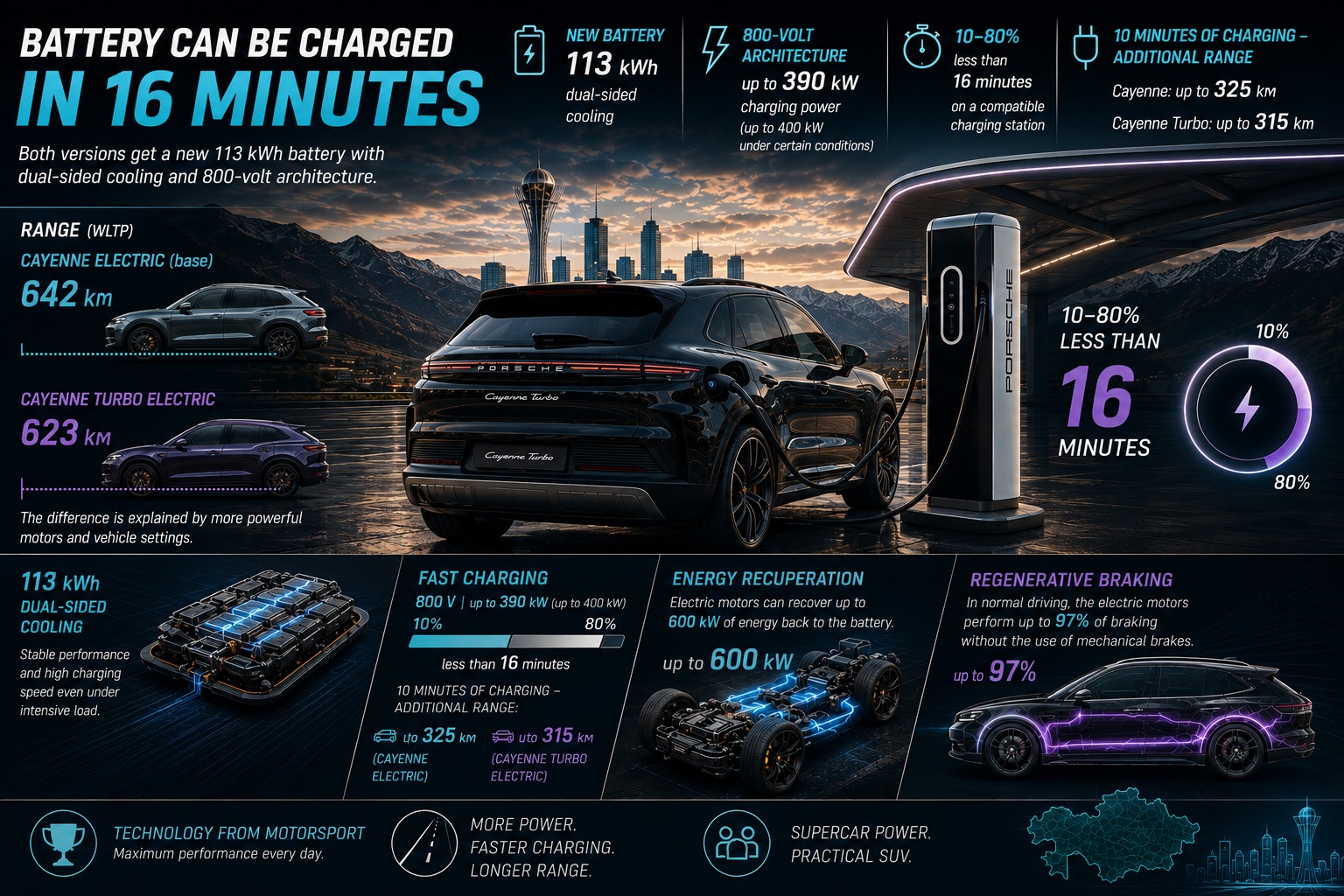
At a suitable charging station, the battery can go from 10% to 80% in under 16 minutes. Ten minutes of charging can add approximately 325 kilometres of range to the Cayenne Electric or 315 kilometres to the Turbo.
The Cayenne Turbo Electric offers up to 623 kilometres of WLTP range. Its lower figure reflects the more powerful motors and performance-focused setup.
Another technology comes directly from motorsport. The electric motors can recover energy at rates of up to 600 kW.
In everyday driving, they can handle around 97% of all braking events without using the mechanical friction brakes.
Four-digit power is available on command
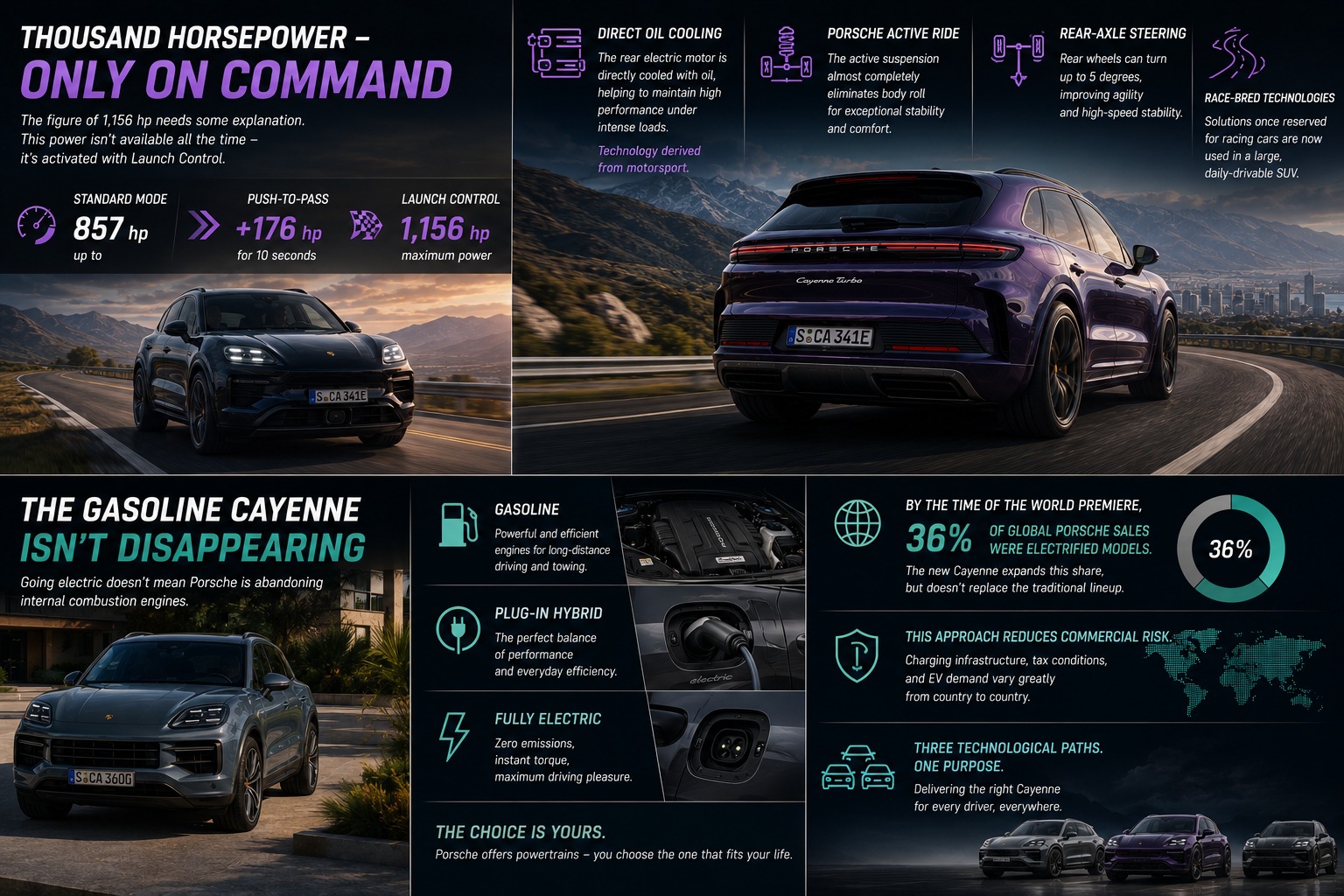
The headline figure of 1,156 PS requires some context. It is not the vehicle’s permanent output.
In normal operation, the Cayenne Turbo Electric produces up to 857 PS. Its Push-to-Pass function adds another 176 PS for ten seconds, giving the driver extra performance for overtaking.
Direct oil cooling for the rear electric motor helps maintain high output under sustained load. Once associated mainly with racing cars, the technology has now reached a large road-going SUV.
The Porsche Active Ride suspension almost completely compensates for body movement. Optional rear-axle steering can turn the rear wheels by up to five degrees, improving manoeuvrability and high-speed stability.
The petrol-powered Cayenne is not going away
The launch of an electric model does not mean Porsche is abandoning combustion engines.
The company intends to sell petrol, plug-in hybrid and fully electric Cayenne variants in parallel. Customers can choose a powertrain instead of being pushed towards a single technology.
At the time of the electric Cayenne’s global premiere, electrified models accounted for around 36% of Porsche’s worldwide sales. The new SUV expands that portfolio without replacing the traditional range.
The multi-powertrain strategy also reduces commercial risk. Charging infrastructure, tax policies and demand for electric vehicles vary significantly between markets, making flexibility valuable.
Why Porsche chose Sokol for the Kazakhstan showcase
In Kazakhstan, Porsche did not unveil the Cayenne Electric inside a conventional exhibition hall. It presented the SUV during a dynamic driving programme at Sokol.
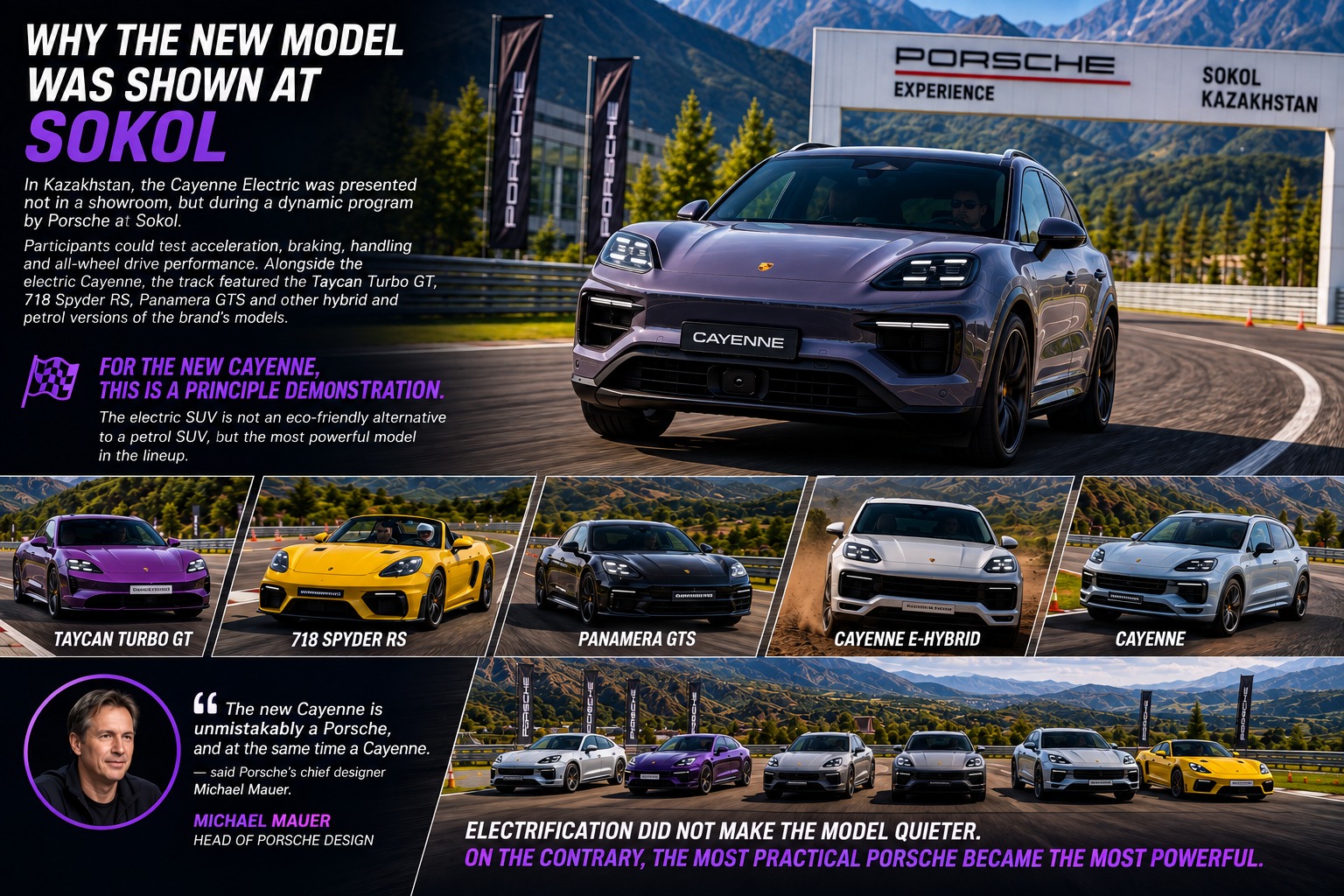
Participants could test acceleration, braking, handling and all-wheel-drive performance. The Cayenne shared the circuit with the Taycan Turbo GT, 718 Spyder RS, Panamera GTS and several petrol and hybrid models.
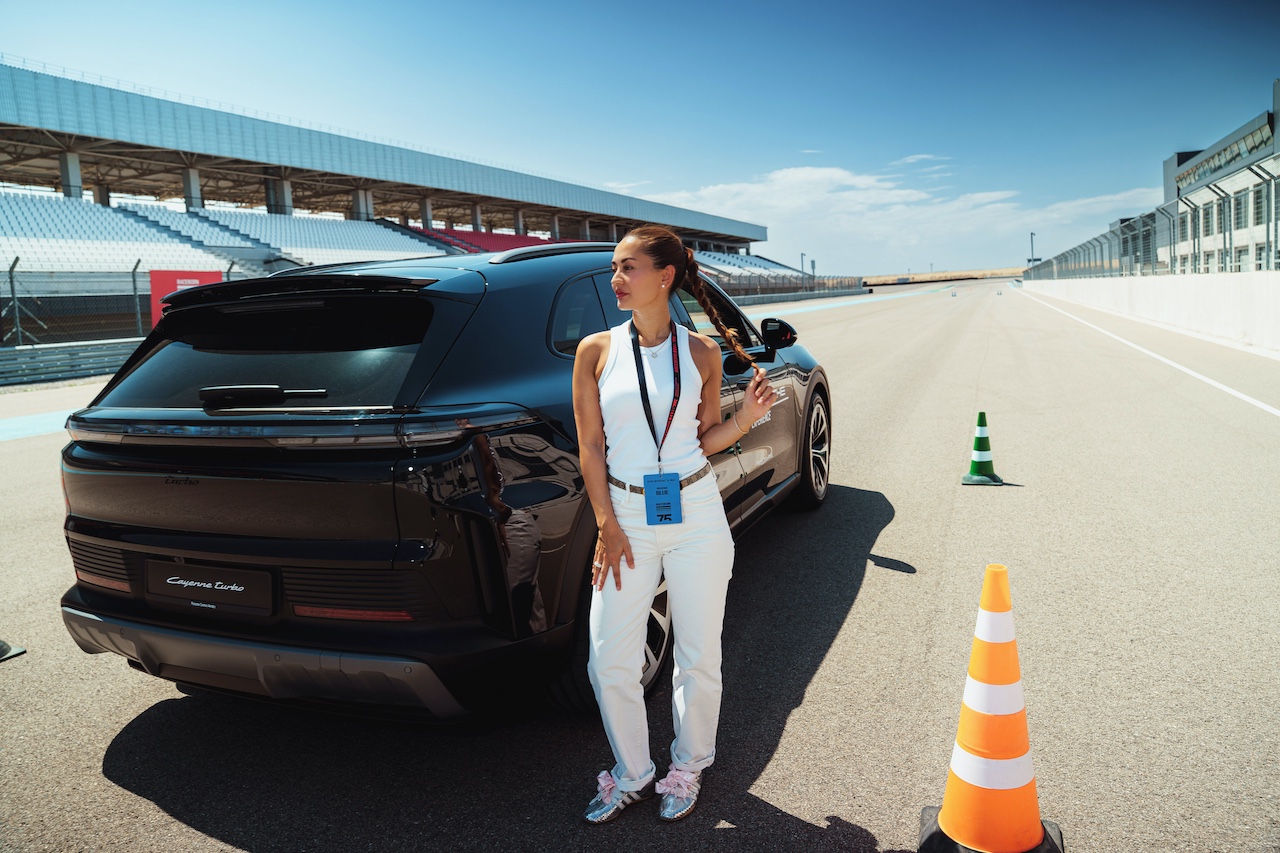 Photo by Nikita Svetlichnyi
The setting delivered a clear message. Porsche is not positioning the Cayenne Electric merely as a greener alternative to a petrol SUV—it is presenting it as the most powerful model in its range.
Chief designer Michael Mauer has described the new model as unmistakably Porsche and unmistakably Cayenne.
Electrification has not made the SUV more restrained. It has turned Porsche’s most versatile model into its most powerful.