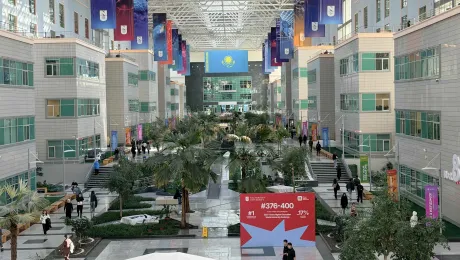


urope is looking at Kazakhstan more broadly. Kazakhstan’s Ambassador to Belgium, Roman Vassilenko, argues that the August 23 elections to the new Kurultai should be viewed not only as a domestic political reform, but also through the lens of the country’s future partnership with the European Union, DKNews.kz reports.
Roman Vassilenko, Ambassador of the Republic of Kazakhstan to the Kingdom of Belgium, outlined his position in an op-ed published by EU Reporter on August 18. He links Kazakhstan’s political modernization with economic resilience, energy security, transport connectivity and technological cooperation with Europe.
Seven parties will compete for Kurultai seats on August 23
The key political date is August 23. On that day, Kazakhstan will hold its first elections to the Kurultai, the new highest representative body established under the new Constitution.
According to Vassilenko, the elections are part of the broader political modernization launched by President Kassym-Jomart Tokayev. Seven political parties are taking part, each seeking to cross the 5% threshold.
“Where there is unity, there is strength.”
Vassilenko uses this Kazakh proverb to underline a broader point: the strength of a modern state depends not only on economic performance, but also on effective institutions, citizen participation and confidence in the future.
For that reason, he argues that the August 23 vote should also be viewed in an international context, including Kazakhstan’s relationship with the European Union.
The economy grew 6.5%, but the focus is moving beyond oil
Political transformation is unfolding alongside major economic changes.
According to figures cited by the Ambassador, Kazakhstan’s economy grew by 6.5% in 2025, while nominal GDP reached about $306 billion. Despite geopolitical turbulence and lower oil production, the economy expanded by another 4.1% in the first seven months of 2026.
Vassilenko notes that Kazakhstan accounts for more than half of Central Asia’s GDP and has attracted more than $450 billion in foreign investment since independence.
At the same time, he sees the next stage in greater diversification: developing higher-value-added industries, strengthening human capital and investing in technology and innovation.
The digital foundation is already substantial. Around 90% of public services are available online, while Kazakhstan ranks 24th out of 193 countries in the UN E-Government Development Index.
Artificial intelligence is another priority. According to the Ambassador, Kazakhstan has already commissioned two high-performance supercomputers that provide computing capacity for AI research, business and public administration.
For relations with the EU, this creates room for cooperation well beyond the traditional areas of oil, metals and raw materials.
Europe needs uranium, reliable routes and resilient supply chains
Energy remains one of the core pillars of the relationship.
Vassilenko points out that Kazakhstan is by far the world’s largest uranium producer and holds substantial reserves of oil, gas and other natural resources.
But the country’s objective, he says, is not limited to exporting raw materials. Kazakhstan wants to expand processing, technology and manufacturing at home, creating more value within the country.
For European partners, that could contribute to more diversified and resilient supply chains.
The issue has become more pressing following recent drone attacks on civilian oil tankers operating near the Caspian Pipeline Consortium’s marine terminal in the Black Sea.
According to Vassilenko, the attacks disrupted loading operations and exposed the vulnerability of critical energy infrastructure to geopolitical risks.
That leads to another strategic priority: alternative transport routes.
The Middle Corridor should add resilience, not simply replace a route
One of the central projects is the Trans-Caspian International Transport Route, also known as the Middle Corridor.
It connects Central Asia with European markets through the Caspian Sea and the South Caucasus.
Vassilenko stresses that the purpose of the corridor is not to replace one route with another.
The aim is to create a more diversified transport network between Europe and Asia, reducing dependence on any single route for businesses and governments.
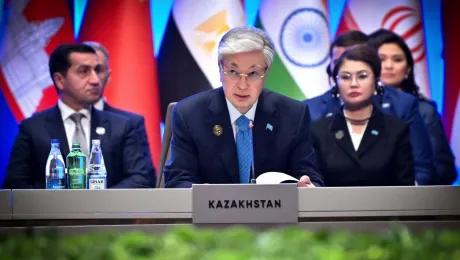
During President Kassym-Jomart Tokayev’s official visit to Brussels in June last year, Kazakhstan and the EU reaffirmed the importance of improving transport connectivity.
The European Investment Bank signed agreements supporting connectivity, while the two sides also agreed to expand air links.
European investment in Kazakhstan has exceeded $210 billion
Economic ties with Europe are already measured in tens of billions of dollars.
According to Vassilenko, trade between Kazakhstan and the European Union reached $45 billion last year.
European investment in Kazakhstan has exceeded $210 billion since 2005, while more than 4,000 companies with European capital operate in the country.
A significant share of the relationship remains concentrated in energy and mining.
The Ambassador sees this as both a strength of the current partnership and evidence of how much room remains for diversification.
The next phase could include artificial intelligence, advanced technologies, renewable energy, critical materials, finance, education and skills development.
Kazakhstan and the EU have already established strategic cooperation in sustainable raw materials, batteries and renewable hydrogen.
The next task, in Vassilenko’s view, is to turn that foundation into concrete projects, investment and jobs.
Kazakhstan wants to be more than a raw-material supplier to Europe
That is the central message of the article.
For Kazakhstan, Europe is seen not only as an export market but also as a source of technology, investment and expertise needed to develop new industries.
For Europe, Kazakhstan is positioning itself as more than a supplier of oil, uranium and other resources. It is also becoming an increasingly important partner in transport, investment and technology.
“A more democratic and resilient Kazakhstan is not only our national objective. It also means a stronger partner for Europe,” Roman Vassilenko writes.
That is the context in which he proposes viewing the August 23 elections: stronger political institutions and deeper economic partnership are linked by one key factor — the country’s predictability for long-term projects.
We previously examined what Kazakhstan will choose on August 23 and how the first Kurultai will be formed.
“By strengthening the democratic foundations and resilience of our political system through these elections, we look forward to further deepening practical cooperation with our European partners — working together to build a more resilient, connected and future-oriented partnership,” the Ambassador said.