
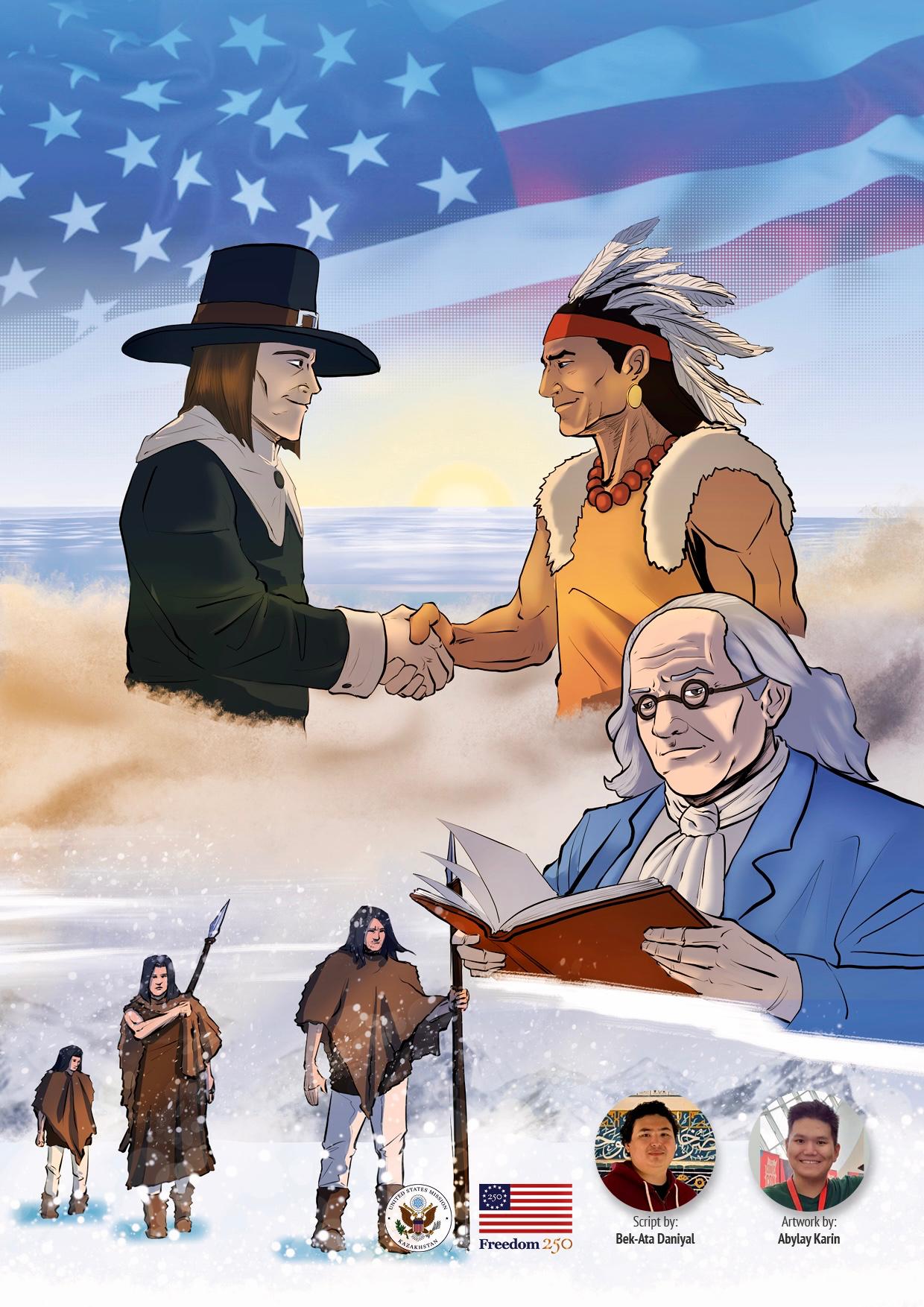
U.S. history is being retold through a Central Asian lens. In Astana, Kazakhstan’s capital, a new graphic novel titled The Long Journey to Liberty was presented to mark the 250th anniversary of U.S. independence and explore historical and cultural parallels between Central Asia and North America, DKNews.kz reports.
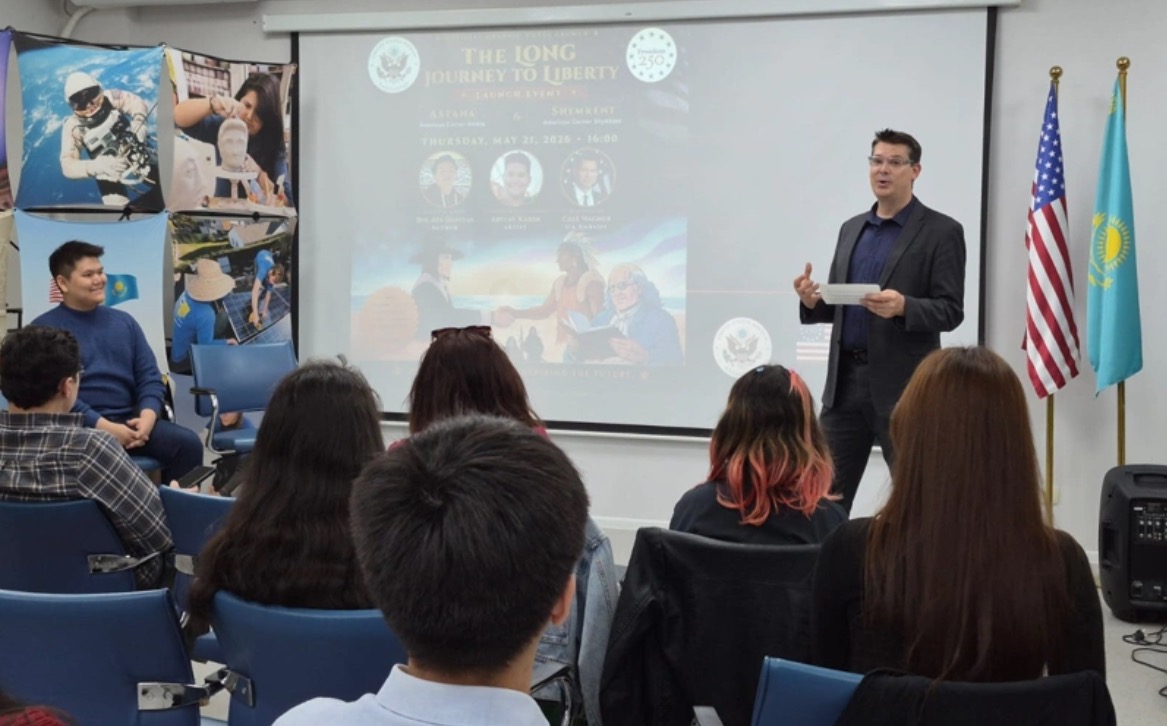 The American Corner in Astana
The presentation took place at American Corner Astana. The project was supported by the U.S. Embassy in Kazakhstan and is part of a broader cultural dialogue built around history, Indigenous heritage and democratic ideas.
Three chapters trace a journey from ancient migration to the founding of the United States
The graphic novel is divided into three chapters: “The Ancient Journey,” “Seeds of Democracy,” and “Inspiring America’s Founders and First Diplomat.”
The first focuses on ancient migration across Beringia, the land bridge that once connected Asia and North America. The second explores relations between early European settlers and the Wampanoag people. The final chapter examines Indigenous systems of governance, particularly the Iroquois Confederacy, and their place in discussions about the development of democratic thought among America’s Founding Fathers.
Throughout the book, the creators draw a historical and cultural line between Central Asia and the Indigenous peoples of North America. Ancient migration, mutual assistance and the evolution of political ideas are woven into a single visual narrative.
“If Africa is the cradle, Central Asia is the nursery”
One of the most memorable comments at the presentation came from Cale Wagner, Public Diplomacy Officer at the U.S. Embassy in Kazakhstan.
“What is really exciting about this comic book project is that our artists and our author took their talents to tell a story that connects Central Asia to the indigenous people of North America,” Wagner said.
According to Wagner, the project aims to look beyond ancient migration and connect that story with the broader historical development of the United States.
He also recalled a phrase from a documentary about early human migration:
“If Africa is the cradle, then Central Asia is the nursery,” Wagner said.
That idea captures one of the central themes of the book. Central Asia is presented not simply as a geographical backdrop, but as part of a much larger story of human movement, cultural continuity and the transmission of ideas.
Freezing weather, thirst and mutual support shape the opening chapter
Author Bek-Ata Daniyal built the first chapter around the migration of ancient peoples across the Bering Land Bridge.
The story focuses not only on migration itself, but also on the qualities that helped communities survive extreme conditions: perseverance, reconciliation and mutual assistance.
“They migrated through freezing weather, through thirst, and they brought with them mutual assistance,” Daniyal said. “This is how ancient tribes of Central Asia and Native Americans are connected.”
For audiences in Kazakhstan, this makes the project particularly unusual. The story connected to America’s 250th anniversary does not begin in 1776, but thousands of years earlier with an artistic reconstruction of human migration from Asia toward North America.
The Iroquois Confederacy enters the story of America’s Founding Fathers
The final chapter moves into a different and often debated area of U.S. history.
The creators examine the governance system of the Iroquois Confederacy and its place in discussions about the political ideas that influenced America’s Founding Fathers.
This is where the book connects its ancient migration narrative with the theme of democracy.
The project was created for a major anniversary: on July 4, 2026, the United States marked 250 years since the adoption of the Declaration of Independence.
From Marvel and DC to Assassin’s Creed
The visual language of the graphic novel was developed by artist Abylay Karin.
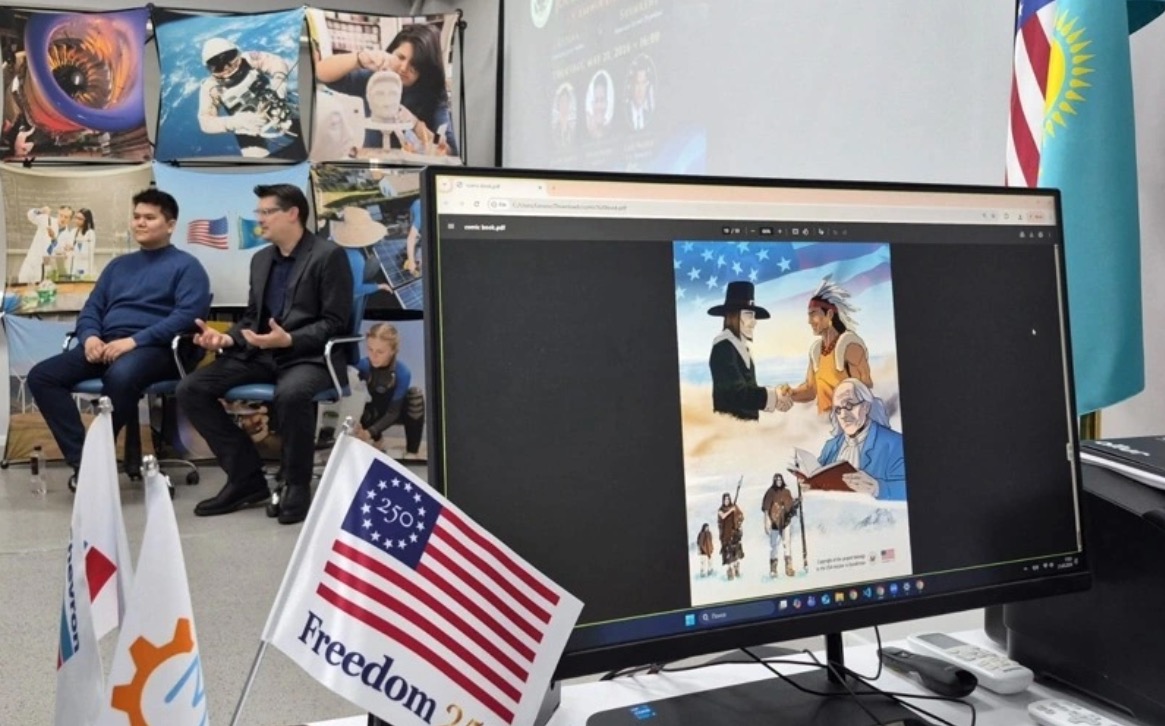 The American Corner in Astana
Karin said his inspiration came not only from traditional comics. He also looked to Marvel, DC, and historical video games such as Assassin’s Creed while creating the atmosphere of different periods.
Color plays an important role in separating the eras. The opening chapter, centered on ancient migration, uses mostly cold tones before gradually shifting toward a warmer palette.
“The first part was mostly in cold colors, but at the end it changed to warmer colors,” Karin said.
One of his favorite scenes is the final page of the first chapter. According to the artist, the move toward warmer colors symbolizes “the beginning of a new time, and the warmth, and the happiness” for the migrating tribes.
The visual language changes again in later chapters, moving from icy landscapes to colonial America and then to the diplomatic and political atmosphere surrounding the formation of the United States.
Why the artist remains skeptical about AI-generated comics
Karin also addressed the role of artificial intelligence in professional art.
In his view, current AI tools remain limited when it comes to comics and animation, where consistency across characters, clothing, environments and small visual details is essential.
“Every detail is essential,” Karin said. “AI doesn’t have this thinking ability. It just copies and makes something similar to the original.”
For a project spanning different historical eras, that consistency becomes especially important: the artist must keep characters and visual elements coherent while still giving each chapter its own identity.
A new format for cultural dialogue between Kazakhstan and the United States
The Astana presentation went beyond the launch of a new comic book. The project uses an accessible visual format to bring together several themes at once: ancient history, Indigenous cultures, democratic ideas and Central Asia’s place in a wider human story.
 The American Corner in Astana
The venue also reflects that mission. American Corners are part of the broader American Spaces network, which supports cultural and educational engagement with local communities around the world.
Kazakhstan and the United States have maintained diplomatic relations since the early years of Kazakhstan’s independence. The United States recognized Kazakhstan’s independence on December 25, 1991, and the U.S. Embassy began operating in Almaty in January 1992.
The 250th anniversary of American independence has added a symbolic cultural dimension to that relationship. Earlier, we reported on Kazakh President Kassym-Jomart Tokayev’s message marking the 250th anniversary of U.S. independence.
Now diplomacy and politics have been joined by another medium: a graphic story stretching from ancient migration across Beringia to the debate over the origins of American democratic ideas.