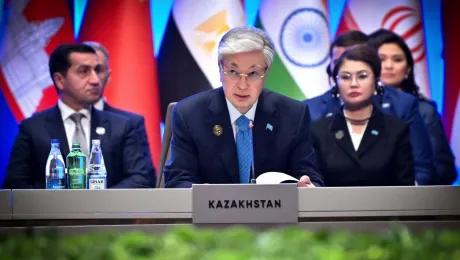


Kazakhstan is preparing for emerging cyber threats. The government has proposed a national roadmap for the transition to post-quantum cryptography as artificial intelligence increases the scale and speed of cyber risks, DKNews.kz reports.
The proposal was announced by Zhaslan Madiyev, Deputy Prime Minister and Minister of Artificial Intelligence and Digital Development, at the opening of the international KazHackStan 2026 cybersecurity conference. His current position is confirmed by the ministry’s official leadership page.
More than 400 critical digital assets identified
KazHackStan 2026 is being held as part of AI MONTH 2026 and Kazakhstan’s Year of Digitalization and Artificial Intelligence. Over two days, the conference is expected to bring together 10,000 participants from seven countries and more than 100 Kazakh and international speakers.
This year’s central theme is cyber resilience. Madiyev said the stability of digital systems has become directly linked to the functioning of government, the economy and people’s everyday lives.

«Today, the resilience of digital systems determines how the government and the economy function, as well as the everyday lives of citizens. Artificial intelligence is changing the scale and speed of cyber threats, which makes resilience against them particularly important. Kazakhstan is building a protection system: the Law on Cybersecurity has been adopted, more than 400 critical digital assets have been identified, and over 40 operational cybersecurity centres are active. The faster digital infrastructure and AI develop, the higher the requirements for their security. Cybersecurity today is a matter of national security, the resilience of the state and the economy, and public trust. The government, business, academia and the professional community must work together», — Madiyev said.
Kazakhstan targets Tier 1 in global cybersecurity ranking
Kazakhstan is currently in Tier 2 of the International Telecommunication Union’s Global Cybersecurity Index. According to information presented at the conference, this is the highest level among Central Asian countries.

The country is now working towards reaching Tier 1.
Madiyev identified five priorities for strengthening Kazakhstan’s cybersecurity:
- safe use of artificial intelligence;
- preparation for post-quantum security;
- international technical cooperation;
- cybersecurity workforce development and cyber culture;
- development of domestic cybersecurity solutions.
The most forward-looking proposal concerns post-quantum cryptography.
National post-quantum roadmap proposed
Madiyev proposed developing a national roadmap for Kazakhstan’s transition to post-quantum cryptography.
The initiative is intended to prepare data protection systems for advances in quantum computing. For Kazakhstan, this becomes increasingly relevant as more government services, databases and critical infrastructure depend on digital systems.
At this stage, the proposal concerns the preparation of a national roadmap. No specific transition deadline was announced.
Kazakhstan has also been expanding international cybersecurity cooperation. Earlier in 2026, Madiyev proposed closer coordination between the Turkic states, including real-time data sharing between national cybersecurity centres and joint workforce development.

Deepfakes and data leaks take centre stage
The first day of KazHackStan focuses on threats that already affect citizens, businesses and public institutions.
Participants are discussing online fraud, personal data leaks, deepfakes and the protection of critical infrastructure.
The main programme includes the panel session «Kazakhstan’s cyber resilience: government, technology and shared responsibility». Leading bug bounty researchers from Kazakhstan, Uzbekistan and Kyrgyzstan are also due to receive the CyberNomad Awards.
Three specialist tracks — Government, Cyber Resilience and OSINT & Forensics — are running in parallel. The Government track includes a meeting of the National Information Security Coordination Centre.
Kazakhstan starts selecting students for 2027 cyber Olympiad
KazHackStan is also being used to develop the country’s cybersecurity talent pipeline.
The CyberKumbez practical cybersecurity competition started on the first day of the conference. Kazakhstan has also launched its national selection process for school students seeking places on the country’s team for the ICO 2027 International Cybersecurity Olympiad in Italy.
The finals are scheduled for the second day of the conference.
On September 30, KazHackStan will continue with Secure Development & Hack Day. Participants will attend technical presentations by Kazakh and international experts, live demonstrations of attacks and defensive techniques, and analyses of real-world vulnerabilities and cyber incidents.
The exhibition area is also bringing together Kazakh and international companies showcasing cybersecurity products and technologies.
Kazakhstan’s broader AI MONTH programme has already included major technology events. On September 23, Astana hosted HackAlem AI, which received 6,586 applications and brought together developers, students, startups and technology companies.
The next challenge for Kazakhstan is turning the five cybersecurity priorities announced at KazHackStan into specific technical projects. One of them has already been put on the agenda: preparing the country for a transition to post-quantum cryptography.
Earlier, we reported on how Kazakhstan plans to respond to AI-driven cyber threats and why post-quantum protection is becoming part of the national cybersecurity agenda.