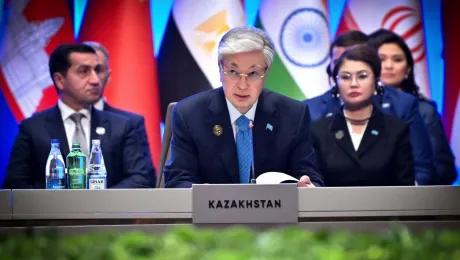

The partnership has entered a new phase. President Kassym-Jomart Tokayev has highlighted the recent upgrade of relations between Kazakhstan and the Republic of Korea to a Future-Oriented Comprehensive Strategic Partnership, DKNews.kz reports.
Tokayev sent a congratulatory telegram to President Lee Jae Myung on October 3 on the occasion of the National Day of the Republic of Korea. He noted that the date symbolizes the Korean people’s rich historical and cultural heritage, national unity and solidarity.
Seoul Visit Elevated Bilateral Relations
The key message of the telegram focused on the outcome of Tokayev’s recent visit to Seoul.
«During my recent visit to Seoul, we elevated our bilateral relations to a Future-Oriented Comprehensive Strategic Partnership. I am confident that this decision will contribute to further deepening Kazakh-Korean cooperation, rooted in the bonds of friendship and strong partnership, for the benefit of our peoples», the telegram reads.
The upgrade was agreed during talks between Tokayev and Lee in Seoul on September 15. The new framework expands the bilateral agenda across investment, technology, infrastructure and industrial cooperation.
$19 Billion Became the Key Economic Figure
The new political status comes with a substantial economic agenda.
During Tokayev’s visit to Seoul, commercial agreements worth $19 billion were signed. The figure represents the announced value of the agreements rather than capital already invested in Kazakhstan, meaning their eventual economic impact will depend on implementation.
The two countries are looking beyond conventional trade toward deeper industrial and technological cooperation. Kazakhstan has proposed expanding localization, developing higher-value production and using the country as a manufacturing platform for exports to third markets.
Priority areas discussed during the Seoul visit included:
- manufacturing and industrial localization;
- energy and critical minerals;
- transport and logistics;
- artificial intelligence and advanced technologies;
- infrastructure and urban development;
- agriculture and higher-value processing.
Kazakhstan also proposed a “Resources-Technology-Industry” model designed to combine its mineral resources with Korean technology and manufacturing expertise, with more processing and production taking place inside Kazakhstan.
Korean Investment Has Exceeded $12 Billion
The partnership already rests on a significant investment base.
Cumulative Korean investment in Kazakhstan has surpassed $12 billion, while more than 1,000 companies with Korean capital operate in the country. South Korea is also among Kazakhstan’s ten largest trade and investment partners.
Cooperation increasingly extends into manufacturing and technology. Korean companies are involved in Kazakhstan’s automotive sector, while the broader bilateral agenda includes energy, metallurgy, infrastructure and advanced technologies.
This gives the new strategic partnership a practical test: how many of the agreements reached in Seoul turn into operating businesses, localized production, infrastructure and technology projects.
Kazakhstan and Korea Set a Longer-Term Economic Agenda
Astana has also proposed developing a Comprehensive Program for Trade, Economic and Investment Cooperation for 2027–2030.
One of the goals is to double bilateral trade while changing its structure by increasing the share of higher-value-added goods. Kazakhstan has additionally proposed a separate industrial cooperation roadmap focused on localization and exports to third-country markets.
The two sides therefore enter their new partnership with both a political framework and a potential economic roadmap.
Tokayev concluded his October 3 telegram by wishing Lee Jae Myung every success in his state service and the Korean people prosperity and well-being.
We recently reported in detail how Kazakhstan and Korea elevated their strategic partnership during the Seoul talks. The visit produced a $19 billion package of commercial agreements and placed investment, industrial cooperation and major infrastructure projects at the center of the next stage of bilateral relations.