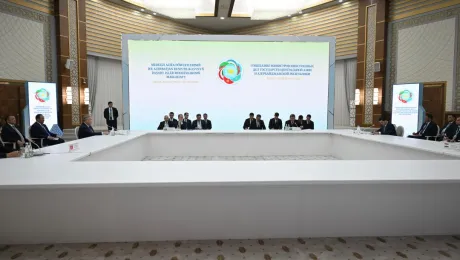


A $1 billion trade target is back on the agenda. Kazakhstan and Azerbaijan have reaffirmed their intention to expand bilateral trade turnover to that level following talks between Presidents Kassym-Jomart Tokayev and Ilham Aliyev in Baku on October 15, 2026. According to the official statement from Akorda, the leaders also discussed energy exports, transport infrastructure and the newly launched Trans-Caspian Fiber-Optic Line, DKNews.kz reports.
The meeting highlighted the increasingly broad scope of Kazakhstan-Azerbaijan cooperation, with economic priorities extending from trade and energy to digital connectivity, logistics and regional diplomacy.
Kazakhstan and Azerbaijan target $1 billion in bilateral trade
Tokayev and Aliyev welcomed the positive momentum in economic relations and reaffirmed their shared objective of increasing bilateral trade turnover to $1 billion.
The target reflects a broader effort to deepen commercial ties between two countries located on opposite shores of the Caspian Sea.
Trade expansion is closely connected to cooperation in manufacturing, agriculture, transport and energy. Progress in these sectors could create additional opportunities for companies operating in both markets.
However, Akorda's statement did not specify a deadline for reaching the $1 billion target or provide updated bilateral trade figures.
The distinction matters: the presidents confirmed an existing strategic objective rather than announcing that the target had already been achieved.
Energy exports through Azerbaijan remain a priority
Another major subject of the talks was the potential expansion of Kazakh energy supplies through Azerbaijan.
For Kazakhstan, developing additional export routes is an important part of diversifying access to international markets.
Azerbaijan's position on the western shore of the Caspian Sea makes it a relevant partner for transport and energy connections linking Central Asia with the South Caucasus and beyond.
The presidents also reviewed prospects for joint projects in several sectors:
- Industry and manufacturing cooperation.
- Energy production and transportation.
- Transport and international logistics.
- Agriculture and related business opportunities.
No new shipment volumes, project investment amounts or implementation deadlines were announced in the official account of the meeting.
A new digital corridor across the Caspian Sea
The two presidents placed particular emphasis on the launch of the Trans-Caspian Fiber-Optic Line, a major telecommunications project connecting Kazakhstan and Azerbaijan.
The infrastructure is designed to strengthen digital connectivity between the countries while providing an additional route for international data transmission between Europe and Asia.
According to the presidential statement, the project is expected to diversify digital corridors and create new opportunities for the wider region.
Its significance extends beyond telecommunications. The initiative adds a digital component to the broader system of transport and economic links being developed across the Caspian.
For Kazakhstan, additional international connectivity could support the development of cloud services, technology infrastructure and data-intensive industries.
For Azerbaijan, it creates further opportunities to participate in the digital networks connecting Central Asia with European markets.
Why the Caspian connection matters strategically
The Caspian Sea has become a central element of Kazakhstan-Azerbaijan cooperation because it connects several economic priorities at once.
Transport routes across the region support international freight movement. Energy infrastructure provides opportunities for exporting resources, while fiber-optic networks enable cross-border data transmission.
These projects serve different purposes but share a common geographic foundation: connecting Central Asia with the South Caucasus and European markets.
For Kazakhstan, cooperation with Azerbaijan can provide additional options for international trade and connectivity.
For Azerbaijan, closer ties with Kazakhstan strengthen its economic links with Central Asia.
However, the practical benefits will depend on infrastructure capacity, investment decisions, commercial demand and the implementation of existing agreements.
Tokayev acknowledges Azerbaijan's role in CICA
The meeting also addressed regional diplomacy and Azerbaijan's chairmanship of the Conference on Interaction and Confidence Building Measures in Asia (CICA).
President Tokayev thanked President Aliyev for the invitation to the summit and for Azerbaijan's traditional hospitality.
He also praised the organization of the event and highlighted Azerbaijan's contribution to advancing CICA's agenda during its chairmanship.
According to Akorda, Tokayev specifically acknowledged efforts to promote practical initiatives and strengthen the organization's international standing.
This diplomatic dimension shows that Kazakhstan-Azerbaijan relations involve not only bilateral economic projects but also cooperation within broader Asian multilateral frameworks.
Education, tourism and parliamentary cooperation
Beyond trade and infrastructure, the leaders discussed the continued development of cultural and humanitarian ties.
Both sides noted progress in educational cooperation, tourism and interparliamentary engagement.
These areas contribute to the broader relationship by creating opportunities for contacts between institutions, businesses and citizens.
Educational cooperation can support academic exchanges and institutional partnerships, while tourism helps strengthen direct connections between the two societies.
The official statement did not announce specific new educational programmes, tourism agreements or numerical targets in these areas.
What the meeting means for Kazakhstan
The Baku talks reaffirmed the main priorities of Kazakhstan's strategic partnership with Azerbaijan.
Economically, the two countries continue to pursue the $1 billion bilateral trade target. In energy, Kazakhstan is exploring opportunities to expand supplies through Azerbaijani territory.
In transport and digital infrastructure, the emphasis is on strengthening connections across the Caspian Sea and creating additional routes between Asia and Europe.
These priorities reflect a relationship increasingly shaped by practical infrastructure and commercial cooperation alongside diplomatic engagement.
At the conclusion of the meeting, Tokayev and Aliyev reaffirmed their commitment to deepening the strategic partnership and consistently implementing agreements across the bilateral agenda.
The next measure of progress will be the extent to which these commitments translate into expanded trade, energy shipments and operational infrastructure projects.
Earlier, we reported on the major projects bringing Kazakhstan and Azerbaijan closer together, including the $1 billion trade objective, the Trans-Caspian transport route, energy cooperation and the fiber-optic connection across the Caspian Sea. The latest presidential meeting reaffirmed these priorities at the highest political level.