Sofiya is still completing her degree, but a three-week internship at the Industrial and Commercial Bank of China has already earned her a job offer. The final-year student at Kazakh Ablai Khan University of International Relations and World Languages said the university arranged the placement. “So now, I’m working while continuing my studies,” she said.
For students learning Chinese at the university in Kazakhstan, the language offers a potential gateway to new career and education opportunities. Some hope to find jobs at local companies, while others plan to pursue further studies in China. Their teachers, meanwhile, are working to connect language learning with the demands of the workplace.
Their ambitions come as economic ties between China and Kazakhstan continue to grow. Bilateral trade reached US$48.7 billion in 2025, up 11 percent from a year earlier, according to China’s Ministry of Foreign Affairs.
In September 2013, Chinese President Xi Jinping proposed the Silk Road Economic Belt, a key component of the Belt and Road Initiative, during a speech at Kazakhstan’s Nazarbayev University.
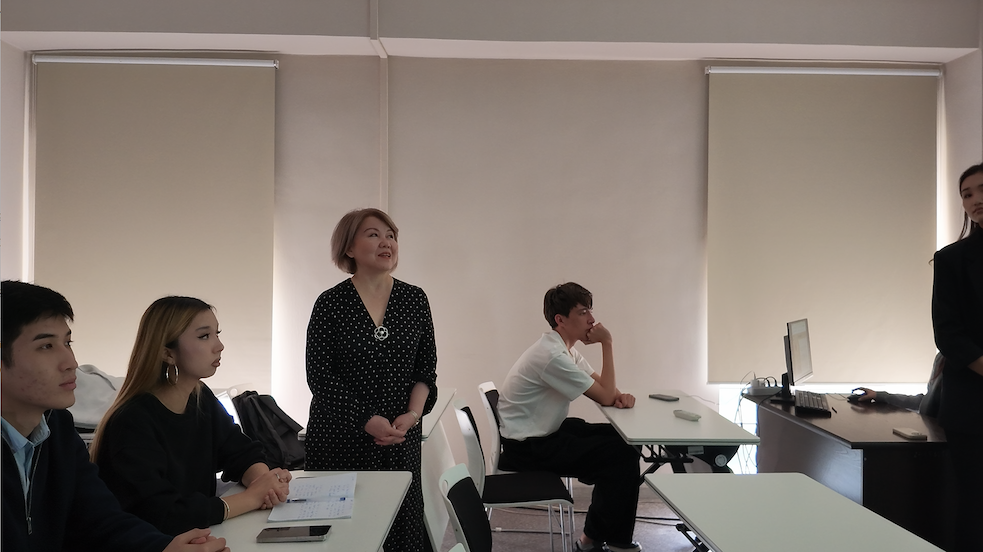
Ayaulim, 23, has been learning Chinese for three and a half years. During a classroom discussion of Chinese mythology, she spoke about Da Yu, the legendary figure credited with controlling devastating floods.
“Legend has it that he passed his home three times without entering. His dedication deeply moves us,” she said.
Now in her final year, Ayaulim is looking beyond the classroom. She hopes to put her language skills to use in a job soon.
Gulnaz, a 20-year-old final-year translation student, first took up Chinese at her father’s encouragement. Her motivation to continue, however, now comes from her own career ambitions.
“I now realize that knowing Chinese can open up better career opportunities and lead to higher-paying jobs,” she said. “Moreover, it allows me to work either in China or for a local company in Kazakhstan.”
There are growing business links to support such ambitions. In June 2025, Chinese and Kazakh companies signed 58 commercial documents worth more than US$24 billion, covering sectors including energy, agriculture, transport, information and communications technology, and education, according to KAZAKH INVEST, Kazakhstan’s investment promotion agency.
Chinese businesses have established a presence across Kazakhstan’s economy. They include China National Petroleum Corporation (CNPC) in the oil and gas sector and Huawei in telecommunications technology. Chinese automakers such as Changan, Chery and Haval also operate in the local market.
At Kazakh Ablai Khan University, one way to connect students with these opportunities is through its Confucius Institute, one of five in Kazakhstan, according to Kazakhstan’s embassy in China. Established jointly with China’s Southwest University, the institute aims to link Chinese-language education with professional development, said Hu Hongyu, a Chinese-language teacher there.
“The institute has partnerships with Chinese companies operating in Kazakhstan to offer internships to students,” Hu said.
The institute is also working to make its teaching materials more relevant to the local business environment. Yang Kun, its director, said it had collaborated with Chinese companies in Kazakhstan to develop materials that reflect how businesses operate in the country.
One example is a business Chinese textbook developed with CNPC. It features bilingual Chinese-Kazakh texts about companies and projects in Kazakhstan, including the China-Kazakhstan natural gas pipeline.
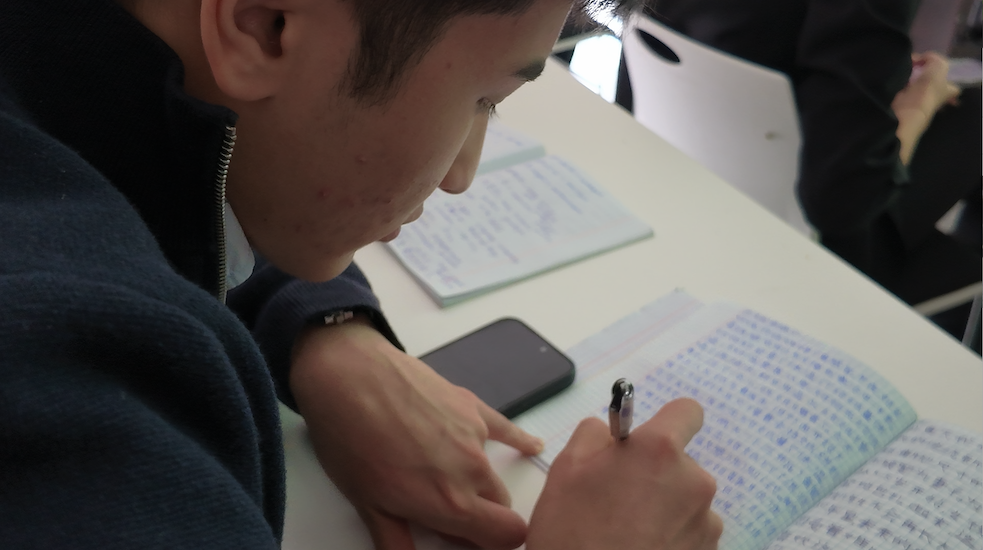
The textbook also covers buses manufactured by Yutong and railway equipment produced by CRRC Corporation Limited, giving students examples of Chinese companies and products they may encounter in their professional lives.
“It serves local Chinese-language learners by providing them with up-to-date learning materials that can better prepare them for the demands of the workplace,” Yang said.
For some students, the next step may be to continue their education in China. The two countries’ educational links offer another route alongside employment opportunities.
As of January 2025, about 4,200 Kazakh students were studying in China, including 459 receiving Chinese government scholarships, according to Kazakhstan’s embassy in China.
Hu said the Confucius Institute offers 10 students each year the opportunity to study at Southwest University through an exchange program.
Gulnaz hopes to take that route for her postgraduate studies. “I plan to pursue my postgraduate studies in China,” she said.
For her, learning Chinese has evolved from a decision encouraged by her father into a choice shaped by her own ambitions. Ayaulim hopes the language will help her enter the workforce, while Sofiya is already balancing employment with her final year of university.
Their plans differ, but all three see Chinese as more than a subject to master. It is a skill they hope will give them greater flexibility in deciding where to study, where to work and how to shape their futures.
The author, WEI Kun, is a student member of the Backpack Reporting and Research Kazakhstan 2026 team from Shanghai International Studies University.