
Diplomats traded negotiations for chess. In Astana, representatives of 14 countries and 11 international organizations gathered around chessboards to compete for a prize pool of 1 million tenge. The winner was Sławomir Kędzierski, the military attaché at the Polish Embassy, DKNews.kz reports.
The third international Diplomatic Chess Cup 2026 took place on the campus of Coventry University Kazakhstan. The tournament was organized by the Kazakhstan Chess Federation and the Ministry of Foreign Affairs of Kazakhstan, with support from the Astana Diplomatic Club, Freedom Group and the university.
Polish military attaché defeats 42 rivals
A total of 43 players competed in the tournament. They included representatives of embassies and consulates, the European Union delegation, the United Nations Development Programme (UNDP), the World Health Organization (WHO) and the Food and Agriculture Organization (FAO), as well as staff from the OSCE Programme Office in Astana and the Secretariat of the Conference on Interaction and Confidence Building Measures in Asia (CICA).
The chessboards brought together people whose daily work involves international relations, diplomatic engagement and security issues.
First place went to Sławomir Kędzierski, the military attaché at the Polish Embassy. This was his second diplomatic chess tournament in Kazakhstan.
The Polish diplomat described chess as much more than a casual hobby. He also acknowledged that playing against Kazakhstan's chess talent has proved challenging.
"I've lost quite a few rating points in Kazakhstan. You could say I've given them away to my opponents. The young players here are particularly strong. I think chess is really thriving in Kazakhstan. I would also like to congratulate Kazakhstan's female chess players. Winning silver at the Olympiad twice in a row is an extraordinary achievement," said Sławomir Kędzierski.
Who finished among the top five?
Although Poland's representative claimed the title, the remaining top positions went to participants from different diplomatic institutions.
The final standings were as follows:
- Sławomir Kędzierski — military attaché at the Polish Embassy.
- Marat Ibraimov — diplomat.
- Zhambyl Zhuparkhan — spouse of an employee of the German Consulate in Almaty.
- Alimzhan Akhmetov — staff member of the Secretariat of the Conference on Interaction and Confidence Building Measures in Asia (CICA).
- Nurlan Zhumekin — employee of the US Embassy in Astana.
Special awards were also presented to participants who achieved the best results in individual categories.
Lashyn Zhanarbek, a representative of the Otandastar Foundation affiliated with Kazakhstan's Ministry of Foreign Affairs, achieved the highest result among women.
Jürgen Seitz, representing the German Consulate General in Almaty, was named the best player in the over-50 category.
The award for the best performance among heads of diplomatic missions went to Ambassador Alkhiasat Mutaz, a representative of the CICA Secretariat.
Detailed standings and tournament statistics are available on the international Chess-Results platform.
German diplomat has been playing chess for 55 years
One of the tournament's most experienced participants, Jürgen Seitz, traveled from Almaty to Astana for the competition.
He started playing chess at the age of six and has now been involved in the game for 55 years.
Seitz also organizes chess tournaments for diplomats in Almaty, giving him firsthand experience of the preparation required to stage such events.
Yet he approaches his own chess achievements with a sense of humor.
"I've been playing chess since I was six years old — that's 55 years now. And I still haven't become any better. But for me, the most important thing here isn't winning. It's meeting interesting people and gaining new experiences," said Jürgen Seitz.
He pointed out that the attractive photographs taken at tournaments rarely reveal the considerable effort involved in organizing them.
Seitz also thanked the Kazakhstan Chess Federation for another opportunity to participate in the event.
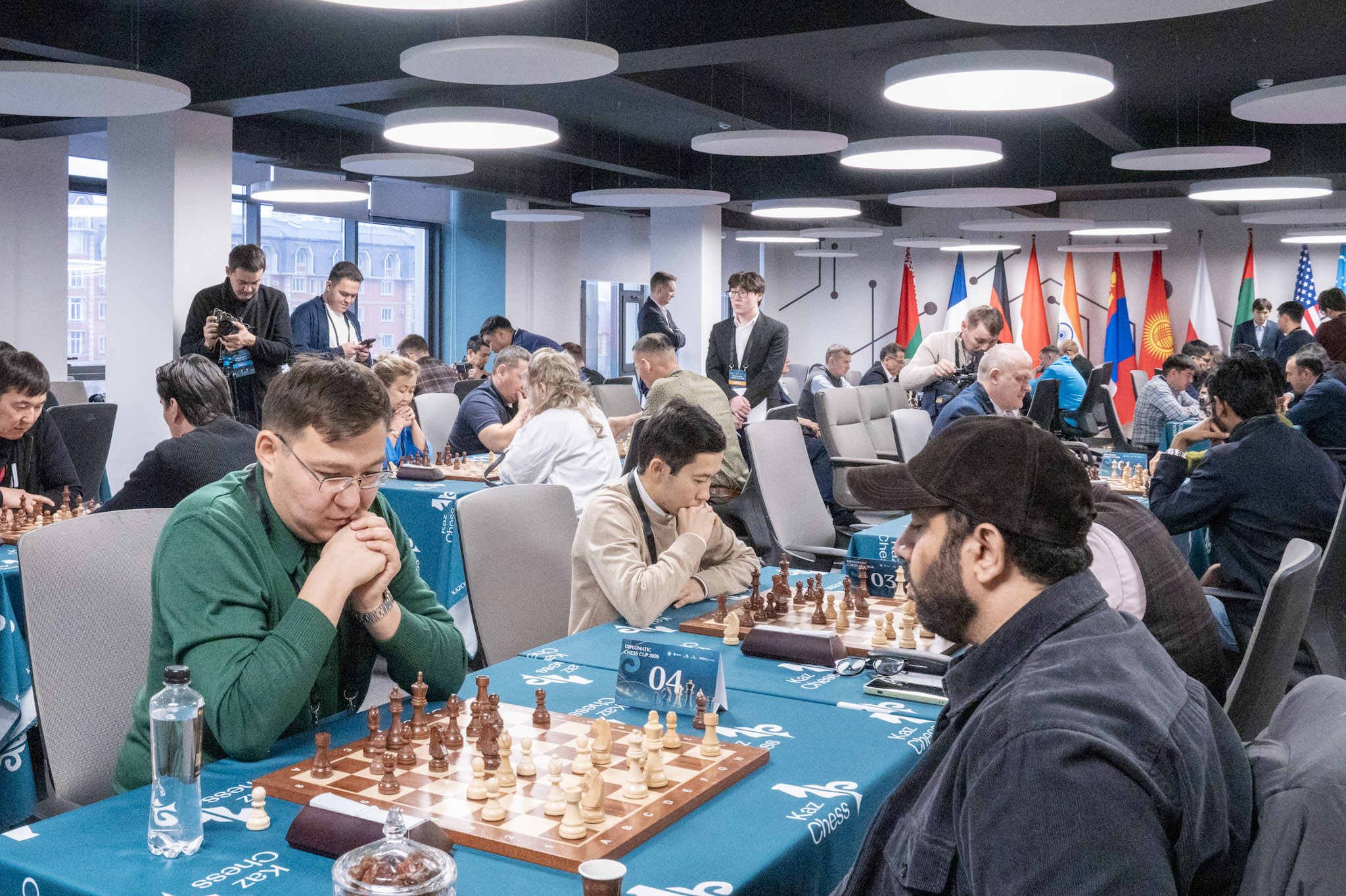
Why representatives of 14 embassies gathered at a university in Kazakhstan
The Diplomatic Chess Cup has now been held three times.
The tournament was originally conceived as an opportunity for diplomatic staff to meet and interact outside formal meetings.
Gulmira Dauletova, executive director of the Kazakhstan Chess Federation, said interest from foreign diplomatic missions has remained strong year after year.
"We see how chess brings together people of different nationalities, and we want to create an atmosphere of friendship and mutual respect at the tournament. Every year, we see interest from embassies and consulates representing different countries. They love chess, and at the board, they do more than compete — they also find common ground," said Gulmira Dauletova.
The event also has an educational dimension for Kazakhstan.
Miras Daulenov, president of Coventry University Kazakhstan, explained that the university operates a diplomatic club where two or three ambassadors deliver lectures to students every week.
The chess tournament complements these activities by bringing international representatives to campus for informal discussions as well as official engagements.
"Fourteen embassies accepted our invitation to play. For the participants, it's an opportunity not only to compete for victory but also to communicate and discuss what's happening around the world," said Miras Daulenov.
Phoenix Chess Cup winner receives a university scholarship
Coventry University Kazakhstan is also developing its own chess competitions.
The university hosts the Phoenix Chess Cup, whose winner receives a scholarship to study at the institution.
For students and prospective applicants, the tournament offers a tangible incentive: success at the chessboard can lead to an opportunity to pursue higher education with scholarship support.
According to Miras Daulenov, the university aims to make chess a regular part of student life.
He also observed that students who play chess frequently appear more confident when making decisions and perform better on tasks requiring strategic thinking.
The university is therefore continuing to promote chess and hopes to host such tournaments regularly.
Freedom Bank highlights the connection between chess and diplomacy
The tournament was supported by Freedom Group.
Ardak Yeleusizov, head of Freedom Bank in Astana, drew attention to the similarities between two activities that might initially seem unrelated.
"Chess and diplomacy go hand in hand. Both require strategic thinking, weighing different options and understanding where the next move might lead. It is a great honor for Freedom to support tournaments like this. I wish all participants exciting games and the best of luck!" said Ardak Yeleusizov.
Compared with formal diplomatic meetings, a chess tournament offers a different setting.
Representatives of different countries compete on equal terms, where official positions and diplomatic rank provide no advantage over an opponent.
The results reflected that principle.
The Polish military attaché took first place, diplomat Marat Ibraimov finished second, and participants connected with Germany, CICA and the United States also made the top five.
For the organizers, the tournament is about more than distributing a prize pool of 1 million tenge.
It also provides diplomats with an opportunity to connect outside the constraints of official protocol.
Perhaps the most revealing comment came from Jürgen Seitz. After 55 years at the chessboard, the German diplomat still attends tournaments primarily to meet new people and gain fresh experiences.