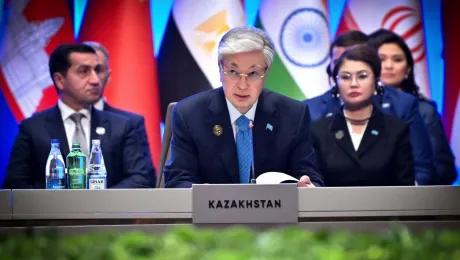

The World Economic Forum in Davos is known not only for high-level panel discussions but also for brief, informal conversations that often carry real political and economic weight. On the sidelines of the forum, President of Kazakhstan Kassym-Jomart Tokayev held a series of short but meaningful talks with world leaders and influential global figures, underscoring Kazakhstan’s active role in international dialogue, DKNews.kz reports.

While the meetings were concise, their significance lies in the range of partners and the breadth of issues touched upon - from geopolitics and trade to global governance and sports diplomacy.
Dialogue With Armenia’s Leadership
President Tokayev held brief conversations with President of Armenia Vahagn Khachaturyan and Prime Minister Nikol Pashinyan. These contacts highlighted the ongoing political dialogue between Kazakhstan and Armenia and reflected Astana’s consistent approach to maintaining open communication channels with partners across the region.

Kazakhstan has long positioned itself as a supporter of stability and constructive engagement, and Davos provided a convenient platform to reaffirm this approach in an informal setting.
Expanding Ties With Asia: Meeting Indonesia’s President
Another notable interaction took place with Indonesian President Prabowo Subianto. As one of Southeast Asia’s largest economies, Indonesia represents an important partner for Kazakhstan as it seeks to deepen cooperation with Asian countries.

Against the backdrop of shifting global supply chains and economic uncertainty, such contacts are increasingly relevant. They signal Kazakhstan’s interest in expanding trade, investment, and broader economic cooperation beyond its traditional markets.
Exchange With Tony Blair on Global Change
President Tokayev also spoke with Tony Blair, Executive Chairman of the Institute for Global Change. Kazakhstan has been actively engaging with international expert and analytical institutions, particularly on issues related to governance reforms, sustainable development, and adaptation to global challenges.

These exchanges allow Kazakhstan to align its domestic reform agenda with global trends and benefit from international expertise at a time of rapid global transformation.

Trade and Economic Dialogue With the United States
Trade-related issues were also on the agenda during President Tokayev’s brief meeting with U.S. Secretary of Commerce Howard Lutnick. Economic cooperation with the United States remains an important element of Kazakhstan’s foreign economic policy, especially in areas such as investment, industrial development, and economic diversification.
Even short conversations at Davos often serve as building blocks for longer-term engagement and future negotiations.
Football and Global Diplomacy: Meeting FIFA’s President
In a less traditional but highly symbolic meeting, President Tokayev spoke with FIFA President Gianni Infantino. Today, sport plays an increasingly visible role in international relations, acting as a tool of soft power and global communication.

For Kazakhstan, developing sports infrastructure and increasing its presence in international sporting initiatives is part of a broader strategy to enhance the country’s global profile.
Davos as a Platform for Fast but Meaningful Engagement
President Tokayev’s meetings in Davos demonstrated the forum’s unique role as a space where even brief exchanges can open the door to deeper cooperation. In a world marked by economic volatility and geopolitical uncertainty, such direct contacts are often as valuable as formal state visits.

For Kazakhstan, Davos remains a key platform to strengthen international connections, clarify positions, and reaffirm its place in the evolving global landscape.