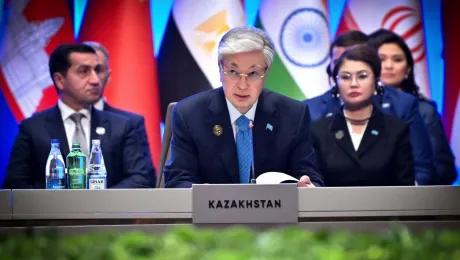

Kazakhstan is moving ahead with a large-scale transformation of its tax system, placing digitalization at the center of fiscal reform. Prime Minister Olzhas Bektenov chaired a meeting on the development of fiscal policy and the digitalization of information systems at the Ministry of Finance, as part of the implementation of instructions from President Kassym-Jomart Tokayev, DKNews.kz reports.
The meeting brought together heads of relevant government agencies and regional departments of state revenues. The key message was clear: taxation in Kazakhstan must become transparent, fair, and service-oriented, while digital tools should support businesses rather than create additional pressure.
Budget 2025: Targets Met
Participants reviewed the performance of the state budget’s revenue side for 2025. According to Finance Minister Madi Takiyev, the revenue plan was fulfilled at 100.1 percent, with 24.6 trillion tenge collected by the end of the year.

These figures, officials noted, demonstrate that changes in tax administration and digital tools are already delivering tangible results.
New Tax Code and First Results
With the new Tax Code coming into force on January 1, 2026, Kazakhstan has entered a new phase of fiscal regulation. Since then:
- 454,000 taxpayers have confirmed their activities under the simplified tax declaration
- 138,000 individuals have registered as self-employed, including 122,000 first-time registrations
- More than 7,000 businesses have been registered as new VAT payers
The expansion of the tax base is seen as a step toward reducing the shadow economy and increasing transparency.
2026: A Transition Year Without Penalties
Prime Minister Bektenov emphasized that government agencies must prioritize service quality and trust-building over enforcement.

“Fair, convenient, and understandable — this is how the tax payment process should be. Tax officers must become consultants and partners for business. Liability measures will apply only to those who deliberately conceal income. That is why 2026 will be a transition year for small and micro businesses, with no penalties or fines for errors,” Bektenov said.
This approach is intended to give entrepreneurs time to smoothly adapt to the new tax rules.
From 12 Systems to 5 Digital Platforms
Deputy Finance Minister Yerzhang Birzhanov reported on the digital overhaul of the State Revenue Committee. As part of the reform, 12 outdated information systems were replaced with five modern digital platforms.

This has led to:
- tax document processing times reduced from one hour to one minute
- the introduction of online payments
- an increase in simultaneous system users from 100,000 to 250,000
- format and logic checks to prevent reporting errors
Currently, digital services support around 1.7 million business entities, with more than 87,000 taxpayers accessing the system daily.
VAT, Self-Employment, and Big Data
From this year, automatic pre-filling of VAT declarations has been introduced, significantly easing compliance for businesses. Self-employed individuals now receive their status automatically via the e-Salyq Business mobile application.
At the same time, a unified Big Data analytics platform has been launched, integrating information from 74 data sources. These include property records, vehicles, land plots, financial transactions, and international operations under currency control.

Thanks to advanced analytics, the system generated over 700 billion tenge in additional tax revenues in 2025, while improving the accuracy of tax oversight.
Digital Tools Against Illegal Schemes
Digitalization has also strengthened the fight against tax violations. Authorities shared several examples:
- In Astana, violations of cash discipline were identified among 55,900 out of 121,000 taxpayers
- In Mangystau Region, inflated procurement costs for pipelines totaling 16.9 billion tenge led to a criminal investigation
- In Almaty, artificial salary increases were detected ahead of government contracts for school construction
- Biometric identification helped identify 17,400 high-risk companies and prevented the illegal issuance of electronic invoices worth 30 billion tenge

Customs Also Goes Digital
Special attention was given to the rollout of the Keden information system, which reduced the processing time for transit declarations from 30 minutes to 10 minutes.
As a result of digitalized customs data and analytics, 115 billion tenge in additional customs payments were collected in 2025 alone.
Government Instructions Going Forward
Following the meeting, Prime Minister Bektenov instructed government agencies to keep the digitalization process under close supervision. Key tasks include:
- ensuring effective implementation of reforms at the regional level
- strengthening outreach and explanations for businesses and citizens
- upgrading IT infrastructure and computing capacity for the Ministry of Finance
- expanding the use of the National Product Catalogue on e-commerce platforms and marketplaces by July 1
The Bottom Line
Kazakhstan is reshaping its fiscal system by turning taxation into a clear and predictable digital service rather than a source of fear for businesses. While 2026 will serve as a transition year, the long-term goal is a tax system that is precise, fair, and data-driven.
Judging by the numbers, this transformation is already beginning to pay off.