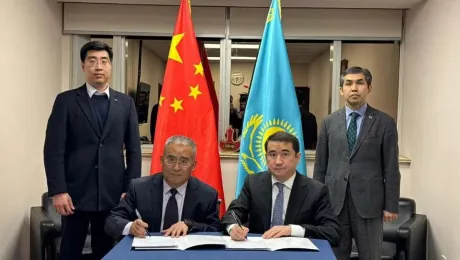

Kazakhstan has officially become the 30th country to join the Protocol on Water and Health to the 1992 Convention on the Protection and Use of Transboundary Watercourses and International Lakes. By doing so, the country has fulfilled the commitment it made at the UN Water Conference 2023 in New York, DKNews.kz reports.
The instrument of accession was deposited on 5 January 2026, and the Protocol will enter into force for Kazakhstan on 5 April 2026. For the country, this step marks more than just participation in another international agreement - it reflects growing recognition that water security, public health and climate resilience are inseparable.
Why water remains a national challenge
According to the WHO/UNICEF Joint Monitoring Programme, Kazakhstan has achieved high coverage in basic water and sanitation services. More than 95% of the population uses at least basic drinking water services, and nearly 98% has access to basic sanitation.
However, deeper challenges remain beneath these figures. Only about 90% of residents benefit from safely managed drinking water, and wastewater treatment remains limited: nationwide, only around one-third of domestic wastewater is safely treated.
Experts note that these gaps are becoming more critical as the country faces:
- increasing water scarcity,
- aging and energy-intensive infrastructure,
- persistent inequality between urban and rural communities,
- the effects of climate change, including glacier retreat and more frequent droughts,
- and dependence on shared transboundary water resources.
Together, these factors pose long-term risks not only to water and sanitation systems, but also to public health, environmental protection and sustainable development.
A health-centered approach to water policy
Kazakhstan’s Minister of Health Akmaral Alnazarova described accession to the Protocol as a strategic and human-centered decision.
“Kazakhstan’s accession to the Protocol on Water and Health is a landmark step in safeguarding the health and well-being of our citizens, while protecting our vital water resources,” she said. “By joining this unique agreement, we commit to continue applying international best practices in ensuring clean drinking water, improving the safety of sanitation systems, and preventing water-related diseases.”
Her statement highlights a key feature of the Protocol: it treats water not only as an environmental or economic issue, but as a public health priority.
International support and regional implications
The move was welcomed by Tatiana Molcean, Executive Secretary of the UN Economic Commission for Europe (UNECE).
“Kazakhstan’s accession will further strengthen efforts to provide access to safe drinking water and sanitation for everyone, increase resilience to climate change impacts, and promote sustainable water management,” she said.
Molcean also called on other Central Asian countries to follow the example set by Kazakhstan and Uzbekistan, stressing that the Protocol offers a practical framework for joint regional action on water and sanitation challenges.
What Kazakhstan commits to next
As a Party to the Protocol, Kazakhstan takes on two core obligations:
- to set integrated national targets on water, sanitation, hygiene and health,
- and to regularly report on progress in achieving those targets.
This work will continue with the support of UNECE and WHO/Europe.
In addition, 2026 will be a key year. Kazakhstan plans to complete a self-assessment of equitable access to water and sanitation, covering four dimensions:
- governance frameworks,
- geographical disparities,
- vulnerable and marginalized groups,
- affordability of services.
The assessment will be conducted at the regional level using the Equitable Access Score-card 2.0 methodology. Its results may also contribute to preparations for the UN Water Conference 2026, scheduled to take place in the United Arab Emirates.
Why the Protocol matters
Adopted in 1999, the Protocol on Water and Health is the only international agreement that directly links water management with human health. It operates under the auspices of UNECE and WHO/Europe and provides:
- a legal framework,
- practical tools for policy implementation,
- support for achieving Sustainable Development Goals, particularly SDG 6 (Clean Water and Sanitation) and SDG 3 (Good Health and Well-being),
- and alignment with international climate commitments.
A long-term investment in resilience
For Kazakhstan, joining the Protocol is not a symbolic gesture. It is a long-term investment in resilience, public health and environmental sustainability. As climate risks intensify and water resources become more strained, integrated and transparent water governance will play a decisive role in the country’s future.
By committing to international standards and accountability, Kazakhstan signals that water security is central to national well-being, not just today, but for generations to come.