

China Outlines Priorities for Relations with Kazakhstan

594
Arman Korzhumbayev Editor-in-Chief
Photo by: Gov

Beijing is putting modernization at the center. China and Kazakhstan are looking beyond trade toward deeper cooperation in transport, energy, technology, science and global governance, DKNews.kz reports.

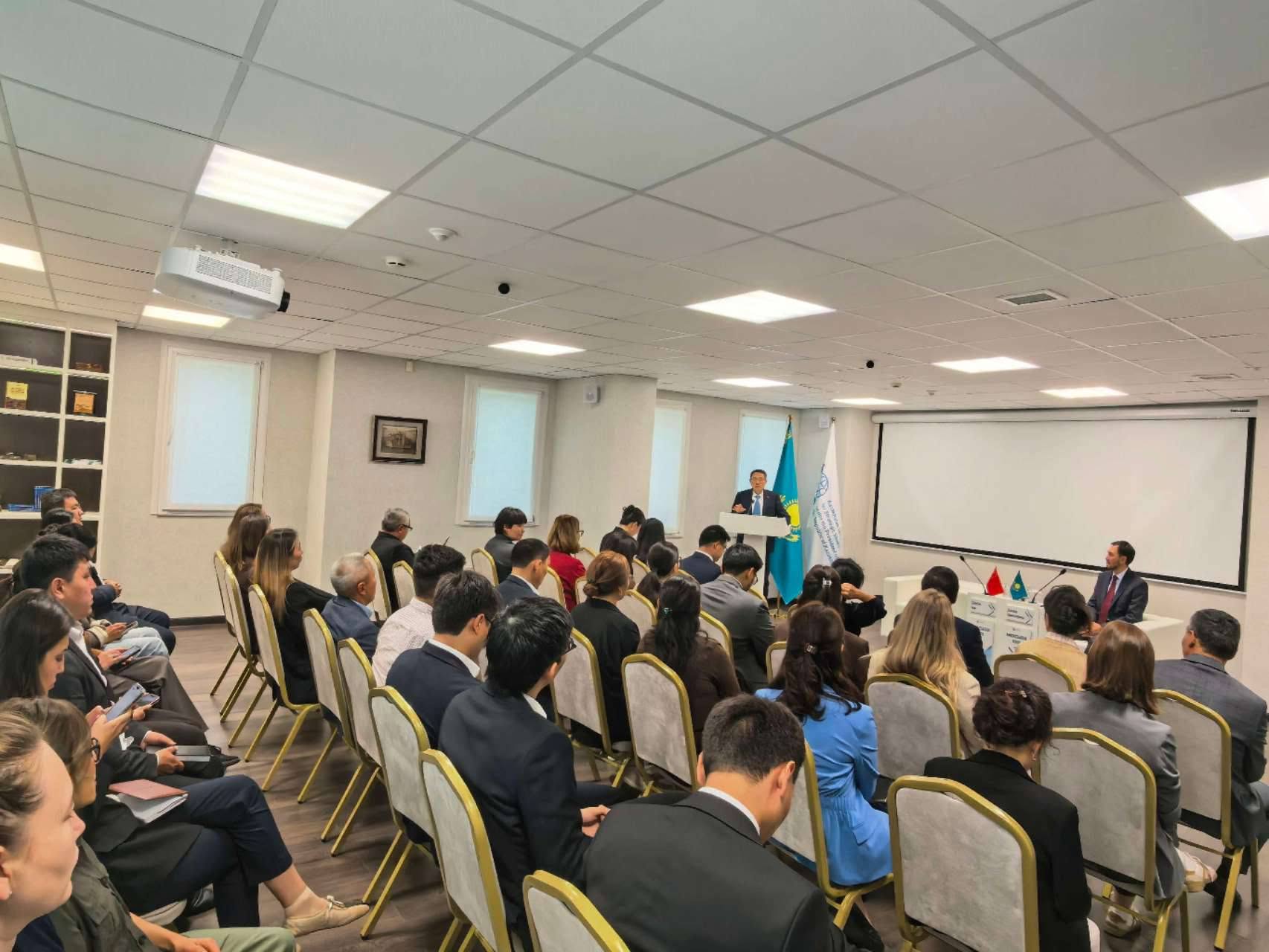
On August 26, Han Chunlin, Ambassador Extraordinary and Plenipotentiary of the People’s Republic of China to Kazakhstan, took part in the “Ambassador’s Hour” hosted by the Kazakhstan Institute for Strategic Studies under the President of the Republic of Kazakhstan. The meeting brought together KISI Director Zhandos Shaimardanov and more than 30 researchers from the institute. Details of the event were published on the official KISI website.

Han’s speech focused on carrying forward the long-standing friendship between China and Kazakhstan and jointly shaping the future of bilateral relations. He addressed cooperation in politics, trade and economics, transport, energy, science and technology, as well as cultural and humanitarian ties.

Han Chunlin puts modernization at the heart of the partnership

The ambassador reviewed the history of China-Kazakhstan relations and outlined the main areas of current cooperation.

One of his central messages was modernization. Han said China was ready to work with Kazakhstan as a reliable partner on this path and to jointly promote a more equitable and rational system of global governance.

This is not the first time the ambassador has used modernization as a framework for bilateral ties. In February, Han Chunlin wrote that China and Kazakhstan were partners on the road to modernization, linking future cooperation to the alignment of development strategies, the Belt and Road Initiative and economic transformation.

The same message has now been delivered at one of Kazakhstan’s key strategic research institutions.

Nearly $49 billion in trade stands behind the diplomacy

The scale of economic ties explains why the two countries are increasingly discussing their relationship in broader strategic terms.

According to Chinese statistics, bilateral trade reached a record $48.7 billion in 2025, up 11% year on year. Kazakhstan exported $19 billion worth of goods to China, while Chinese exports to Kazakhstan amounted to $29.7 billion. The figures were cited in official information published by Kazakhstan’s diplomatic mission in China.

Kazakhstan’s customs statistics give a different figure — $34.1 billion. The discrepancy reflects differences in the two countries’ foreign-trade accounting methodologies, making the source of the data essential when comparing the numbers.

Growth continued in 2026. During the first five months of the year, bilateral trade reached $22 billion, an increase of 27% from the same period a year earlier, according to official economic data.

The figures show how deeply the China relationship now extends into Kazakhstan’s exports, industry, logistics and investment agenda.

85% of China-Europe overland freight passes through Kazakhstan

Transport is one of the areas where the relationship has the most immediate practical significance for Kazakhstan.

Official data indicate that around 85% of overland freight traffic between China and Europe passes through Kazakhstan.

During the first half of 2026, freight traffic between Kazakhstan and China reached 18.7 million tonnes, up 9% from a year earlier.

Kazakhstan shipped 11.7 million tonnes of cargo toward China, a 10% increase. Export freight alone grew by 20% to 8.5 million tonnes, including ore, grain, oil and petroleum products, ferrous and non-ferrous metals and other commodities. Official transport statistics also point to rising volumes through the Dostyk and Altynkol border crossings.

That makes transport cooperation more than diplomatic language. The capacity of railways and border crossings directly affects how much Kazakhstan can export to China and how much transit traffic it can handle between Asia and Europe.

Kazakhstan’s agricultural exports to China jumped 82.4%

Another shift is becoming visible in the structure of trade.

Kazakhstan is trying to expand sales to China beyond raw materials by increasing agricultural and processed exports.

In January-March 2026, Kazakhstan’s agricultural exports to China surged 82.4% to $550 million. In 2025, the figure stood at $1.43 billion.

According to Kazakhstan’s Ministry of Agriculture, the two countries have agreed protocols covering exports of 34 categories of agricultural products — 21 crop products and 13 livestock products.

For Kazakh businesses, however, access to the Chinese market depends on more than demand. Producers must pass approval procedures, comply with veterinary and phytosanitary requirements and build reliable logistics chains.

More than 8,500 companies operate with Chinese capital

Science and technology were also among the areas highlighted by Han Chunlin.

That part of the bilateral agenda has become increasingly prominent in 2026.

During President Kassym-Jomart Tokayev’s July meeting with executives of major Chinese companies in Shanghai, he said that more than 8,500 enterprises with Chinese participation were operating in Kazakhstan. Cumulative Chinese investment in the Kazakh economy has exceeded $30 billion.

In the official presidential account of the meeting, Tokayev said the two countries had entered a new “golden thirty years” of bilateral relations.

For Kazakhstan, the next question goes beyond the volume of investment: how much of that cooperation will lead to technology localization, new production capacity and the training of local specialists?

Beijing adds global governance to the bilateral agenda

Han Chunlin’s address was not limited to economics.

The ambassador also discussed China’s Global Governance Initiative, saying Beijing was prepared to work with Kazakhstan to promote a more equitable and rational international governance system.

That signals an effort by China to complement rapidly growing economic ties with closer coordination on international issues.

On August 10, during a meeting with Kazakhstan’s First Deputy Foreign Minister Yerzhan Ashikbayev, Han Chunlin similarly said China was ready to strengthen cooperation and coordination with Kazakhstan in promoting a fairer international order. The Kazakh side pointed to close interaction between the two countries at the United Nations and other multilateral platforms.

KISI expects cooperation to deepen further

Zhandos Shaimardanov, Director of the Kazakhstan Institute for Strategic Studies, said China-Kazakhstan relations had made significant progress and that practical cooperation had produced results across multiple areas.

He expressed confidence that continued joint efforts would strengthen traditional friendship and mutually beneficial cooperation, bringing tangible benefits to the people of both countries and greater predictability to the region.

The context is already different from only a few years ago. Kazakhstan and China are simultaneously expanding trade, freight traffic, agricultural exports, investment and technological cooperation.

Tokayev’s description of a new “golden thirty years” in bilateral relations reflects that ambition.

We previously looked at how Kazakhstan is changing its approach to trade with China: the focus is gradually shifting from simply expanding trade volumes toward higher-value exports, industrial cooperation and technology.

Han Chunlin’s meeting with Kazakhstan’s strategic research community now brings the next question into focus: can record growth in trade and transit develop into deeper technological, industrial and scientific cooperation?

DKNews International News Agency is registered with the Ministry of Culture and Information of the Republic of Kazakhstan. Registration certificate No. 10484-AA issued on January 20, 2010.

Как разместить агитационные материалы политическим партиям на DKNews.kz

Theme
Autoreload
МИА «DKnews.kz» © 2006 -