

Kazakhstan’s oilfield services industry faces a shift.
The next stage of growth will depend less on simply increasing local content and more on whether domestic companies can develop their own engineering, drilling and technological expertise, DKNews.kz reports.
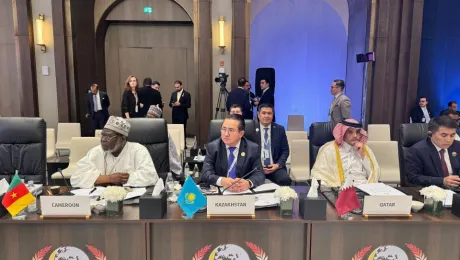
That message emerged at the III Annual KazDrilling: Upstream of Kazakhstan conference held in Atyrau on September 4. The industry forum brought together government officials, national companies, international oil and gas operators, investors and Kazakhstan’s oilfield services businesses.
The conference, held with the support of Kazakhstan’s Ministry of Energy and the National Chamber of Entrepreneurs Atameken, focused on exploration, drilling, hard-to-recover reserves, enhanced oil recovery, investment and new technologies. The official KazDrilling 2026 programme lists representatives of KazMunayGas, QazaqGaz, Shell, Eni, Tengizchevroil, NCOC and KPO among the plenary participants.
Kazakhstan wants more than local content
Kanat Sharlapaev, Chairman of the Presidium of the Atameken National Chamber of Entrepreneurs, identified a central challenge for the industry: Kazakhstan needs not only companies capable of servicing existing major oil and gas projects, but a sustainable domestic oilfield services sector able to work with increasingly complex reserves and higher technological requirements.
“Government policy in geological exploration is also a policy for developing the oilfield services industry. Every new exploration well creates work not only for a drilling contractor. It means geology and geophysics, drilling fluid services, cementing, logging, well testing, laboratory research, logistics, mechanical engineering and dozens of other areas,” Sharlapaev said.
The argument puts geological exploration at the centre of a much broader industrial chain. New drilling programmes can generate demand across multiple service segments rather than benefiting drilling contractors alone.
That is particularly relevant as Kazakhstan looks at technologies for hard-to-recover reserves and enhanced oil recovery — topics that were placed prominently on the KazDrilling 2026 agenda.
Mature fields could create a long-term market
Another potential source of demand is Kazakhstan’s mature oilfields.
Maintaining production at such assets increasingly requires horizontal and multilateral drilling, complex well trajectories, advanced stimulation techniques, digital modelling and enhanced oil recovery technologies.
For local contractors, this could create a sizeable long-term market — but only if they can move further up the technological value chain.
Sharlapaev argued that localisation should no longer be measured mainly through goods produced in Kazakhstan or physical work performed by domestic contractors.
“Our task is to localise not only the production of individual goods or the performance of physical work. We need to localise competencies: engineering calculations, well design, management of complex drilling operations, data interpretation and the development of technological solutions. In other words, we need to gradually move from local content towards creating our own technological and engineering base,” Sharlapaev said.
The distinction is significant for the domestic industry. A company that performs work according to technology developed elsewhere occupies a different position in the value chain from one that can design a well, interpret subsurface data and develop its own engineering solution.
Kazakh companies account for about 60% of drilling businesses
According to market estimates cited at the conference, around 60% of drilling companies are represented by Kazakh businesses, while Chinese companies account for 23% and international players for another 17%.
Yet market share alone does not solve one of the sector’s biggest investment problems: visibility.
Modern drilling rigs, specialised equipment, engineering teams and new technologies require substantial capital. Companies are less likely to make those investments if they cannot estimate how much work will be available several years ahead.
Sharlapaev said the industry therefore needs predictable workloads and the ability to plan investment over a three-to-five-year horizon.
This makes the future drilling pipeline almost as important for contractors as the total size of today’s market.
Contractors need to know what they will be drilling in five years
Predictability was one of the central themes raised in Atyrau.
For an oilfield services company, a major equipment purchase cannot easily be justified by a short contract or an uncertain order book. Long-term financing becomes difficult for the same reason: lenders and investors need some visibility over future revenue.
The discussion at the plenary session therefore covered not only technology but also expansion of the resource base, exploration activity, future drilling volumes, new projects and opportunities to increase participation by Kazakh businesses.
These issues are closely connected. Exploration creates potential reserves; field development creates drilling programmes; predictable programmes give contractors a reason to invest in equipment and people.
Without that sequence, technological localisation risks remaining limited to individual contracts rather than becoming a sustainable industrial capability.
Atyrau has the most immediate stake
The debate carries particular weight for Atyrau Region, home to some of Kazakhstan’s largest oil and gas projects and a substantial domestic oilfield services sector.
Atyrau Region is currently headed by Bolat Akchulakov, who was appointed akim in July 2026, according to the region’s official government page.
New exploration, additional projects and further development of existing fields could expand the addressable market for local suppliers and contractors, while giving Kazakhstan-based companies a larger role in the production chains of major operators.
But Sharlapaev stressed that domestic status by itself will not be enough.
“We must strive to ensure that Kazakh companies become competitive according to international standards in safety, quality, technology and productivity,” Sharlapaev said.
That requirement sets a higher bar than conventional local-content targets. Kazakhstan’s oilfield services companies would have to compete on engineering capability and productivity as well as their presence in the country.
For Atameken, that is where the industry’s next stage lies: more exploration, a longer and more predictable order book, technological modernisation and national companies capable of competing beyond Kazakhstan.
The final test will be whether the sector can turn its existing position — including the estimated 60% Kazakh share of drilling companies — into technological capacity that can compete across the wider regional oilfield services market.