

The global economy has reached an estimated $117 trillion, and in 2025 its structure is becoming clearer than ever. A large-scale visualization based on The Economist data shows who is driving global growth, which economies are losing momentum, and how the balance of economic power is shifting worldwide, DKNews.kz reports.
In 2025, the United States, China, and Germany remain the world’s largest economies by GDP.
The United States Extends Its Lead
The United States remains the world’s largest economy by a wide margin. In 2025, U.S. GDP is estimated at $30.6 trillion, exceeding the combined economic output of China, Germany, and Japan. Growth is expected to reach around 2% this year.
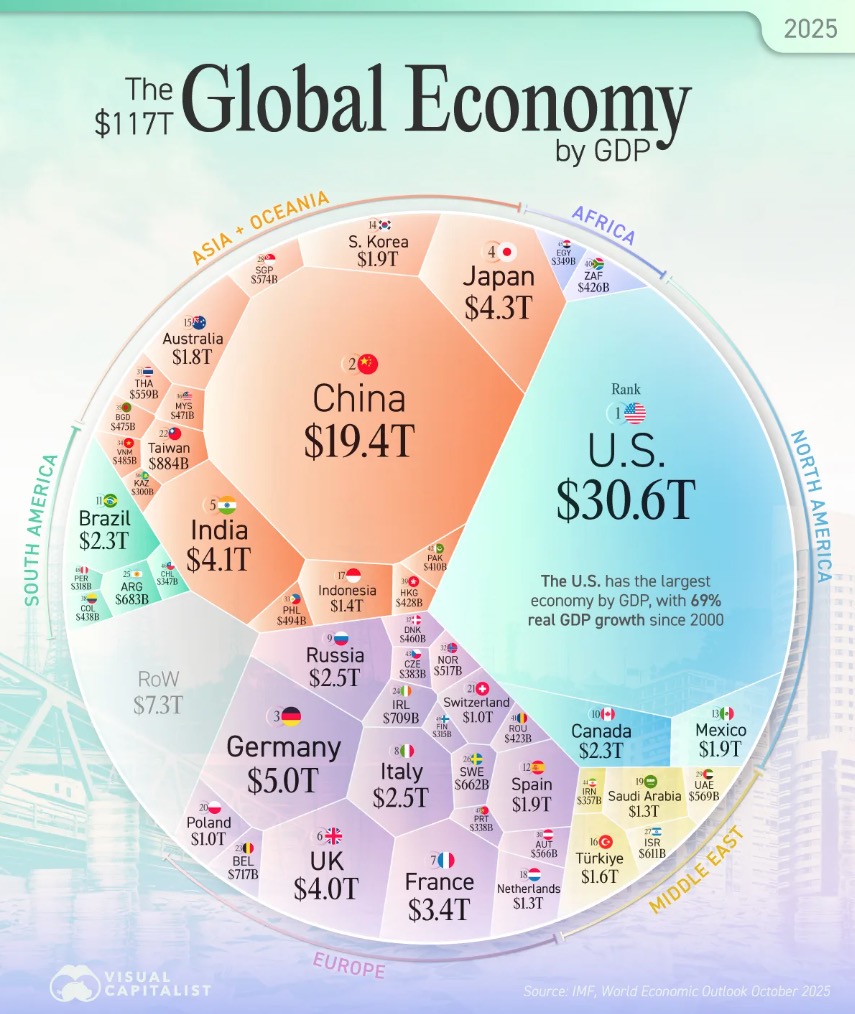
Over the past 25 years, real U.S. GDP has increased by nearly 70%, averaging 2.1% growth per year. Analysts attribute this resilience to a strong technology sector, robust domestic demand, and a flexible labor market that continues to absorb shocks better than most advanced economies.
India Emerges as a Key Growth Engine
Among major economies, India stands out as one of the fastest-growing. In 2025, its economy is projected to expand by 6.6%, making it a central driver of global growth.
Over the last quarter-century, India’s GDP has more than tripled, reaching $4.1 trillion. Economists expect India to overtake Japan in the near future and become the world’s fourth-largest economy, behind only the United States, China, and Germany. This trajectory is fueled by favorable demographics, rapid digitalization, and the continued expansion of the services sector.
Interestingly, the highest growth rate in 2025 is forecast not in Asia, but in Ireland, at 9.1%, largely due to export performance and the presence of multinational corporations.
Europe Struggles to Gain Momentum
In contrast, Europe continues to lag behind. Germany, the largest economy in the European Union, is expected to grow by just 0.2% in 2025, following contractions in 2023–2024. The weak outlook reflects structural challenges in industry, energy costs, and external trade.
The long-term picture is equally subdued. Over the past 25 years, Italy has grown at an average annual rate of only 0.4%, while France has managed 1.2%. Together, these figures highlight Europe’s persistent struggle with low growth across much of the continent.
A More Uneven Global Economy
Economists note that the world economy is becoming increasingly uneven. On one side are countries with strong demographic trends and high growth potential, such as India and several emerging markets. On the other are advanced economies facing aging populations, slower productivity gains, and structural constraints.
The visualization of a $117 trillion global economy makes one thing clear: the center of economic growth is gradually shifting, and the gap between fast-growing and slow-growing economies is widening. These imbalances are likely to shape global economic dynamics for years to come.