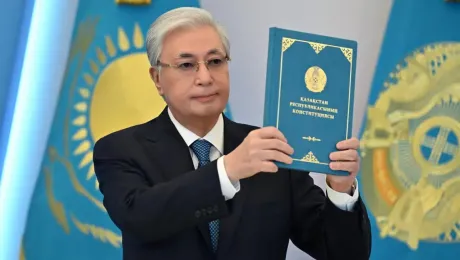


The President of Kazakhstan has signed a new Construction Code, aimed at updating and systematizing the rules governing the country’s construction sector. The document is the result of an extensive and substantive process involving government agencies, members of parliament, and the business community, DKNews.kz reports.
However, the Code’s path to adoption was far from straightforward. Its initial draft raised serious concerns within the construction industry and faced criticism from lawmakers, prompting a broad debate over its potential impact on the sector.
Why the Industry Raised Concerns
At the early stages of discussion, developers, designers, and engineering companies warned of the risks of excessive state control, duplication of supervisory functions, more complex procedures, and a growing administrative burden on businesses.
Industry representatives argued that such measures could slow down projects and increase costs rather than improve construction quality.
.jpg)
“During the discussion and drafting of the Construction Code, businesses had justified concerns that some provisions would complicate processes and increase administrative barriers rather than enhance quality. For the industry, what matters is not the number of control mechanisms, but their effectiveness and predictability,” said Nazira Ussenova, Deputy Chair of the Management Board of the National Chamber of Entrepreneurs Atameken.
Compromises Reached, Questions Remain
As work on the document progressed, compromise solutions were found on the most sensitive issues for entrepreneurs, allowing a balance to be maintained between the interests of the state and the business community.
At the same time, sector experts note that some provisions of the adopted Code will require close monitoring during implementation, as their real impact will depend on how they are applied in practice.
The Role of Atameken and Industry Associations
The National Chamber of Entrepreneurs of Kazakhstan Atameken accompanied the Construction Code throughout all stages of its development — from the initial concept to consideration in the Mazhilis and the Senate of Parliament.
Representatives of Atameken, along with industry associations and unions, participated in working groups, proposed amendments, prepared expert opinions, and defended the position of business on all key issues. In total, hundreds of norms and proposals were reviewed, with a significant number revised to reflect business feedback.
.jpeg)
“It is essential that the new rules do not become a tool for additional pressure on entrepreneurs. Their application must be transparent, must not allow for overly broad interpretation by supervisory bodies, and should be uniform across Kazakhstan,” said Viktor Mikryukov, President of the Association of Developers of Kazakhstan.
Warranty Periods Preserved
One of the key compromise decisions was the preservation of existing warranty periods:
- Five years for a construction project as a whole
- Ten years for critical structural elements such as the load-bearing frame, façade, and roofing
Warranty periods for construction materials and equipment will be set in accordance with the terms defined by manufacturers, which helps avoid additional costs for developers.
Private Expertise Remains in Place
Considerable attention was paid to preserving the institution of non-state (private) construction expertise. During the drafting phase, professionals expressed concern that the role of state expertise could be expanded.
However, according to the Chamber of Expert Organizations, the adopted norms do not pose significant risks to private expert companies. The existing model — based on competition and professional responsibility — remains intact, and key accreditation and examination mechanisms have not undergone fundamental changes.

“A great deal of joint work was carried out with Atameken to preserve and develop the institution of non-state expertise. We succeeded in defending the core principles of independent expert activity. Now it is crucial that these approaches are consistently reflected in subordinate legislation and respected in practice,” said Birlik Yerezhepov, Chairman of the Board of the Chamber of Expert Organizations.
Broader Reforms Built Into the Code
The new Construction Code also includes provisions aimed at:
- developing self-regulation in the industry
- improving certification systems for engineering and technical personnel
- advancing digitalization across the sector
- strengthening state oversight of construction, including in seismic zones
- expanding the role of local representative bodies
- increasing public participation in urban planning decisions
Implementation Is the Real Test
Atameken emphasizes that the adoption of the Code is only the beginning of a new phase. The Chamber will continue to monitor implementation, participate in the review of subordinate regulations, analyze enforcement practices, and propose changes where necessary to protect the legitimate interests of entrepreneurs.
The new Construction Code will enter into force on July 1 of this year. How effectively it works in practice will largely depend on the ongoing dialogue between the state and business.