

The first China–Europe / China–Central Asia freight train of 2026 departs from the China–Kazakhstan logistics base in Lianyungang, Jiangsu Province, eastern China, bound for Kazakhstan. /Photo provided by Lianyungang Port Group/
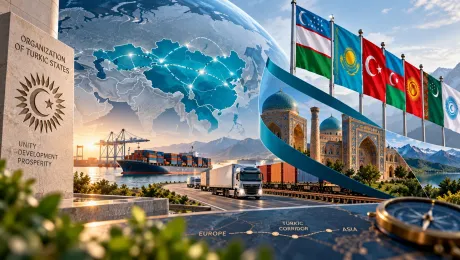
In 2025, cooperation between China and Kazakhstan in the transport and logistics sector reached a new level. The implementation of key joint projects moved forward at full speed, giving fresh momentum to the development of a new Eurasian land–sea multimodal transport corridor, DKNews.kz reports.
This is not simply about higher cargo volumes. It is about building an integrated logistics system that connects China with Central Asia, the Caspian region and, further on, the markets of Europe and the Middle East.
Lianyungang: Central Asia’s gateway to the sea
The China–Kazakhstan logistics base in the city of Lianyungang, officially commissioned in 2014, was the first concrete project under the Belt and Road Initiative. Today, it has become a transport hub of international importance.
By the end of 2025, the cargo throughput of the base reached 5.1597 million tonnes, up 13.74 percent year on year. Cumulative cargo turnover since its launch has totaled 43.02 million tonnes.
The base now serves six international rail freight routes covering 104 stations across Asia and Europe. It has evolved into a key platform for transit, warehousing and trade for five Central Asian countries. More than 400 types of goods are consolidated and distributed here, including wheat, mineral products, household appliances and photovoltaic modules.
From Lianyungang, freight trains reach Almaty in about six days and Tashkent in roughly ten days. At the same time, the port’s maritime links allow cargo to be shipped to nearly 1,000 ports in more than 150 countries and regions worldwide.
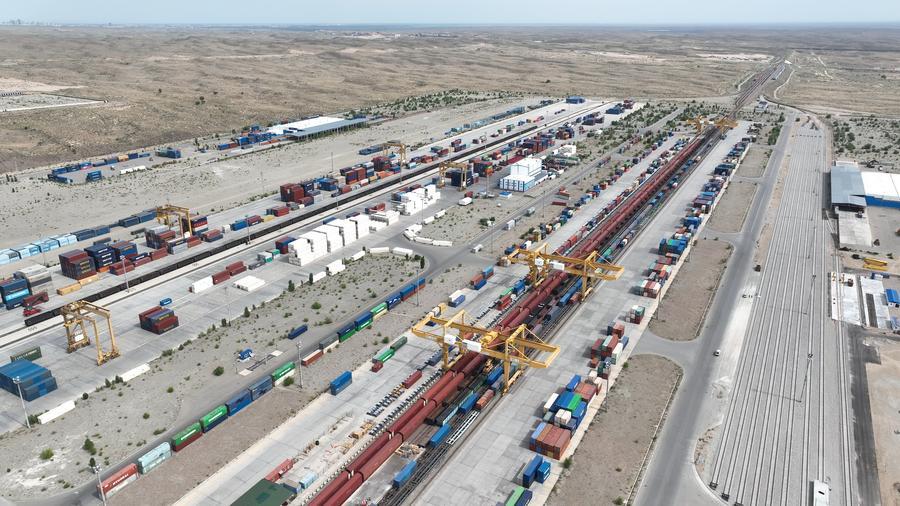 Ten new broad-gauge railway lines were officially put into operation at the Khorgos – Eastern Gate dry port in Kazakhstan to mark the 10th anniversary of the port’s launch.
/Photo provided by Lianyungang Port Group/
Khorgos: a critical transshipment hub
The second major pillar of the corridor is the Khorgos – Eastern Gate dry port on the China–Kazakhstan border, where different rail gauges and transport formats converge.
In 2025, the port underwent a significant technological upgrade. Ten new broad-gauge railway lines were put into operation, and intelligent modernization of infrastructure was carried out. As a result, container transshipment time was reduced from five hours to less than one hour.
Between 2017 and 2025, a total of 2.0974 million TEU were handled at Khorgos. This accounts for nearly one-fifth of all containers transported westward by China–Europe and China–Central Asia freight trains. The port has become one of the most important nodes in Eurasian cross-border logistics.
At the same time, the Khorgos – Eastern Gate special economic zone is developing rapidly, attracting companies in manufacturing, logistics and information technology.
Aktau: a pillar of the Trans-Caspian route
The third strategic element of the emerging corridor is the container hub at Kazakhstan’s port of Aktau. This is the first large-scale logistics project with Chinese investment on the Caspian Sea coast.
Construction of the first phase was completed at the end of 2025, with commissioning scheduled for June 2026. The project covers around 19 hectares and has a designed capacity of up to 240,000 TEU per year.
The initial phase includes three rail loading and unloading lines and a container yard capable of supporting a full cycle of operations, from transshipment and customs inspection to the handling of dangerous goods.
The project will increase the port’s throughput capacity, reduce cargo handling times and strengthen Aktau’s role as a key hub of the Trans-Caspian International Transport Route.
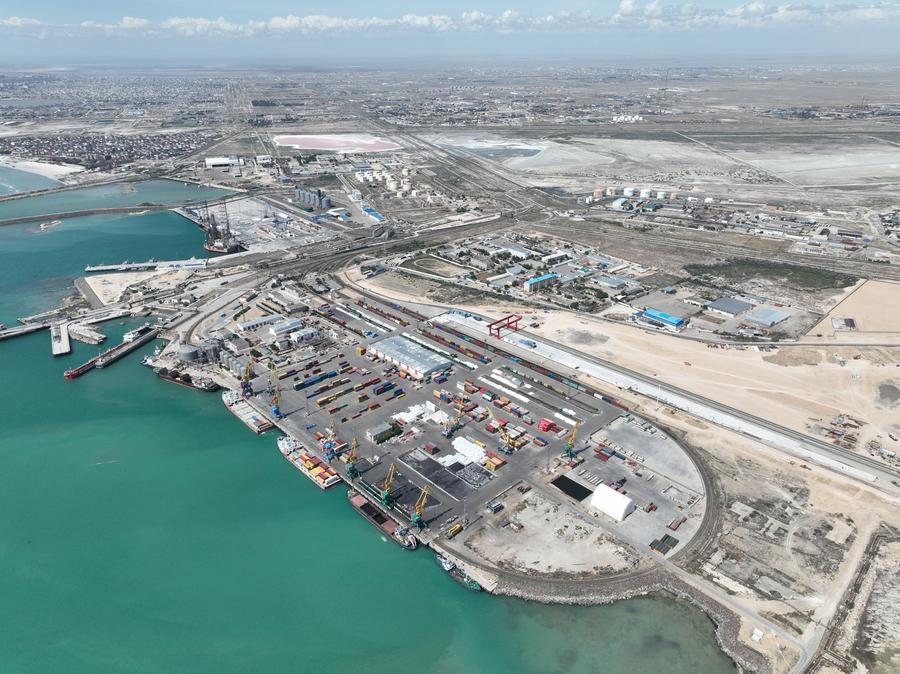 The first phase of the first start-up complex of the container hub project at Kazakhstan’s Port of Aktau was officially commissioned./Photo provided by Lianyungang Port Group/
Logistics as an integrated system
Importantly, Lianyungang, Khorgos and Aktau are not being developed as isolated facilities, but as elements of a single logistics architecture. Already today, China–Europe and China–Central Asia freight trains can be tracked in real time along their entire routes.
In the future, full data connectivity between these three hubs is planned through the joint development and use of data transmission channels for multimodal transport.
Kazakhstan’s evolving role
Joint China–Kazakhstan logistics projects are working on the principle of mutual reinforcement. They are not only increasing transit volumes, but also transforming Kazakhstan’s role in the Eurasian economy – from a transit corridor into a full-fledged logistics and industrial hub.
The new land–sea corridor linking East Asia, Central Asia and the Caspian region is becoming a key factor in ensuring the long-term resilience of regional transport routes and expanding trade links between continents.