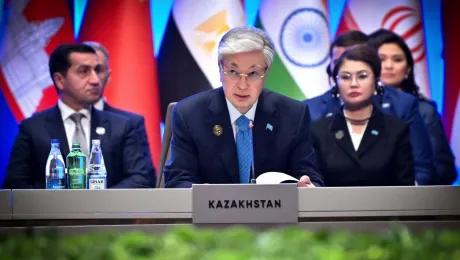


At a time when climate anxiety is no longer abstract but deeply personal, Central Asia has made a rare and powerful move — choosing cooperation over fragmentation, DKNews.kz reports.
During the Regional Environmental Summit in Astana, five countries — Kazakhstan, Kyrgyzstan, Tajikistan, Turkmenistan and Uzbekistan — signed a Regional Cooperation Declaration on biodiversity conservation. It may sound like another diplomatic document, but in reality, this step could reshape how the region protects its natural future.
Why this moment matters
Central Asia is one of the world’s most environmentally vulnerable regions. Glaciers are shrinking, deserts are expanding, and ecosystems that once supported entire communities are under pressure.
What makes this declaration different is its regional approach.
Instead of acting alone, the countries agreed to:
- Coordinate their biodiversity policies
- Share resources and expertise
- Tackle environmental problems that don’t stop at borders
Because nature, as experts often remind, doesn’t recognize political lines on a map.
 Photo: UNDP Kazakhstan / Iris Mambur
From words to action
The declaration is not just symbolic. It lays the groundwork for something much more concrete:
- A regional umbrella programme
- A joint action plan
- A shared funding strategy
These tools aim to help countries actually implement global commitments like the Convention on Biological Diversity and the Kunming-Montreal Global Biodiversity Framework — agreements that often remain ambitious on paper but difficult in practice.
The plan is to present these efforts at the upcoming COP17 conference in Armenia, giving Central Asia a stronger, united voice on the global stage.
A region with untapped potential
High-level participants didn’t just talk about risks — they emphasized opportunity.
Haoliang Xu pointed to what he called a “triple planetary crisis”: climate change, biodiversity loss, and pollution. But he also stressed that Central Asia could become a place where integrated solutions are tested and scaled.
In simple terms: the region isn’t just facing problems — it could become part of the global answer.
 Photo: UNDP Kazakhstan / Iris Mambur
Why cooperation is no longer optional
Environmental challenges in Central Asia are deeply interconnected:
- Rivers flow across multiple countries
- Wildlife migrates across borders
- Dust storms and desertification affect entire regions
Astrid Schomaker highlighted a key reality: no country can solve these issues alone.
Regional cooperation allows countries to:
- Protect shared ecosystems
- Align national strategies
- Strengthen their negotiating power globally
It also increases the chances of attracting international funding and technical support.
 Photo: UNDP Kazakhstan / Iris Mambur
Kazakhstan’s role: setting the tone
Kazakhstan is positioning itself as a regional leader in environmental policy.
In 2025, the country adopted a long-term Biodiversity Conservation Concept and Action Plan for 2026–2035, signaling that sustainability is becoming part of its national development strategy — not just rhetoric.
Minister Yerlan Nyssanbayev emphasized that the declaration reflects a shared commitment to protecting natural resources while using them responsibly.
What happens next
The real challenge begins now.
Signing a declaration is the easy part. Turning it into measurable change will require:
- Political will
- Consistent funding
- Transparent cooperation between countries
Still, there are reasons for cautious optimism. International partners, including UN agencies and development organizations, have already expressed readiness to support implementation.
 Photo: UNDP Kazakhstan / Iris Mambur
Why this story matters beyond Central Asia
This initiative reflects a broader shift happening globally.
Countries are starting to realize that:
- Climate, biodiversity, and land issues are interconnected
- Fragmented policies don’t work
- Regional cooperation is essential
Central Asia, often overlooked in global environmental discussions, is now stepping forward with a unified approach.
The bigger picture
This declaration is not just about protecting plants and animals.
It’s about:
- Water security
- Food systems
- Economic stability
- The future of entire communities
If implemented effectively, it could become a model for other regions facing similar challenges.
And perhaps most importantly, it sends a clear message:
In a world of growing environmental crises, cooperation is no longer a choice — it’s survival.