


Summer on Wall Street is often described as a dead season: traders go on vacation, trading volumes decline, and major news becomes less frequent. Yet the market follows its own calendar. Historically, July has been one of the strongest months for US stocks, DKNews.kz reports.
According to Tural Aliyev, an analyst at Freedom Finance Global, the first ten trading days of July have been the best ten-day period for the S&P 500 since 1928. The index gained an average of about 1.5 percent during this stretch and delivered a positive return nearly seven times out of ten. The pattern is also reflected in Bank of America’s historical calculations.
However, the summer optimism does not always last. Market behavior tends to change in August, while September has historically been the most difficult month of the year.
Why stocks often rise in July
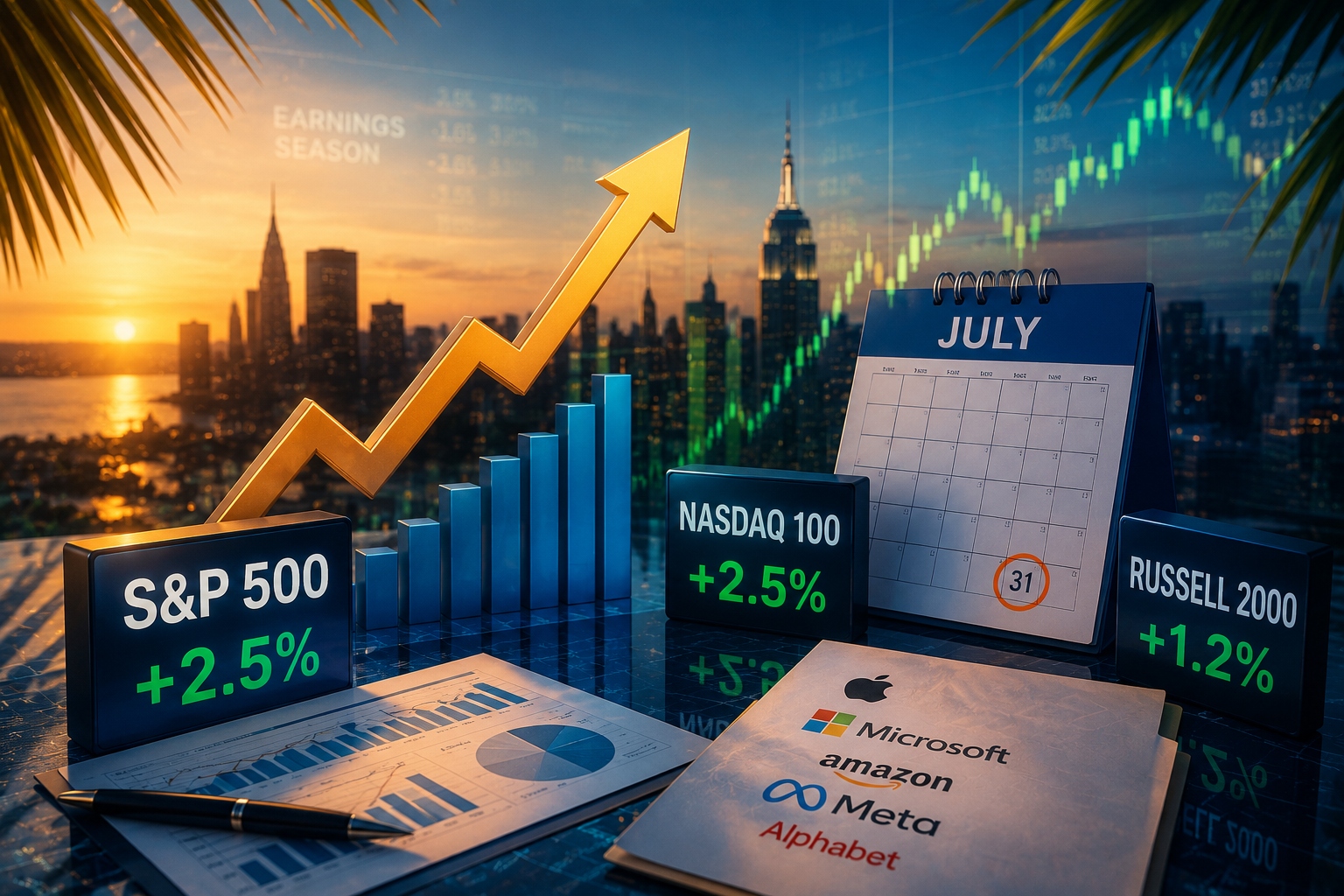
Over the past two decades, both the S&P 500 and the technology-heavy Nasdaq 100 have ended July higher roughly four years out of five, with average gains exceeding 2.5 percent.
The start of the corporate earnings season often supports the market. Major banks and technology companies begin reporting their second-quarter results, and their performance can influence the direction of entire indices.
The Nasdaq 100 is particularly sensitive to earnings announcements. A handful of technology giants account for a significant share of the index, meaning that strong results from just one or two companies can lift the broader market.
Small-cap stocks also frequently perform well in July, although their results are less consistent. The Russell 2000 is more dependent on interest rates, access to credit and market liquidity. When financing becomes more expensive, smaller companies generally face greater pressure.

What changes in August
August does not necessarily bring a decline. The main problem is that trading volumes tend to fall, allowing even relatively modest orders to move prices more sharply.
In such an environment, an unexpected inflation report, disappointing results from a major company or a hawkish statement from the US Federal Reserve can trigger an outsized market reaction.
“Since 1950, six of the nine monthly S&P 500 declines of more than 10 percent occurred between August and November. This does not mean the calendar creates crises. Lower liquidity can simply amplify the market’s reaction,” Tural Aliyev said.
Every major sell-off had its own cause. In 1998, markets faced Russia’s sovereign default. In 2011, the United States lost its top credit rating. In 2015, the yuan was devalued, while in 2024 investors rapidly unwound carry trades funded in Japanese yen.
The calendar did not cause these events, but thinner summer liquidity may have intensified the resulting volatility.
Why September worries investors
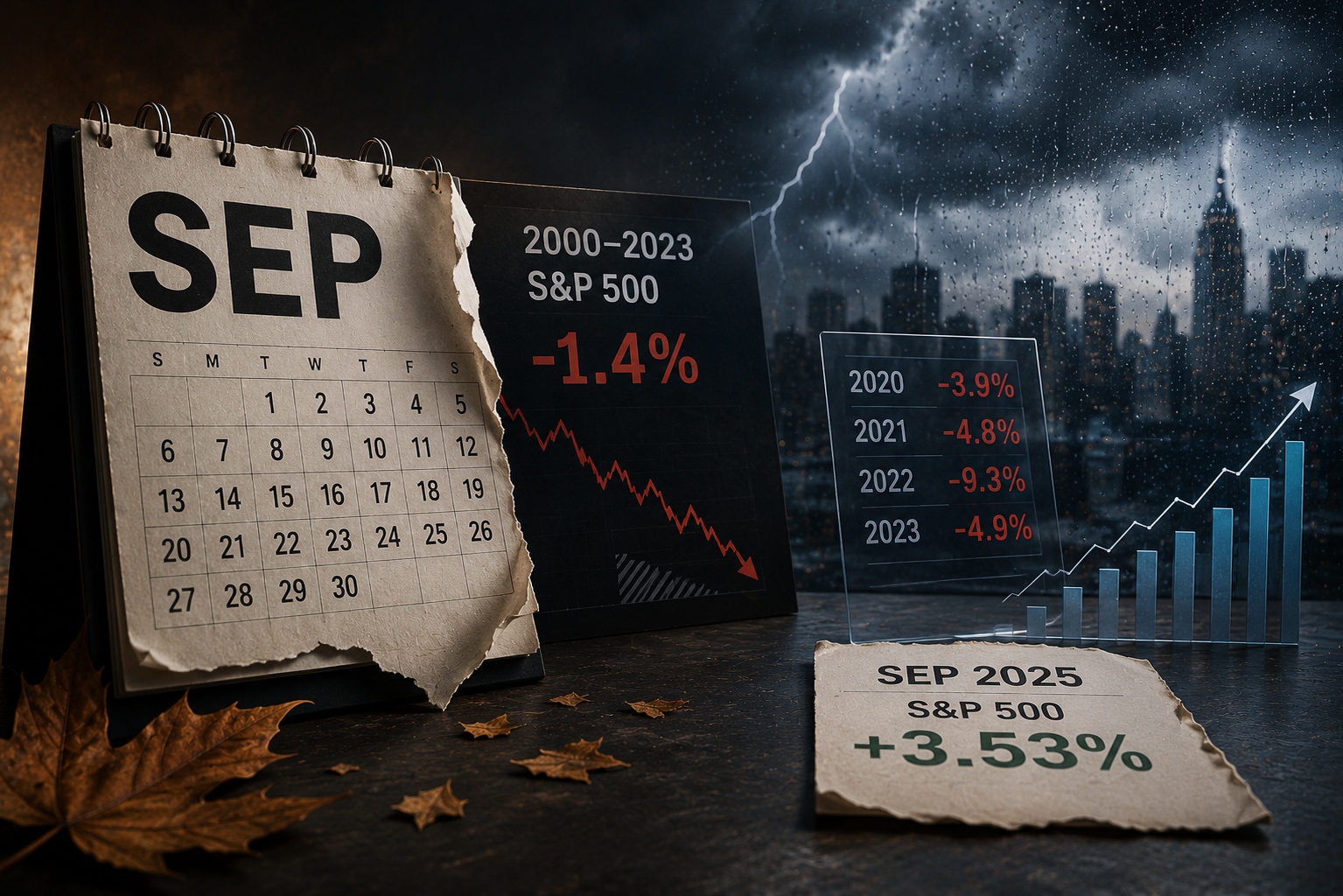
September has the weakest long-term reputation of any month. Since 2000, the S&P 500 has lost an average of about 1.4 percent during September. From 2020 through 2023, the index declined for four consecutive Septembers, with losses ranging from 3.9 to 9.3 percent.
Still, seasonality is not an unbreakable rule. In September 2025, the S&P 500 Price Index gained 3.53 percent. Strong corporate earnings, lower bond yields or improving expectations for interest rates can easily overturn the usual seasonal pattern.
That is why a strategy based solely on buying in July and selling in September is far too simplistic for real-world markets.

Where summer seasonality comes from
The effect is not caused by anything unique to a particular month. It is largely driven by recurring money flows.
At the beginning of the second half of the year, major institutional investors review their portfolios following June rebalancing. The direction of these flows cannot be known in advance, but the transition between the first and second halves of the year often produces meaningful capital movements.
The second factor is share buybacks. Ahead of earnings announcements, many companies temporarily restrict transactions involving their own shares. Once results are released, they can resume their buyback programmes, returning a portion of corporate demand to the market.
The third factor is earnings season itself. Investors are interested not only in the previous quarter’s figures but also in management guidance for the rest of the year.
Ahead of the second-quarter 2026 earnings season, analysts raised their profit expectations for S&P 500 companies — an unusual development, as forecasts are normally reduced over the course of a quarter. Between March 31 and June 30, estimated earnings per share increased by 3.4 percent. As of July 10, S&P 500 earnings were expected to grow by 23.6 percent year-on-year.
Systematic trading strategies can also magnify market moves. When realised volatility declines, some algorithmic funds increase their exposure to equities. When volatility suddenly rises, the same strategies begin reducing risk.
As a result, a calm July can help sustain a rally, while an unexpected shock in August may accelerate a sell-off.

What could break the seasonal pattern in 2026
Federal Reserve policy, inflation and corporate earnings matter far more than historical averages.
The events of 2022 provide a clear example. A strong July rally was completely erased in August and September after the Federal Reserve delivered a hawkish message at its Jackson Hole symposium.
The market environment in the summer of 2026 remains mixed. Investors are entering the earnings season with elevated expectations, while uncertainty over inflation and interest rates persists. The key question is therefore not whether the S&P 500 will match its average July performance, but whether companies can justify the optimism already reflected in market prices.
Another source of risk is the US midterm elections. Historically, midterm years have produced deeper average intra-year drawdowns. Political uncertainty can be particularly important for healthcare, energy, financial services, defence, infrastructure and technology companies.
Volatility has often declined after the elections, but the historical sample is too limited to treat this pattern as a guarantee.
What investors should watch
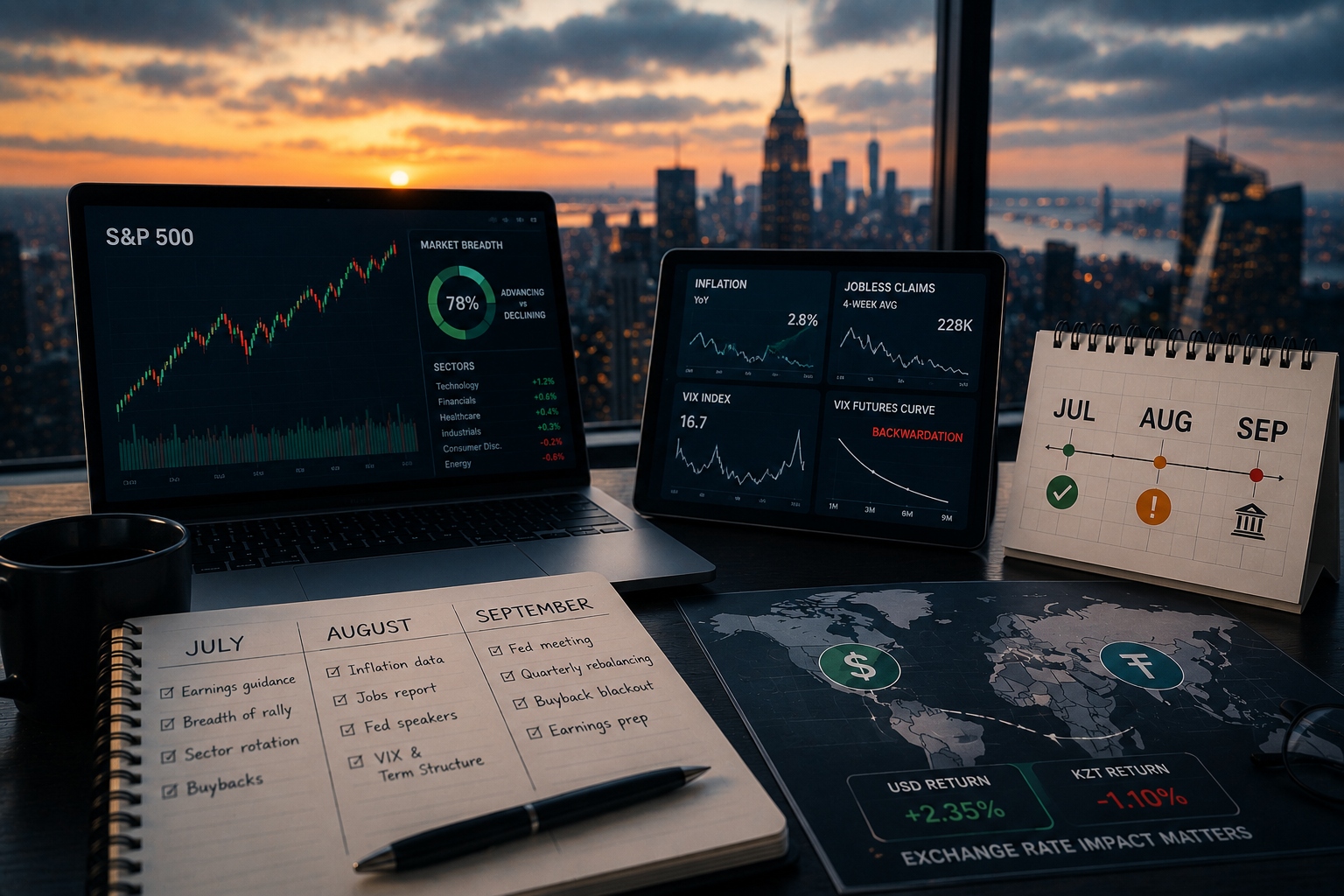
In July, investors should pay close attention to management guidance and market breadth. A rally supported by most stocks is generally more sustainable than one driven by only a few technology giants.
In August, the focus shifts to inflation, employment data, Federal Reserve commentary and the VIX volatility index. When near-term VIX futures become more expensive than longer-dated contracts, the market is signalling increased short-term stress.
In September, investors must also consider the Federal Reserve meeting, quarterly portfolio rebalancing and renewed restrictions on corporate buybacks ahead of the next earnings season.
Kazakh investors face an additional factor: exchange-rate movements. The return on a US stock measured in dollars may differ considerably from the final result measured in tenge. A seasonal rise in an index therefore does not guarantee an equivalent return in the local currency.
“Seasonality is not a reason to buy in July or sell in September. It is an adjustment to the analysis of earnings, interest rates, liquidity and positioning. Its value lies not in predicting the market’s next move, but in understanding when the market becomes especially vulnerable to surprises,” Aliyev concluded.
History may favour July, but the calendar can only indicate when the market is more vulnerable. It cannot reliably tell investors where prices will move tomorrow.