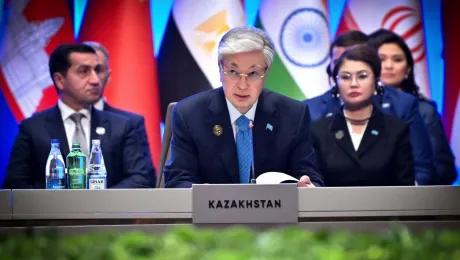

Kazakhstan is closing in on the global top 50.
The country climbed from 70th to 53rd place in the Safest Countries for Investors 2026 ranking, becoming the highest-ranked economy in Central Asia, DKNews.kz reports.
Investing.com has published an article titled “Trust Becomes the New Capital as Kazakhstan Climbs 17 Places in Global Investor Risk Rankings.” Its central message is clear: in the global race for capital, trust is replacing cheap labour and tax incentives as the decisive advantage.
What investors are seeing
The pandemic, geopolitical crises and the restructuring of global supply chains have changed how international businesses make decisions. High potential returns can no longer compensate for weak institutions and unpredictable policies.
Investors now assess how quickly governments make decisions, protect investments and maintain stable rules. These factors determine financing costs, project launch timelines and companies’ willingness to establish production in a country.
“Trust has become the new economic capital.”
Kazakhstan advanced 17 positions against this backdrop. The ranking evaluates the quality of public administration, regulatory efficiency, macroeconomic stability, political and currency risks, and investment protection.
Kazakhstan ranked 53rd among 150 countries in the May edition of the Global Investment Risk and Resilience Index. In October 2025, it was ranked 70th.
More than $20 billion invested in the economy
The improvement in the ranking coincided with stronger investment activity.
Fixed capital investment reached 9.5 trillion tenge in the first half of 2026. In comparable prices, the figure increased by 9.6%, according to Kazakhstan’s Bureau of National Statistics.
That amounts to more than $20 billion. Private investment grew by over 21%, while private capital accounted for 87% of total investment.
For the market, this carries more weight than growth driven solely by public spending. Private investors commit their own money only when they see demand, sound project economics and an acceptable level of risk.
Non-resource sectors are driving growth
Kazakhstan remains dependent on oil, uranium and metals. However, an increasing share of new investment is moving beyond the extractive sector.
Capital is flowing into manufacturing, construction, transport, agriculture, information and communications. These industries create higher added value within the country.
Kazakhstan’s GDP grew by 6.5% in 2025. Manufacturing, construction, transport and trade made the largest contribution.
The economy expanded by 4.1% in January-June 2026. Construction grew by more than 15%, while transport, logistics and industrial production maintained strong momentum.
This is changing how investors perceive the country. The more diverse the sources of growth, the less dependent the economy becomes on a single commodity cycle and the better it can withstand falling global prices.
Kazakhstan’s three advantages
The first is market size. Kazakhstan remains Central Asia’s largest economy, giving investors access to a rapidly expanding regional market.
The second is geography. Its location between China, Russia, the Caucasus and Europe is turning the country into a major Eurasian logistics hub.
The third is relative macroeconomic stability. It allows companies to plan projects with payback periods measured in decades rather than months.
The International Monetary Fund expects Kazakhstan’s economy to grow by 4.6% in 2026. The forecast appears in the IMF’s country profile for Kazakhstan.
From investment volume to project quality
Kazakhstan is gradually changing the priorities of its investment model. The government is focusing not only on the amount of capital attracted but also on processing, localisation, technology and high-value-added production.
The Investment Headquarters coordinates government agencies and helps remove administrative barriers. The National Digital Investment Platform supports projects throughout their implementation.
Strategic investors can sign agreements guaranteeing stable conditions for up to 25 years. By mid-2026, Kazakhstan had concluded 57 such agreements.
The Altyn Visa programme has become another tool for attracting investors, entrepreneurs and highly qualified professionals. Countries are now competing not only for money but also for technology, management expertise and people capable of building new industries.
Three agencies confirm investment-grade status
Credit ratings provide major companies with another benchmark for assessing country risk.
Fitch Ratings affirmed Kazakhstan at BBB with a stable outlook. S&P Global Ratings maintained its BBB- rating with a positive outlook, while Moody’s kept the country at Baa1, also with a positive outlook.
The convergence of assessments from the three major agencies indicates that Kazakhstan’s economy and public finances remain at investment-grade level. This affects borrowing costs and expands the pool of international funds permitted to invest in the country.
Kazakhstan also ranked 34th in the 2025 IMD World Competitiveness Ranking and climbed to 56th place in the Global Peace Index.
The country stands 67th among 169 economies in the Sustainable Development Report 2026. The index covers 123 indicators, ranging from economic development and education to healthcare, environmental performance and institutional quality.
Why a higher ranking guarantees nothing on its own
A ranking does not build factories or create jobs. It only changes the initial risk assessment international companies use when considering a market.
“Rankings are not the objective in themselves. Their function is to provide independent expert assessment, reduce perceived risk, lower the cost of capital, and increase the willingness of international business to treat a country as a platform for new projects.”
The real test begins after the ranking is published. Investors need enforceable contracts, stable regulation, independent courts, reliable infrastructure and the ability to forecast costs years ahead.
The 17-place rise shows that international perceptions of Kazakhstan are changing. The country’s next challenge is to convert that trust into new factories, technology, exports and well-paid jobs.