

The alleged eGov hack remains unconfirmed. Reports claiming that the personal data of 15 million Kazakhstanis had been stolen and offered for sale on the darknet spread rapidly online, but Kazakhstan’s digital authorities said their systems had not been breached, DKNews.kz reports.
Kazakhstan-based GFCN expert, journalist and head of the nofake.kz project Ilya Rybin argues that the incident illustrates a broader problem: sensational claims can gain credibility simply because media outlets repeat them before the underlying evidence has been verified.
What happened
On August 11, reports began circulating that a database containing information on 15 million Kazakh citizens had allegedly been put up for sale on the darknet.
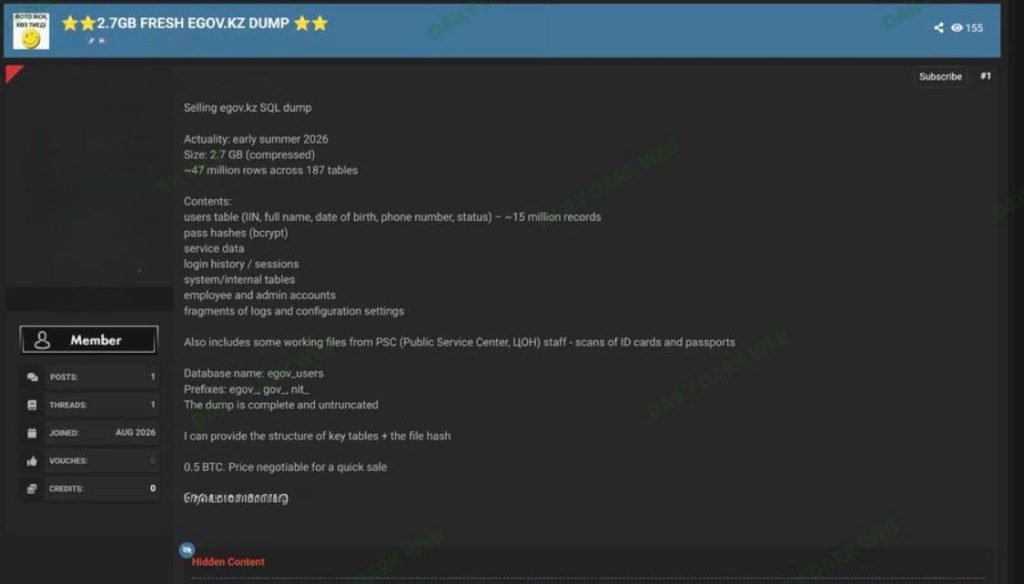
The claims originated from a post about a dark web listing. According to the seller, the information had supposedly been obtained by hacking Kazakhstan’s eGov electronic government infrastructure.
The listing claimed the database contained sensitive information such as:
- Passport details
- Phone numbers
- Addresses
- Personal data allegedly belonging to millions of citizens
However, the claim itself did not prove that eGov had been compromised.
Kazakhstan’s Ministry of Digital Development subsequently denied that its systems had been breached.
According to the ministry, specialists obtained access to the exposed files and found an assortment of unrelated files and images rather than evidence of data extracted from eGov infrastructure.
Why experts questioned the claim
GFCN analysts also examined the incident and identified several details that raised doubts about the authenticity of the alleged leak.
According to their assessment, the account behind the listing had only been registered in August 2026. The complete dataset was not publicly demonstrated, while the seller’s reference to eGov was presented without independent evidence confirming its origin.
One possible explanation is that previously leaked information was compiled into a new dataset and given a high-profile label to increase its perceived value.
For a seller, attaching the name of a major government platform to an archive can make an otherwise questionable dataset appear more valuable to potential buyers.
How scammers build a viral headline
Ilya Rybin points to the vocabulary used in such listings as one of the first warning signs.
Terms such as “state database,” “millions of citizens” and “passports” immediately increase the perceived scale of an incident.
In effect, the seller can create a ready-made sensational headline before journalists even begin reporting on the claim.
The more alarming the description appears, the greater the likelihood that it will spread through social networks, messaging platforms and media publications.
How the media can amplify an unverified claim
According to Rybin, media coverage can unintentionally become part of the mechanism that gives such claims credibility.
Once multiple publications report that a major government database has supposedly been compromised, audiences — and even potential buyers of the data — may begin treating the allegation as an established fact.
If the objective is financial, publicity can increase the perceived value of the alleged database.
If the objective is to cause panic or undermine trust in public digital infrastructure, widespread reposting can produce a similar benefit for the original source.
The distinction between a confirmed breach and an anonymous claim about a breach therefore becomes critical.
Rybin argues that a headline stating that hackers breached eGov and stole the data of 15 million Kazakhstanis goes beyond the available evidence.
A more accurate formulation would make the uncertainty explicit: an unknown user claims to be selling information on 15 million people and alleges that it came from an eGov breach.
The difference is fundamental. The existence of a database — even if the database itself is genuine — does not prove how or when the information was obtained.
Red flags journalists should check
The source of the allegation is particularly important in cases involving supposed darknet leaks.
In this case, the person claiming that the database had been stolen was also the person allegedly attempting to sell it.
That creates an obvious financial incentive to exaggerate its authenticity, size or origin.
Before treating such claims as evidence of a cyberattack, fact-checkers can examine several questions:
- When was the seller’s account created?
- Does the account have a credible history?
- Has a genuine sample of the alleged database been provided?
- Has an independent cybersecurity specialist examined the data?
- Does the dataset contain information that could realistically originate from the claimed system?
- Does its structure correspond to the architecture of the allegedly compromised platform?
- Could the information have been assembled from older leaks?
A recently created account immediately claiming responsibility for a massive cyber incident should therefore be treated as a reason for additional verification rather than as confirmation.
A database does not prove a hack
One of the most important technical questions concerns the structure of the alleged leak.
If someone claims that information was extracted from a particular government system, the organization and characteristics of that data should be consistent with the system from which it supposedly originated.
A random archive of documents, photographs or previously exposed information does not by itself establish that the claimed platform was breached.
As Rybin notes, digital documents within a government system would not simply exist as an arbitrary collection of PDF scans in a hypothetical folder containing citizens’ documents.
That is why cybersecurity specialists need to examine not only what information appears in an archive, but also its metadata, structure and possible origin.
Why this case matters
The incident demonstrates how cybercrime claims can become an information-security problem even when the alleged technical breach itself has not been established.
An anonymous darknet post can be transformed into a major national story within hours. Once a dramatic claim is repeated across multiple platforms, corrections and official denials may struggle to reach the same audience.
For citizens, the key distinction is simple: a claim that millions of records are for sale is not automatically evidence that a government system has been hacked.
For the media, preserving that distinction in headlines and reporting is essential. In cybersecurity stories, words such as “claims,” “allegedly” and “unconfirmed” are not minor qualifications — they tell readers what has actually been established and what remains an assertion by an interested party.