
Abai’s Legacy Brings Kazakh and Uzbek Scholars Together

462
Arman Korzhumbayev Editor-in-Chief

Abai has once again become a focal point of cultural rapprochement. In Samarkand, Kazakh and Uzbek scholars discussed how the poet and thinker’s ideas can contribute to contemporary dialogue in Central Asia and how his legacy can be passed on to younger generations, DKNews.kz reports.

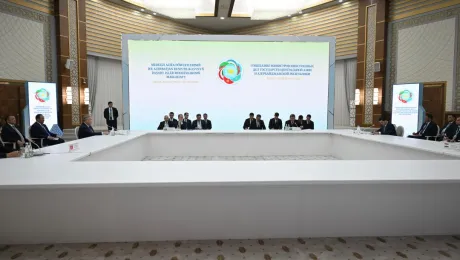
The roundtable was held at the Abai Scientific and Cultural Center at Sharaf Rashidov Samarkand State University. The event was jointly organized by the Consulate General of the Republic of Kazakhstan in Samarkand and the university.

Абай и новая эпоха Центральной Азии

Abai’s Legacy Viewed as Part of the Shared Turkic Heritage

One of the central themes of the discussion went beyond the boundaries of national literature. Participants emphasized that the legacy of Abai Kunanbaiuly belongs not only to Kazakh culture but to the broader Turkic world.

Абай и новая эпоха Центральной Азии

Researchers highlighted how Abai’s worldview was shaped at the intersection of steppe traditions, Eastern philosophy and world classics.

His intellectual world encompassed the works of Navoi, Ferdowsi and Nizami, while the writings of Pushkin, Lermontov and Goethe entered the Kazakh cultural space through Abai’s translations.

His ability to connect different literary and philosophical traditions became one of the key subjects of discussion in Samarkand.

Абай и новая эпоха Центральной Азии

Scholars Discuss Kazakh-Uzbek Literary Ties

Participants included Akmal Akhatov, Vice-Rector of Samarkand State University, prominent Uzbek poet, prose writer, journalist, statesman and public figure Farmon Toshev, as well as professors and researchers from the Institute of Turkology and specialized academic departments.

The discussion covered Kazakh-Uzbek linguistic and literary ties, scholarly interpretations of Abai’s works and the relevance of his ideas to the contemporary cultural environment.

A separate practical focus was placed on initiatives aimed at promoting Abai’s legacy among young people, researchers and wider audiences.

Абай и новая эпоха Центральной Азии

Abai’s Ideas on Work and Morality Remain Relevant

Participants highlighted Abai’s reflections on morality, work and mutual respect between peoples.

Against the backdrop of strengthening cooperation in Central Asia, these ideas have gained renewed relevance: literary heritage is being considered not only as a subject of philological research but also as an instrument of intercultural dialogue.

For Kazakhstan and Uzbekistan, this format provides an opportunity to deepen humanitarian ties through universities, research centers and direct exchanges between scholars from the two countries.

Абай и новая эпоха Центральной Азии

Abai Center in Samarkand Becomes a Platform for Academic Dialogue

Talgat Sharipov, Consul General of the Republic of Kazakhstan in Samarkand, delivered welcoming remarks at the event.

He expressed gratitude to Sharaf Rashidov Samarkand State University and its Rector Rustam Khalmuradov for organizing the roundtable and supporting the development of Kazakh-Uzbek intercultural ties.

Абай и новая эпоха Центральной Азии

Sharipov stressed that Abai’s works continue to retain their relevance and provide intellectual guidance for social, cultural and spiritual life.

The roundtable also demonstrated another role of the Abai Center in Samarkand: the Kazakh thinker’s legacy is discussed there not merely as a commemorative symbol, but as a living subject of academic research and cultural exchange.

Earlier, we reported how, at an international conference in Uzbekistan, Abai was described as a bridge between East and West.

DKNews International News Agency is registered with the Ministry of Culture and Information of the Republic of Kazakhstan. Registration certificate No. 10484-AA issued on January 20, 2010.

Как разместить агитационные материалы политическим партиям на DKNews.kz

Theme
Autoreload
МИА «DKnews.kz» © 2006 -