


AI money is flowing into infrastructure. While the market debates which new model or chatbot is smarter, the clearest profits are going to companies selling chips, memory, networking equipment, cooling systems and the power infrastructure needed to run massive computing workloads, DKNews.kz reports.
That is the conclusion of Tural Aliyev, an analyst at Freedom Finance Global. In his August 20, 2026 review, he examines the full AI value chain — from NVIDIA and TSMC to Microsoft, OpenAI, data centers and energy infrastructure.
“The best-known AI products have not yet become its most profitable businesses,” Tural Aliyev writes.
NVIDIA Gets Paid Before Most of the Market
At the top of today’s AI value chain are the companies supplying computing hardware.
For NVIDIA, the AI accelerator market has already become a mature, high-margin business. For its customers, the economics are much more complicated: after buying the chips, they still have to pay for data-center buildings, networking equipment, cooling and electricity.
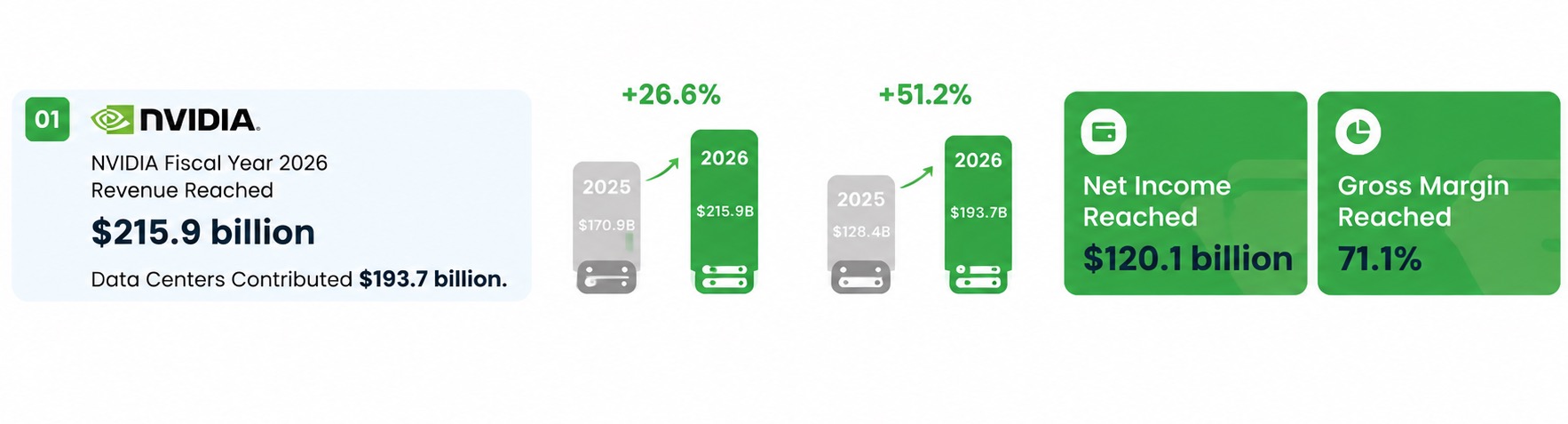
NVIDIA’s advantage is not based on demand for GPUs alone. Its accelerators work alongside networking equipment, software libraries and the CUDA platform.
A customer can technically switch suppliers. In practice, that means rebuilding part of the software environment and reconfiguring workloads.
Another factor is the rise of reasoning models. In the past, the heaviest computing burden came from model training. Now inference itself is becoming expensive: a single complex answer can require substantially more compute.
TSMC Does Not Need to Guess Which Chip Will Win
TSMC occupies a different position.
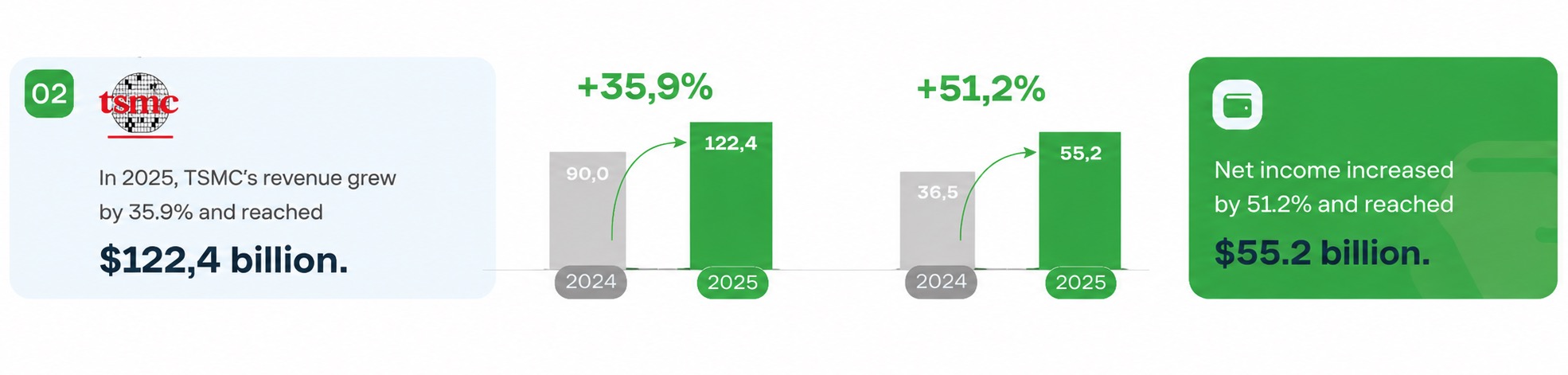
The company does not have to bet exclusively on NVIDIA. It manufactures chips both for the current accelerator leader and for companies trying to replace general-purpose GPUs with their own custom silicon.
That means even if large cloud platforms move toward proprietary accelerators, TSMC may remain firmly inside the revenue chain.
A significant share of those processors will still need to be physically manufactured by contract chipmakers.
Broadcom benefits from the same trend from another angle: cloud giants are ordering specialized solutions to reduce dependence on universal accelerators.
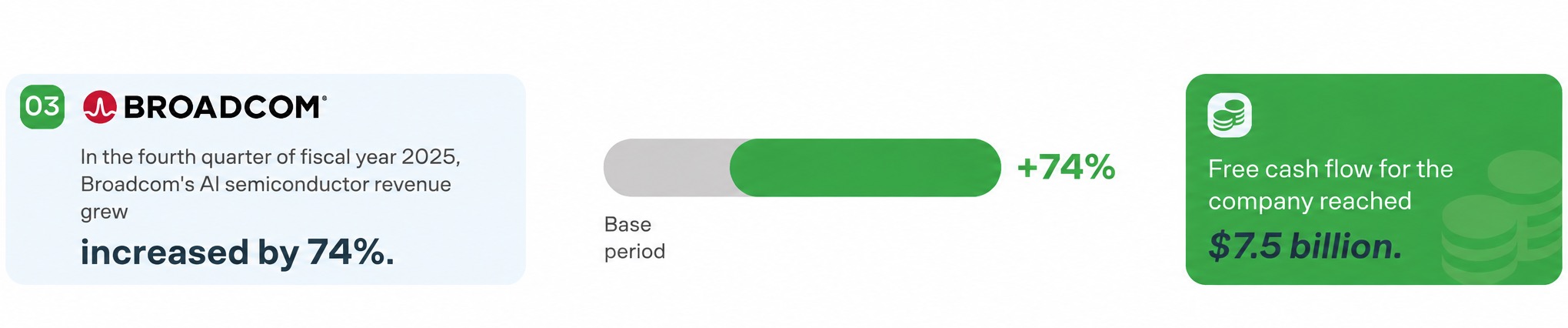
Competition between chips has not made AI infrastructure cheap. It has simply increased the number of suppliers that cloud companies are willing to pay.
The Biggest Risk for Hardware Is a Turn in the Cycle
Today’s boom does not guarantee permanent shortages.
When capacity is scarce, customers book production well in advance and may order more than they ultimately need. Once supply catches up with demand, some of those orders can disappear and pricing can come under pressure.
NVIDIA is better protected than many traditional semiconductor companies because of its software ecosystem.
But even NVIDIA depends on one condition: cloud providers must keep building infrastructure fast enough for customers to monetize expensive equipment before it becomes obsolete.
Memory Has Become Another Winner of the AI Race
Demand for accelerators has pulled neighboring components higher as well.
According to figures cited by Aliyev, Micron’s revenue from HBM, high-capacity DIMMs and server LP DRAM reached $10 billion in fiscal 2025, rising more than fivefold.
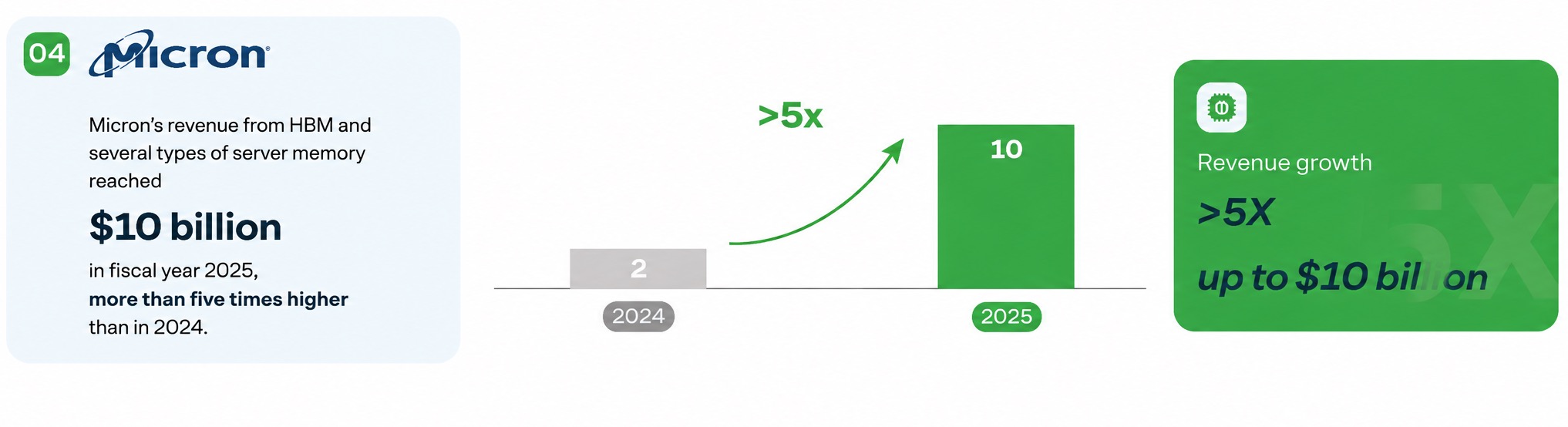
The reason lies in the architecture of modern AI systems.
Models constantly move huge volumes of data between processors and memory. If memory is too slow, an expensive accelerator sits idle. That makes it difficult to cut costs on this part of the system.
Arista, Vertiv and Eaton Can Profit Without Building a Chatbot
The next layer of the AI market is far less visible to ordinary users.
Arista sells networking infrastructure. Vertiv builds power and cooling systems. Eaton supplies electrical equipment.
These companies do not need to release their own language model to benefit from the AI boom.
According to the analyst, GE Vernova received more than $2 billion in direct data-center orders, three times the level recorded a year earlier.
Here, revenue is not tied to the popularity of a particular chatbot. It depends on something simpler: how many new computing sites are being built.
Data Centers Could Need About 945 TWh by 2030
Electricity is becoming one of the hardest constraints.
Citing the International Energy Agency, Aliyev notes that global electricity consumption by data centers could rise from 415 TWh in 2024 to about 945 TWh by 2030.
That is more than a doubling in six years.
The problem is not whether the world has enough electricity in aggregate. Power has to be available in the specific location where a data center is being built, together with grid access, substations and transmission capacity.
In heavily loaded regions, a ready connection to the power grid is becoming almost as valuable as a good piece of land.
There is also a fundamental difference between servers and energy infrastructure. An accelerator may be replaced by a new generation after a few years, while a substation, transmission line or cooling system can support several generations of computing hardware.
Microsoft Is Already Counting AI Revenue in the Tens of Billions
Cloud giants are also monetizing AI quickly, but they sit on the other side of the infrastructure contracts.
According to the review, the annualized revenue run rate of Microsoft’s AI business exceeded $37 billion in the third quarter of 2026.
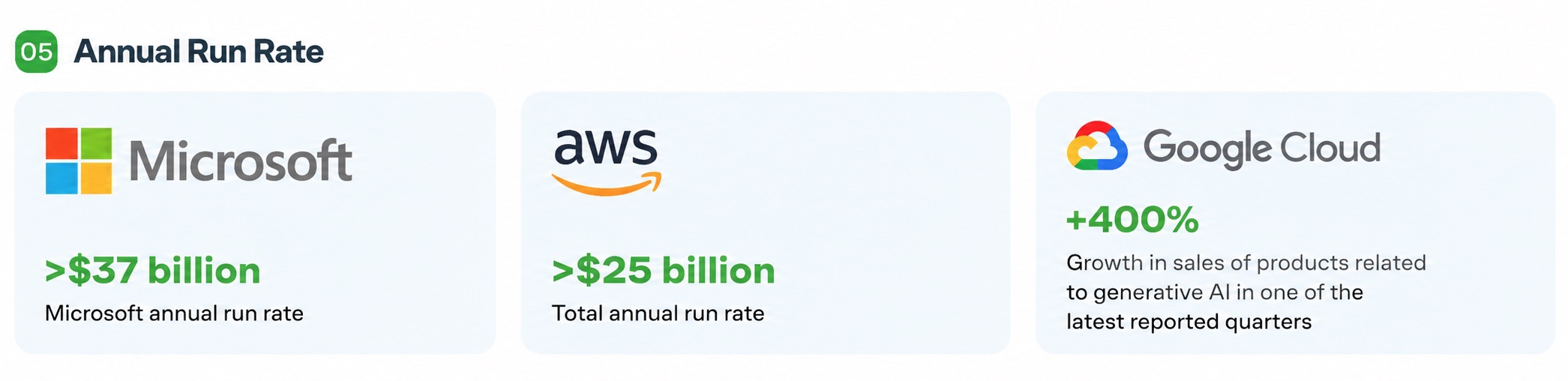
Amazon said in the second quarter that the annualized run rate of its in-house chip business, including Graviton, Trainium and Nitro, had exceeded $25 billion. Sales of Google Cloud products linked to generative AI grew by nearly 400% in one of its recent reporting quarters.
The numbers are enormous. So are the costs required to generate them.
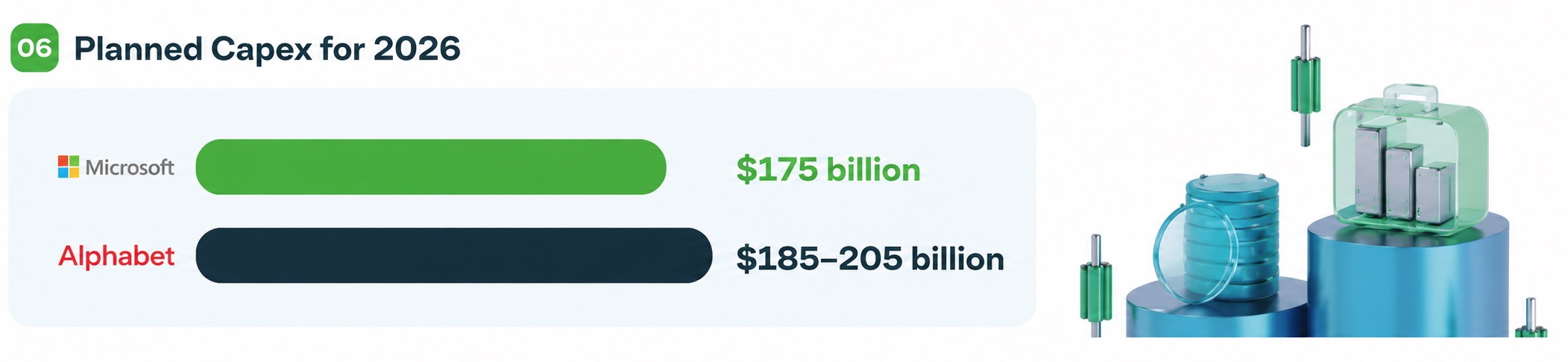
Cloud companies have to build data centers in advance because power connections, construction and equipment installation can take years.
That creates an uncomfortable trade-off: build too little and lose customers, or build too much and end up with expensive GPUs sitting idle.
An Idle Accelerator Is Still Expensive Metal
For cloud businesses, utilization is the key metric.
A data center where customers are queuing for compute can justify very large upfront investments.
Idle accelerators, by contrast, continue to depreciate even when they are not generating corresponding revenue.
Rapid hardware turnover creates another risk. A new generation of chips may perform the same task at a much lower cost per unit of compute, forcing owners of older equipment to cut prices or move those machines to simpler workloads.
How long a server can remain economically competitive will determine the real return on billions of dollars invested by cloud platforms.
Amazon, Google and Microsoft Are Designing Their Own Chips
The largest cloud companies are trying to reduce infrastructure costs themselves.
Amazon, Google and Microsoft are developing proprietary processors. At their scale, this can reduce dependence on external suppliers.
But an in-house chip is not free.
Companies take on design costs, software-support expenses and the risk that specialized hardware will not be fully utilized. Custom accelerators work best when there is a massive flow of similar workloads.
For smaller customers, a general-purpose platform often remains simpler.
OpenAI and Anthropic Created Demand, but Their Margins Still Need Proof
The economics are even more complicated for AI model developers.
Revenue at OpenAI and Anthropic is growing, but so are spending on model training, researchers and serving user requests.
Free users help products spread quickly, yet every query still consumes compute.
That creates an unusual economic structure: a massive user base can be both a competitive advantage and a major cost center.
Even cheaper inference does not automatically solve the problem. As each query becomes less expensive, users begin to use longer context windows, reasoning modes and AI agents more intensively.
One task turns into a chain of model calls. The cost of each unit of compute falls, but the number of computations rises.
Money Can Circulate Inside the Same AI Investment Cycle
Aliyev also highlights the issue of circular financing.
A hardware supplier invests in a model developer. The model developer buys capacity from a cloud provider. The cloud provider orders more accelerators.
The sales are real, but some of the capital keeps circulating inside the same investment ecosystem.
The real test will come when an independent end customer can show that spending on AI is being repaid by profits generated in its core business.
Accenture Generated $2.7 Billion From Generative AI
Money is also beginning to appear at the application layer.
Accenture generated $2.7 billion in revenue from generative and agentic AI in fiscal 2025, while new bookings reached $5.9 billion.
Palantir doubled its U.S. commercial revenue, while recurring revenue from Salesforce Agentforce exceeded $1 billion.
But the analyst cautions against adding these figures together mechanically.
A single enterprise AI project may appear simultaneously in the revenue of a cloud provider, a software vendor and an implementation consultant. Each may describe the revenue as AI-related.
For investors, a more useful question is whether AI allowed the company to raise prices, bring in new customers or materially cut costs.
Higher Productivity Does Not Automatically Mean Higher Profit
Laboratory and applied studies show sizeable productivity gains.
Citing the Stanford AI Index, Aliyev points to gains of around 14–15% in customer support, 26% in software development and up to 50% in certain marketing tasks.
At the company level, however, the picture is much more modest.
According to McKinsey data cited in the review, only around 6% of organizations simultaneously linked AI to more than 5% of earnings before interest and taxes and reported meaningful value from the technology.
The challenge is converting saved time into money.
If an employee completes the same work faster but the company does not change processes, workloads or its cost structure, higher productivity does not automatically become additional profit.
Infrastructure Suppliers Are Still the Clearest AI Winners
The clearest economics today exist where the customer pays before it has made any money from AI itself.
“Today, NVIDIA, TSMC and Broadcom are making the most money from AI,” Tural Aliyev concludes.
They are followed by suppliers of memory, networking equipment, power systems, cooling technologies and energy infrastructure.
Cloud platforms are already generating billions of dollars in AI-related revenue, but they are simultaneously funding enormous infrastructure expansion. Model developers created demand across the entire chain, yet they still have to prove that their margins can remain sustainable.
For investors, the dividing line is fairly clear: suppliers of scarce infrastructure get paid when they deliver the equipment, while a large part of the rest of the market is still paying today for the possibility of earning from AI later.
We previously looked at why AI infrastructure has become one of the key trends shaping the global economy.