

Autumn is reshaping investors’ priorities. Globally, artificial intelligence and data-center spending remain dominant themes, while in Kazakhstan the focus is shifting toward dividends, commodity prices and pressure on banks from high interest rates, передает DKNews.kz.
Freedom Finance Global analysts outlined this split in their Autumn 2026 investment outlook, covering opportunities from major technology companies to financial, pharmaceutical, consumer, defense and energy businesses.
Microsoft, NVIDIA and Alphabet remain at the center of the AI trade
Artificial intelligence continues to dominate the global investment agenda.
Companies are increasing spending on data centers, computing capacity and proprietary AI solutions. That means the investment opportunity is no longer limited to developers of AI models themselves: chipmakers, cloud platforms and infrastructure providers are becoming an increasingly important part of the same cycle.
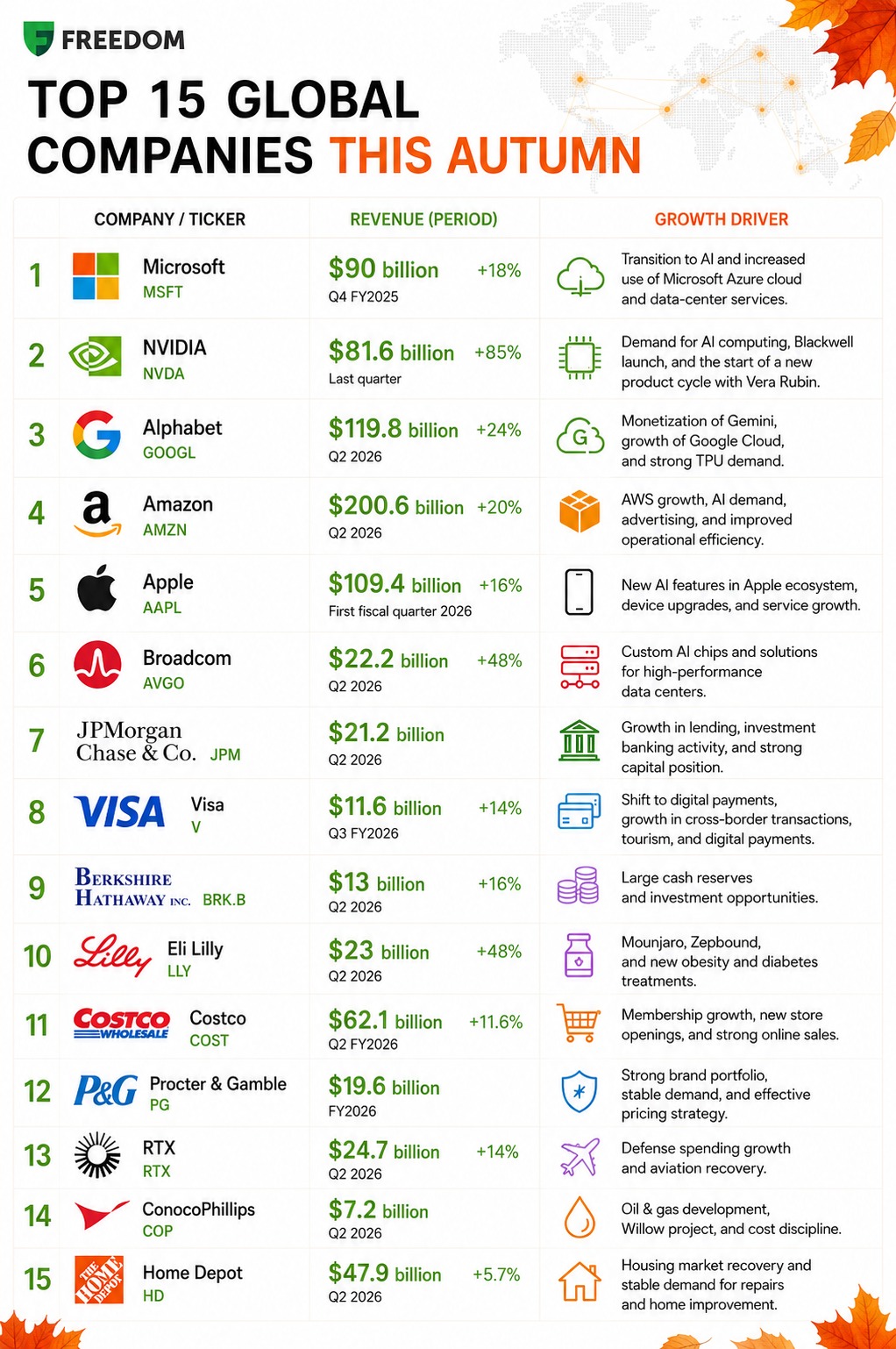
Among the 15 global companies highlighted in the Freedom Broker autumn selection are Microsoft, NVIDIA, Alphabet, Amazon, Apple and Broadcom.
Microsoft leads the list. The accompanying analysis puts the company’s revenue at $90 billion, up 18%, with everyday AI adoption, Azure and data-center expansion among the key drivers.
NVIDIA ranks second. Its latest quarterly revenue is shown at $81.6 billion, up 85%, with demand for AI computing, the Blackwell platform and the next Vera Rubin product cycle supporting the case.
Alphabet follows with revenue of $119.8 billion, representing growth of 24%. Gemini monetization, Google Cloud, proprietary TPUs and YouTube are highlighted among the company’s main growth engines.
The broader point is that the AI boom is moving far beyond chatbots. More computing requires more chips, servers, networking equipment, cloud infrastructure and electricity.
Amazon, Apple and Broadcom are also riding the infrastructure cycle
Amazon ranks fourth in the global selection, with revenue of $200.6 billion and growth of 20%.
Its investment case is tied to AWS, rising demand for AI computing and improving efficiency in advertising and logistics.
Apple is fifth. Revenue is shown at $109.4 billion, up 16%, while investors are watching the introduction of new AI capabilities across Apple’s ecosystem, the device replacement cycle and continued services growth.
For Broadcom, revenue is listed at $22.2 billion, with growth of 48%. The company is positioned to benefit from demand for custom AI chips and high-speed networking infrastructure.
Freedom Broker’s broader research coverage of global markets also reflects how investor attention has expanded from AI software toward the companies supplying the infrastructure required to run it.
JPMorgan, Visa and Berkshire offer an alternative to Big Tech
Not every autumn investment idea depends on artificial intelligence.
JPMorgan Chase is seventh in the selection. Its quarterly net income is listed at $21.2 billion, with lending, a recovery in investment banking and asset management among the drivers.
For Visa, the story is the continued shift toward digital payments, growth in travel and expansion of cross-border transactions. Revenue is shown at $11.6 billion, up 14%.
Berkshire Hathaway ranks ninth, with analysts pointing to its large cash reserves and ability to deploy capital when attractive opportunities emerge.
The selection therefore gives investors exposure not only to technological growth but also to businesses built around payments, banking and durable cash flows.
Eli Lilly, Costco and Procter & Gamble add defensive exposure
Healthcare is represented by Eli Lilly.
The company’s revenue is listed at $23 billion, up 48%, with Mounjaro, Zepbound and the broader obesity and diabetes treatment market driving growth.
Costco benefits from membership growth, new warehouse openings and expanding online sales. Revenue is shown at $62.1 billion, an increase of 11.6%.
For Procter & Gamble, the investment argument rests on strong brands, resilient consumer demand and cash generation that supports shareholder distributions.
This is why the Freedom Broker autumn outlook is broader than a simple bet on AI: it combines high-growth technology with businesses that may prove more resilient if market volatility increases.
RTX, ConocoPhillips and Home Depot complete the top 15
Defense and aerospace company RTX reported revenue of $24.7 billion, up 14% in the figures included in the autumn selection.
Higher defense spending and the recovery of commercial aviation are cited as the main drivers.
ConocoPhillips provides exposure to the oil and gas sector, with LNG projects, the Willow development and a portfolio of relatively low-cost assets supporting the investment thesis.
The list closes with Home Depot, where revenue is shown at $47.9 billion, up 5.7%. A recovery in the US housing market and resilient demand for home-improvement products could provide additional support.
The 15 global stocks in focus this autumn
Freedom Broker’s global selection includes:
- Microsoft
- NVIDIA
- Alphabet
- Amazon
- Apple
- Broadcom
- JPMorgan Chase
- Visa
- Berkshire Hathaway
- Eli Lilly
- Costco
- Procter & Gamble
- RTX
- ConocoPhillips
- Home Depot
The structure of the list reflects the market’s current logic: AI remains a major growth engine, but investors are also looking at payments, healthcare, consumer spending, energy and defense.
Kazakhstan’s biggest autumn theme is dividends
Kazakhstan enters the season with a very different set of drivers.
According to Freedom Finance Global analyst Daniyar Orazbayev, the local market will be shaped by dividend season, commodity-price dynamics and changing conditions for the banking sector.
Second-quarter 2026 results have produced a mixed picture.
Oil and gas companies and infrastructure businesses continue to show strong financial results, while banks face pressure from the high base rate, tighter reserve requirements and a heavier tax burden.
The local market nevertheless entered the second half of the year from a stronger base. According to KASE’s official first-half 2026 results, the KASE Index rose 9.7% from the beginning of the year, while stock-market capitalization increased 21.9% to KZT 47.6 trillion.
Halyk Bank’s dividend yield has reached 15%
Despite pressure on the banking sector, Halyk Bank stands out as one of the clearest dividend stories.
The Freedom Finance Global material says the bank is making a second dividend payment this year, taking dividend yield to around 15%, described in the report as the highest level on KASE.
The latest distribution has already been approved. According to the official KASE disclosure on Halyk Bank, shareholders approved a dividend of KZT 28.09 per common share, with payment scheduled to begin on September 7.
That creates an unusual combination for investors: profitability faces regulatory and tax pressure, but substantial cash distributions continue to support the appeal of the shares.
Kaspi.kz faces the Hepsiburada challenge
Kaspi.kz presents a different case.
Its results have been affected by losses at Turkish marketplace Hepsiburada, while the company has also proposed raising its dividend to KZT 1,000 per ADS.
The figure is described as a record level in the Freedom Broker material.
However, the distinction between a proposed and approved dividend matters. According to Kaspi.kz’s official shareholder meeting notice filed with the SEC, the board recommended a KZT 1,000 distribution, with shareholders due to consider the proposal at the September 9 meeting.
For investors, Hepsiburada’s performance therefore remains an important factor alongside the appeal of higher shareholder payouts.
KEGOC’s dividend could rise to KZT 100 per share
KEGOC is another major dividend idea for the autumn.
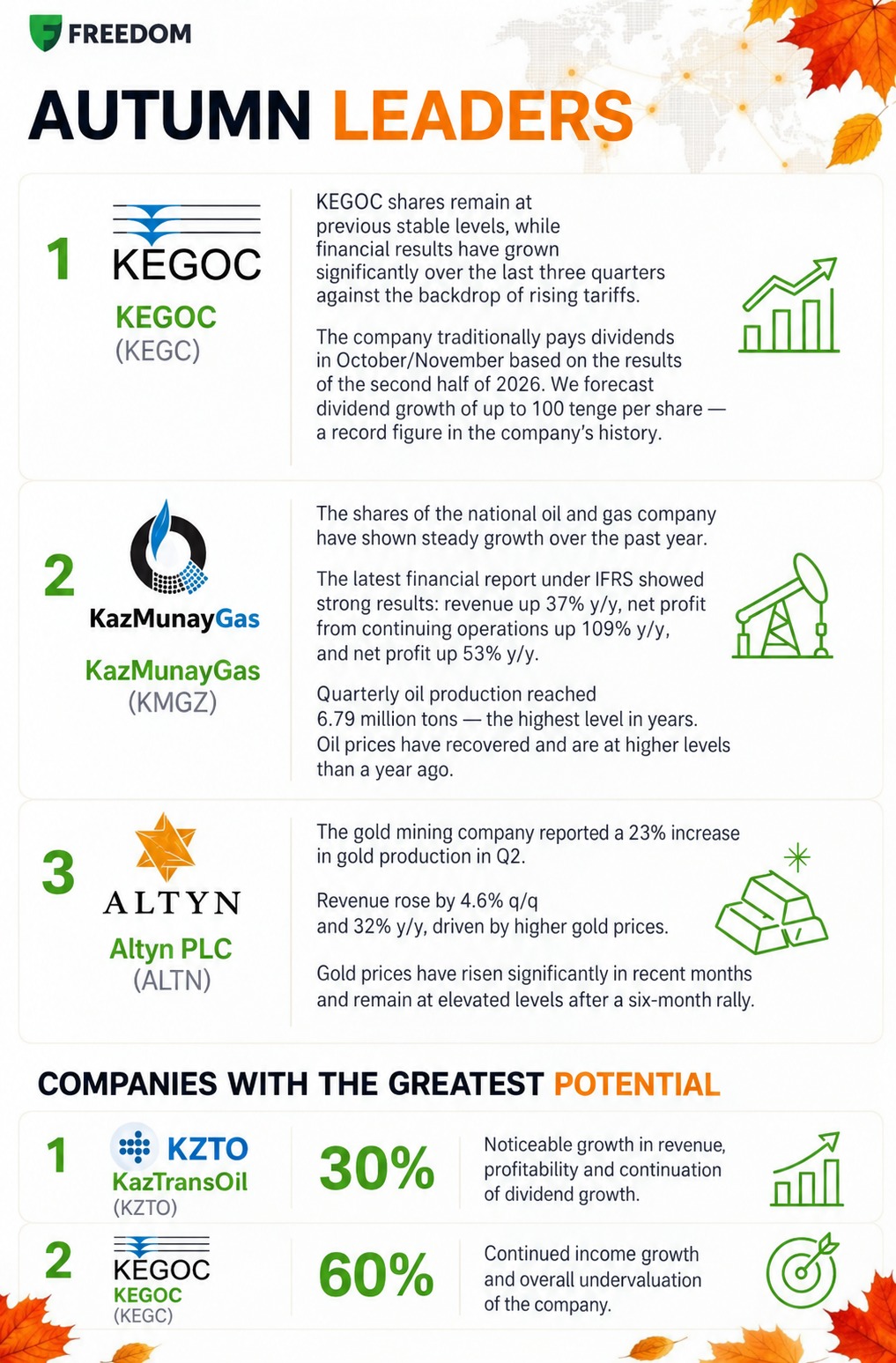
The company traditionally distributes dividends twice a year, and Freedom Finance Global analysts expect the next payment could increase to as much as KZT 100 per share, compared with roughly KZT 80 previously.
That remains a forecast rather than an approved payment.
For comparison, KASE’s official disclosure on KEGOC dividends shows that the company approved KZT 81 per share for the second half of 2025, for a total distribution of almost KZT 22.3 billion.
For income-focused investors, the next corporate decision will therefore be one of the key local market events to watch.
KazMunayGas is relying on strong financial performance
KazMunayGas is also among the local names highlighted for autumn.
Its latest financial results show why. According to the company’s first-half 2026 results published through KASE, revenue reached KZT 5.568 trillion, EBITDA was KZT 1.655 trillion, and net profit adjusted for the company’s share in joint ventures and associates reached KZT 904 billion.
Oil prices remain one of the company’s main external drivers.
Strong commodity prices can support revenue and profitability, but the investment case remains exposed to the volatility of the global energy market.
KazTransOil’s net profit rose 33.4%
Another local company drawing attention is KazTransOil.
According to KASE’s publication of its first-half 2026 results, consolidated revenue increased 10.28% to almost KZT 180 billion.
Consolidated net profit rose 33.4% to KZT 29.4 billion.
The Freedom Broker infographic assigns 30% potential to KazTransOil. That figure should be understood as an analyst estimate rather than a guaranteed return.
KEGOC is assigned 60% potential
The same autumn infographic assigns 60% potential to KEGOC.
The argument is linked to further revenue growth and the company’s valuation.
As with any analyst target, the estimate depends on financial results, market rates, corporate decisions and investor risk appetite. Official company disclosures and previous dividend decisions can be tracked through KEGOC information published by KASE.
Kazatomprom’s profit fell 8% despite stronger uranium prices
The uranium market provides one of the clearest examples of why a rising commodity price does not always translate into higher corporate earnings.
According to Freedom Finance Global, Kazatomprom’s net profit declined by 8% year on year.
Higher production costs following a tax-rate increase and foreign-exchange losses caused by the stronger tenge weighed on the result. Higher dollar-denominated uranium prices only offset those negative factors.
The currency effect is also visible in Kazatomprom’s own 2026 financial reporting, where exchange-rate movements and sales volumes are among the factors affecting performance.
Meanwhile, the company’s first-quarter 2026 operating update showed that the average uranium spot price had increased significantly year on year.
For investors, the lesson is practical: uranium prices matter, but so do taxes, production costs and the tenge-dollar exchange rate.
Autumn offers no single winning trade
Globally, AI infrastructure remains one of the strongest themes, putting Microsoft, NVIDIA, Alphabet, Amazon and Broadcom in focus.
But the top 15 also includes Visa, JPMorgan, Eli Lilly, Costco, RTX and ConocoPhillips — companies whose earnings depend on very different economic drivers.
Kazakhstan tells another story. Here, dividends, pressure on banks, oil and uranium prices and actual corporate earnings are likely to matter more.
Freedom Broker analysts favor companies with strong financial performance, resilient business models and clear growth drivers, while paying particular attention to dividend potential.
We previously looked at the key investment ideas for the summer of 2026, when AI infrastructure, energy demand and dividend-paying Kazakhstan companies were already emerging as major themes.
This autumn, those ideas will face a more concrete test: Kaspi.kz’s proposed KZT 1,000 dividend, Halyk Bank’s 15% dividend yield, expectations of up to KZT 100 per share from KEGOC and Kazatomprom’s ability to offset rising costs will be among the figures investors watch most closely.