


Apple remains the profit leader.
But the financial results of the three technology giants show that smartphone sales alone no longer reveal which company has the strongest business model, DKNews.kz reports.
Apple turns iPhone owners into long-term users of its services ecosystem. Samsung earns money not only from Galaxy devices, but also from semiconductors and displays. Xiaomi, meanwhile, is rapidly expanding into electric vehicles and artificial intelligence.
This difference in strategy is examined in an analysis by Freedom Broker. Kazakhstan offers an especially interesting case, as Apple devices have a significantly stronger position there than the global average.
Apple posted $112 billion in net income
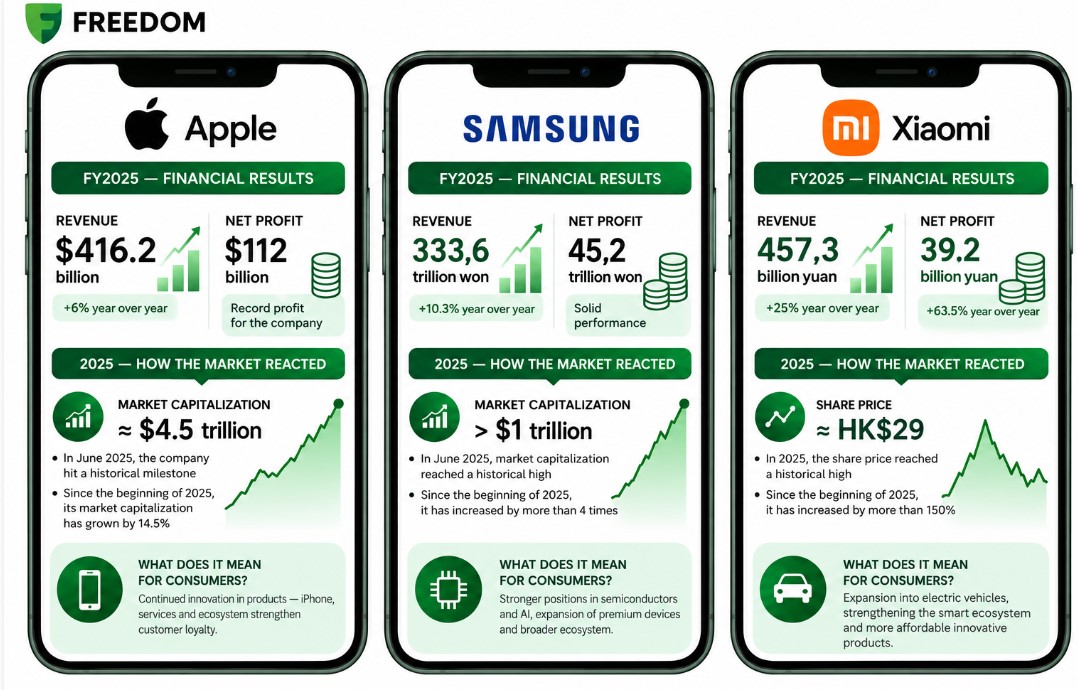
Apple generated $416.2 billion in revenue in fiscal 2025, while net income reached $112 billion.
The iPhone remained the company’s largest source of revenue, generating approximately $209.6 billion.
Apple’s services business contributed another $109.2 billion. This segment includes digital products and services tied to the company’s ecosystem, such as the App Store, iCloud and subscriptions.
That structure helps explain Apple’s financial strength.
The company does not stop earning from a customer once an iPhone has been sold. The device continues to serve as a gateway to paid services and other products within the Apple ecosystem.
For Apple, customer loyalty therefore has a direct financial value. The longer users remain inside its ecosystem, the less the company has to rely solely on the next smartphone replacement cycle.
Samsung earned 45.2 trillion won in net profit
Samsung Electronics operates a much broader business model.
Its Galaxy smartphones compete directly with Apple and Xiaomi, but mobile devices represent only one part of the company’s operations.
In 2025, Samsung reported 333.6 trillion won in revenue, with 45.2 trillion won in net profit and 43.6 trillion won in operating profit.
Samsung also manufactures memory chips, processors, displays and other components used across the global electronics industry.
Its Device Solutions division recorded approximately 130.1 trillion won in sales in 2025, up 17.2% year on year.
This gives Samsung exposure to several markets at once. It competes for consumers buying Galaxy smartphones while also supplying components needed by electronics manufacturers and the rapidly expanding AI infrastructure industry.
Rising demand for memory and semiconductors used in artificial intelligence systems has made this side of Samsung’s business increasingly important.
Xiaomi increased revenue by 25%
Xiaomi remains considerably smaller than Apple and Samsung in financial terms, but its business is changing at a much faster pace.
In 2025, Xiaomi’s revenue increased 25% to 457.3 billion yuan.
Adjusted net profit reached 39.2 billion yuan, up 43.8% from the previous year. This is a non-IFRS figure, so it should not be compared directly with the reported net income of Apple or Samsung.
Smartphones and AIoT products remain Xiaomi’s largest business segment, generating 351.2 billion yuan in revenue.
But the fastest growth is coming from elsewhere.
Revenue from electric vehicles, AI and other new initiatives surged 223.8% to 106.1 billion yuan.
Xiaomi also reported deliveries of 411,082 electric vehicles in 2025.
That marks a significant shift in the company’s business. Smartphones remain its core product, but an increasingly large share of future growth is tied to cars, AI and other technology businesses.
Apple accounts for 46.7% of mobile web traffic in Kazakhstan
Kazakhstan stands out from the global market.
According to Statcounter GlobalStats data cited in the Freedom Broker analysis, Apple devices accounted for 46.7% of mobile internet traffic in Kazakhstan in July 2026.
Samsung followed with 18.7%, while Xiaomi accounted for 14.6%.
Apple’s global average during the same period was around 32%.
These figures refer to mobile web traffic by device brand, not smartphone sales, so they should not be interpreted as retail market-share data.
“The situation in Kazakhstan differs noticeably from the global average. According to Statcounter GlobalStats, Apple devices accounted for 46.7% of mobile internet traffic in the country in July 2026, compared with a global average of around 32%. Samsung followed with 18.7%, while Xiaomi had 14.6%. Apple therefore holds an especially strong position in Kazakhstan, significantly ahead of its closest competitors. Other notable brands include Oppo at around 4.4% and vivo at 3.1%,” said Aliyar Akymgaliyev, analyst at Freedom Finance Global.
On this metric, Apple’s share in Kazakhstan is more than twice Samsung’s and more than three times Xiaomi’s.
The smartphone is becoming a gateway to an ecosystem
Competition among smartphone makers is no longer limited to cameras, processors or display size.
Consumers now use their phones for payments, banking, shopping, transportation, entertainment and a growing range of everyday services.
The more activity users conduct within one digital ecosystem, the more valuable they become to the company operating it.
A similar trend is developing in Kazakhstan. As noted in the Freedom Broker analysis, Freedom Mobile is developing mobile connectivity services, while Freedom SuperApp brings financial and everyday digital services together in a single application.
For technology companies, the commercial relationship therefore continues long after the smartphone itself has been purchased.
The key question is increasingly not only which device a customer buys, but which ecosystem they continue using for years afterward.
So which company makes the most money?
Based on reported net income, Apple is the clear financial leader among the three companies.
It earned $112 billion in net income in fiscal 2025, while its services business alone generated more than $109 billion in revenue.
Samsung follows a more diversified strategy, earning money from smartphones as well as memory chips, semiconductors, displays and other electronics.
Xiaomi remains smaller in scale, but its growth trajectory is different. Electric vehicles, AI and other new businesses already generated more than 100 billion yuan in annual revenue.
For consumers, choosing between Apple, Samsung and Xiaomi may come down to price, camera quality or screen size.
For investors, the comparison is very different: profitability, recurring service revenue, diversification and the ability to keep users inside an ecosystem increasingly matter more than the number of smartphones sold.
We previously examined which smartphone brands are most popular in Kazakhstan and how Apple, Samsung and Xiaomi compare in the local market.