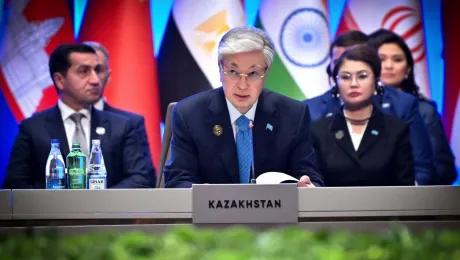

Kazakhstan is accelerating its financial shift.
The debate is no longer about whether AI agents, blockchain and digital assets will enter mainstream finance, but about how quickly regulators and the market are prepared to integrate them into the existing system, DKNews.kz reports.
That question dominated the “Transformation of Financial Architecture” plenary session at Astana Finance Days 2026, bringing together policymakers, financial executives and global technology leaders.
Among the speakers were Timur Suleimenov, Governor of the National Bank of Kazakhstan; Renat Bekturov, Governor of the Astana International Financial Centre, or AIFC; Timur Turlov, CEO of Freedom Holding Corp.; Balaji Srinivasan, founder of Network School; and other industry figures.
AIFC asks a harder question: lead or wait?
AIFC Governor Renat Bekturov framed the issue as a question of regulatory speed and competitiveness.
He pointed to prediction markets as one example of a financial technology that is already gaining traction in the United States.
“Prediction markets, for example, are already actively developing in the United States. Are we ready to be among the first movers in adopting new technologies, or are we going to wait? And if we wait, for how long?” Bekturov said.
For Kazakhstan, this is more than a theoretical debate. Faster adoption may make the country more attractive to fintech and investment, but it also raises questions about market readiness, consumer protection and financial stability.
Bekturov said there is no universal formula.
“At the AIFC, we closely follow international experience and regulatory developments. What was only a forecast yesterday is becoming reality today. So it is important to understand which innovations can already be introduced and to find our own balance between market readiness and technological development. There is no single recipe,” he said.
Suleimenov sees digital assets as an opportunity for Kazakhstan
Timur Suleimenov, Governor of the National Bank of Kazakhstan, said blockchain, cryptocurrencies and related technologies are fundamentally reshaping financial flows.
Regulators, he argued, now have to balance traditional institutions — banks, securities markets and foreign-exchange markets — with emerging forms of crypto finance.
“For financial regulators around the world, developing new rules is a very difficult task, but at the same time it is also an opportunity. For Kazakhstan, I would say it is more of an opportunity,” Suleimenov said.
According to Suleimenov, Kazakhstan has already adopted rules covering cryptocurrency and stablecoin trading as well as asset tokenization.
He also stressed that regulation alone is not enough. The country has been building the infrastructure needed to support digital finance both within the AIFC jurisdiction and across Kazakhstan more broadly.
The unresolved issue is how to encourage innovation without weakening trust in the financial system.
“How to find the balance between financial stability, trust and current instability is a question with no single answer. So when the necessary rules do not yet exist, we need to look at principles and values and build our own framework around them,” Suleimenov said.
Stablecoins are moving beyond the experimental phase
The global digital-assets industry delivered a similar message.
Sergio Mello, Global Head of Stablecoin Solutions at Anchorage Digital, said digital assets are already being used by financial institutions in the United States, Kazakhstan and other markets.
Stablecoins, he argued, are no longer merely an experiment.
“After 10 years of experimentation, we are reaching the stage where digital assets can become a standard technology within the financial system,” Mello said.
For Kazakhstan, that changes the nature of competition.
The contest is no longer only between banks or fintech companies. Countries themselves are competing to become attractive jurisdictions for capital and international business.
Mello said the quality of regulation and infrastructure will determine whether digital-finance companies can scale or are held back.
Turlov expects AI agents to reshape financial apps
Timur Turlov, CEO of Freedom Holding Corp., shifted the discussion from infrastructure to the end user.
His argument was simple: financial services are becoming more sophisticated, but consumers should not need to become experts to use them.
“We need to teach people to consume complex services easily. Sometimes people simply do not know how to use certain services. I believe that in the future, AI agents will help people use technology properly,” Turlov said.
He suggested that AI assistants embedded in apps could explain in plain language how to use financial tools, access services or complete everyday tasks.
For banks and fintech firms, that could shift the competitive focus.
The advantage may increasingly come not from offering more functions, but from making complex services easier to understand and use.
Srinivasan links AI in finance to blockchain security
Balaji Srinivasan, founder of Network School and author of The Network State, focused on the relationship between artificial intelligence and blockchain.
He argued that the reliability of AI-driven financial systems will depend heavily on the security of the underlying infrastructure.
“Artificial intelligence is a powerful tool, but you need to give it the right prompts. I think AI will be used somewhat differently in finance. I believe a blockchain-based system could be reliable because it offers a higher level of protection,” Srinivasan said.
The broader message from the session was clear: the debate has moved beyond whether digital finance will expand.
The focus is now on which technologies can be deployed safely, at scale and within a regulatory framework that keeps pace with the market.
Capital was discussed far beyond finance
The first day of AFD 2026 later widened the conversation from financial capital to creative industries.
During a fireside chat with Renat Bekturov, internationally known Kazakh singer Dimash Qudaibergen, People’s Artist of Kazakhstan, spoke about the lack of specialists, professional management and distribution channels needed to take Kazakh creative products to international markets.
“We need to do more to develop the industry, create opportunities for talent and open the way to international markets. We need to pay more attention to management and to building a creative-industry ecosystem. We need investment, infrastructure and clear rules,” Qudaibergen said.
That message echoed the financial discussion earlier in the day.
Talent alone does not guarantee global reach. Companies, artists and technology firms also need capital, infrastructure, market access and institutions capable of connecting them with international partners.
From Kazakhstan to global markets
Renat Bekturov closed the first day with a broader vision of Kazakhstan’s place in the global economy.
He linked knowledge, entrepreneurship, investment and creative talent to the country’s ability to expand beyond its domestic market.
“We must help Kazakhstanis invest around the world, help entrepreneurs enter new markets and build international businesses, help ideas find global partners, and help talent compete on the global stage,” Bekturov said.
The immediate question for Kazakhstan’s financial sector is now practical: which of the technologies discussed at Astana Finance Days — stablecoins, tokenization, AI agents or other digital-finance tools — will be the first to move from conference debate into everyday financial services?