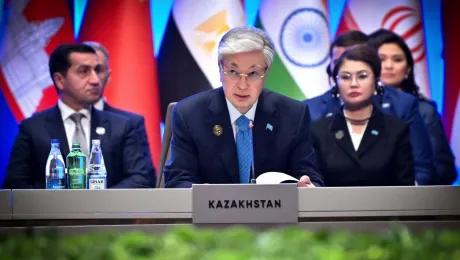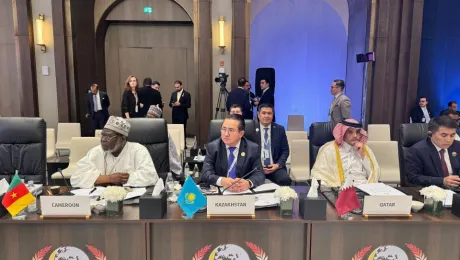


Participants of an international seminar on China’s regional development practices continued their programme in Fujian Province, combining a discussion of China’s poverty reduction experience with a field visit to Jinjiang - a city that has become one of the country’s best-known examples of private-sector development, manufacturing growth and county-level economic transformation.
One of the most striking features of China’s development experience is that theory becomes much more convincing when it can be seen in a particular city, factory or community.
This was precisely the case during the latest stage of the international seminar in Fujian.
The programme brought together two themes that may initially appear different: China’s achievements in poverty reduction and the remarkable economic transformation of Jinjiang. Yet the connection between them soon became clear. Sustainable poverty reduction requires more than financial assistance. It ultimately depends on creating an economic foundation — jobs, entrepreneurship, infrastructure and the ability of people and communities to generate development themselves.
Development rather than assistance alone
The first part of the programme focused on China’s practical achievements in poverty reduction and their potential relevance to other developing countries.
Since the beginning of reform and opening-up, more than 800 million Chinese people have been lifted out of poverty. China gradually moved beyond simply providing assistance and focused increasingly on creating conditions for sustainable, self-generated development.
A central element of this approach has been targeted poverty alleviation. Instead of treating poverty as an abstract statistical phenomenon, policies were designed to identify individual households, understand the specific causes of their difficulties and provide corresponding solutions — whether through education, healthcare, housing, professional training, infrastructure or support for local industries.
Chinese development literature often describes this transition metaphorically as moving from a “blood transfusion” to “blood production”: from dependence on continuing assistance to the ability of communities to generate sustainable growth themselves.
This helps explain why China’s poverty reduction campaign should not be viewed purely as a social welfare programme. In many respects, it was also a development programme.
Jinjiang: where theory becomes visible
The seminar participants then travelled to Jinjiang. Here, many of the ideas discussed earlier could be observed in practice.
Today Jinjiang is associated with well-known Chinese brands such as Anta, Xtep, 361° and Septwolves, along with a broad ecosystem of private manufacturing companies.
Yet the most interesting story is not the list of famous brands. It is the trajectory that produced them.
At the beginning of China’s reform era, Jinjiang was a relatively poor agricultural county with limited land resources. Local residents began establishing small businesses and workshops. These gradually developed into industrial clusters, while local enterprises eventually grew into national and international brands.
In 1978, Jinjiang’s GDP stood at only 145 million yuan. Over the following decades, the city transformed itself into one of China’s notable centres of private-sector economic activity.
Behind these figures lies a much broader question: why do some regions successfully transform their opportunities into long-term economic growth while others remain on the margins of development?
In Jinjiang, much of the answer is associated with what became known as the “Jinjiang Experience” — 晋江经验.
Xi Jinping’s seven research visits
The formation of this concept is closely connected with Xi Jinping’s years of work in Fujian Province.
Between 1996 and 2002, Xi made seven research visits to Jinjiang, visiting enterprises, communities and villages and studying the forces driving the city’s economic transformation.
Photographs displayed at the Jinjiang Experience Hall, visited by seminar participants, document several stages of this process, including Xi’s visit to Chendai Township in 1996, his research into Jinjiang enterprises in 1998 and subsequent field visits.
In June 2002, while serving as Governor of Fujian Province, Xi returned to Jinjiang for another extensive research trip. After years of observation and field research, he systematised the main lessons behind Jinjiang’s development.
On August 20, 2002, the People’s Daily published his article examining the Jinjiang Experience and its implications for accelerating county-level economic development. A reproduction of that historic newspaper page is now displayed in the Jinjiang Experience Hall and was among the exhibits seen by seminar participants.
A local development story had thus become the subject of a much broader economic analysis.
Six principles that remain relevant
At the heart of the Jinjiang Experience are the well-known “Six Consistent Commitments”.
Their logic remains remarkably contemporary: the development of productive forces should remain the fundamental direction of reform and development; economic development should be market-oriented; success requires perseverance and competitive spirit; integrity is essential for the healthy functioning of a market economy; regions should build on their own comparative advantages and choose development paths suited to their conditions; and government should strengthen its guidance and services for the development of the market economy.
Alongside these principles came the need to properly manage five important relationships: between physical and intangible channels of development; between small and large enterprises; between high-tech and traditional industries; between industrialisation and urbanisation; and between the development of the market economy and the construction of a service-oriented government.
This is perhaps one of the most interesting aspects of the Jinjiang Experience. It is not about choosing between the state and the market. It is about finding an effective relationship between them.
Entrepreneurs need the freedom to create businesses and compete. Markets must determine whether companies are viable. At the same time, government remains responsible for the institutional environment, infrastructure, strategic planning and public services that enable business to develop.
From workshops to global brands
The Jinjiang Experience Hall also highlights another important characteristic of the local model — its commitment to the real economy.
Shoes. Clothing. Textiles. Food products. Building materials. At first sight, these are traditional industries.
But Jinjiang demonstrates that traditional manufacturing does not have to mean technological backwardness.
Local enterprises gradually moved from simple manufacturing to developing their own brands, research and development capabilities, digital production systems and international supply chains.
Anta offers a particularly visible example. The company has invested heavily in innovation and research while expanding the use of new materials, technologies and digital manufacturing.
Inside the Jinjiang Experience Hall, dozens of local brands are displayed together. They form a visual map of how small private businesses can gradually evolve into an industrial ecosystem.
Private enterprise as a development engine
Another important lesson from Jinjiang concerns the role of private entrepreneurship.
The logic is relatively straightforward: when businesses create products, employment and competitive manufacturing capacity, the economic environment should allow them to grow.
Over time, this approach helped create entire industrial clusters.
Private entrepreneurship here is not seen as being in conflict with broader national development objectives. On the contrary, it has become one of the instruments through which productivity, employment, technological capability and living standards can be improved.
From reducing poverty to creating opportunity
This is where the two parts of the seminar programme ultimately come together.
China’s poverty reduction experience demonstrates how public policy can help people gain access to education, healthcare, housing, infrastructure and initial development opportunities.
Jinjiang demonstrates what can happen next — when opportunity is converted into entrepreneurship, manufacturing, innovation and employment.
Poverty reduction therefore cannot end when a certain income threshold has been crossed. The more difficult task is to create an economic environment in which people are able to improve their own prosperity.
In this sense, Jinjiang is relevant far beyond China.
A lesson worth considering for Kazakhstan
There is also something here worth reflecting upon from a Kazakh perspective.
Kazakhstan faces its own challenge of strengthening regional economies, developing small and medium-sized businesses, creating new production chains and reducing the dependence of individual regions on a limited number of major employers or resource industries.
The Chinese model cannot simply be copied.
Indeed, one of the most important lessons of the Jinjiang Experience is precisely the opposite: a region should identify and develop its own advantages rather than mechanically imitate someone else’s model.
For one region of Kazakhstan, that advantage may be agricultural processing; for another, logistics, tourism, engineering, critical minerals or digital technologies.
What matters is creating an environment in which a small local manufacturer has the opportunity to become a strong company — and in which entrepreneurs understand that the state sees them not as a problem, but as partners in development.
Experience born from practice
Leaving the Jinjiang Experience Hall, one particular feature of China’s development model becomes especially clear.
Many concepts that are now discussed as elements of national development strategy were originally born not in offices but in the practical experience of individual cities, villages and enterprises.
First, people began producing shoes, clothing and food products. Then businesses emerged. Industrial clusters followed. Later came brands, research centres, digital factories and international markets.
Government studied these processes, identified mechanisms that worked and transformed successful local practices into broader development approaches.
This is why the visit to Jinjiang was a logical continuation of the seminar’s discussion on poverty reduction.
Ultimately, sustainable development is not only about distributing wealth. It is about building the capacity to create it.
And that may be one of the most important lessons of the Jinjiang Experience.