

Kazakhstan is pitching its transport infrastructure to global partners.
First Deputy Prime Minister Nurlybek Nalibayev presented projects of international importance in Beijing as Astana seeks to expand cargo flows with China and strengthen the Trans-Caspian route linking Asia and Europe, DKNews.kz reports.
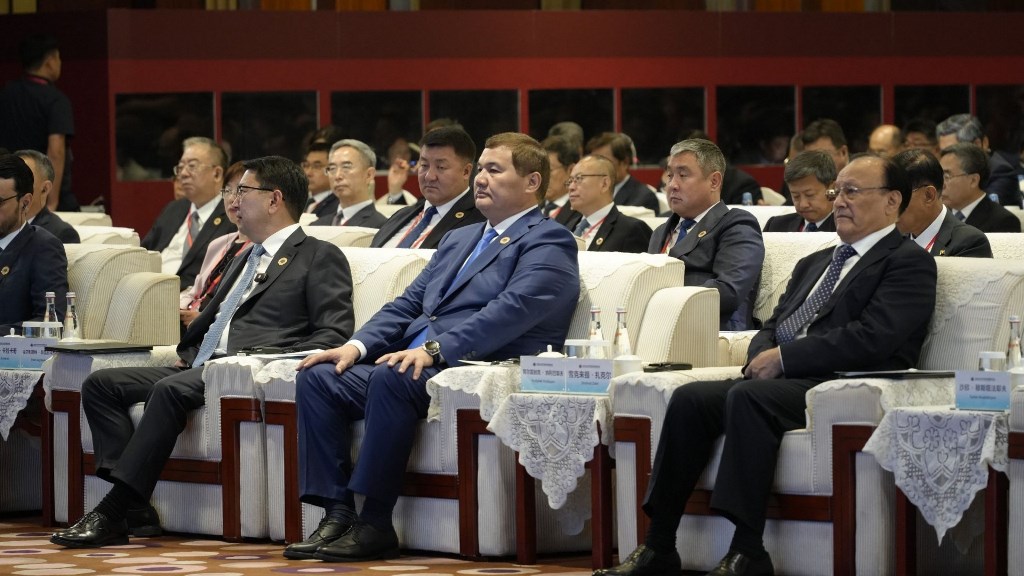
Nalibayev arrived in China on September 23 at the invitation of a Vice Premier of the State Council and participated in the Global Sustainable Transport Forum, according to the official information service of the Prime Minister of Kazakhstan. Nearly 1,000 representatives of governments, international organizations, diplomatic missions, expert circles and businesses attended the event.
Kazakhstan puts the Trans-Caspian route at the center
Transport connectivity was one of the central themes of Nalibayev’s visit.
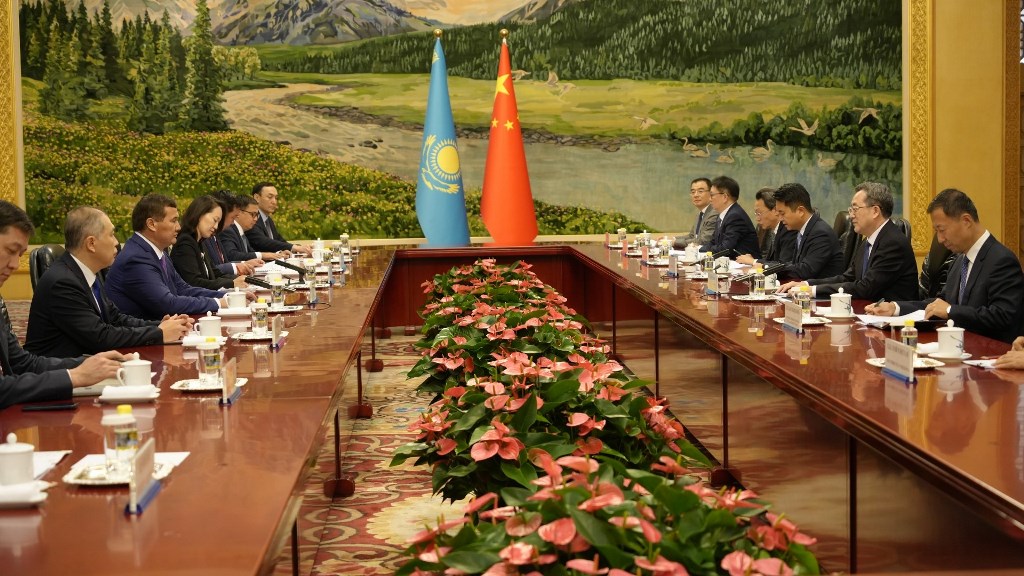
At a session dedicated to the Trans-Caspian International Transport Route (TITR), the First Deputy Prime Minister presented Kazakhstan’s position alongside Vice Chairman of the Standing Committee of China’s National People’s Congress Shohrat Zakir, Azerbaijani Deputy Prime Minister Shahin Mustafayev and Kyrgyz Deputy Chairman of the Cabinet of Ministers Erlist Akunbekov.
Participants described the TITR as an increasingly important corridor in international freight transportation connecting China and Europe.
Kazakhstan occupies a central position in that system. According to recent figures reported by DKNews.kz, more than 85% of overland freight transit between China and Europe passes through Kazakhstan.
The country has also been expanding the infrastructure supporting this flow. The logistics chain increasingly links Chinese hubs with Kazakhstan’s Khorgos facilities and the Caspian port of Aktau, creating an integrated route toward Azerbaijan and European markets.
Cargo growth with China creates pressure for more capacity
At the opening of the Beijing forum, Nalibayev presented Kazakhstan’s transport-sector priorities and infrastructure projects with international significance.
Special attention was given to growing cargo volumes between Kazakhstan and China and the potential for deeper cooperation in transport and logistics.
The numbers explain the focus. In the first half of 2026, freight traffic between Kazakhstan and China reached 18.7 million tonnes, 9% more than a year earlier. Kazakhstan-bound-to-China traffic amounted to 11.7 million tonnes, while export freight increased 20% to 8.5 million tonnes.
This makes additional railway, border and logistics capacity directly relevant to Kazakhstan’s export potential as well as its ability to compete for transit cargo.
The Trans-Caspian route is already demonstrating shorter delivery times on some services. A China-Europe train departing Xi’an via Kazakhstan at the beginning of 2026 was expected to complete its journey in about 11 days, compared with roughly two months by traditional maritime transport, according to a DKNews.kz report citing the Chinese project operator.
Nalibayev holds first meeting with Ding Xuexiang
The visit also moved beyond transport.
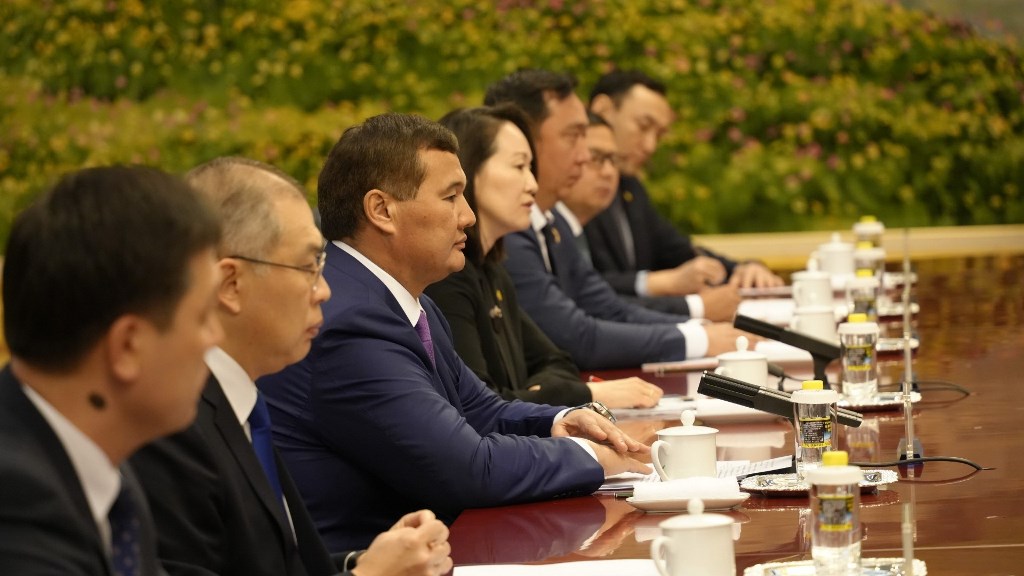
Nalibayev held his first bilateral meeting with Ding Xuexiang, Vice Premier of China’s State Council and Chinese co-chair of the Kazakhstan-China Cooperation Committee.
The agenda covered:
- trade and economic cooperation;
- agriculture and high technology;
- investment;
- interregional cooperation;
- transboundary rivers;
- the work of the Kazakhstan-China Cooperation Committee.
The breadth of the agenda reflects the expanding economic relationship between the two countries. Chinese capital is increasingly present not only in traditional infrastructure and industrial projects but also in Kazakhstan’s financial market. In the first half of 2026 alone, deals connected to China’s capital market accounted for around $915 million of the $3.6 billion attracted through the Astana International Exchange.
Kazakhstan seeks new projects with CITIC and CCCC
Investment discussions continued in meetings with two major Chinese corporations.
Nalibayev met Xi Guohua, Chairman of CITIC Group, and Zhang Bingnan, President of China Communications Construction Company. The talks covered investment in Kazakhstan, joint infrastructure and investment projects, and possible cooperation in new areas. The government statement did not specify the value or implementation timetable of potential new projects.
Chinese investors have shown growing interest in Kazakhstan’s position at the intersection of the Belt and Road Initiative and the Trans-Caspian route. Recent business discussions have increasingly focused on using Kazakhstan not simply as a transit territory but as a platform for cross-border investment and regional projects.
That distinction is important for Astana. Expanding transit generates transport revenue, but logistics hubs, processing facilities and related infrastructure can potentially retain more economic activity inside Kazakhstan.
CITIC chairman receives Order of Dostyk
The visit also included a symbolic recognition of Kazakhstan-China business ties.
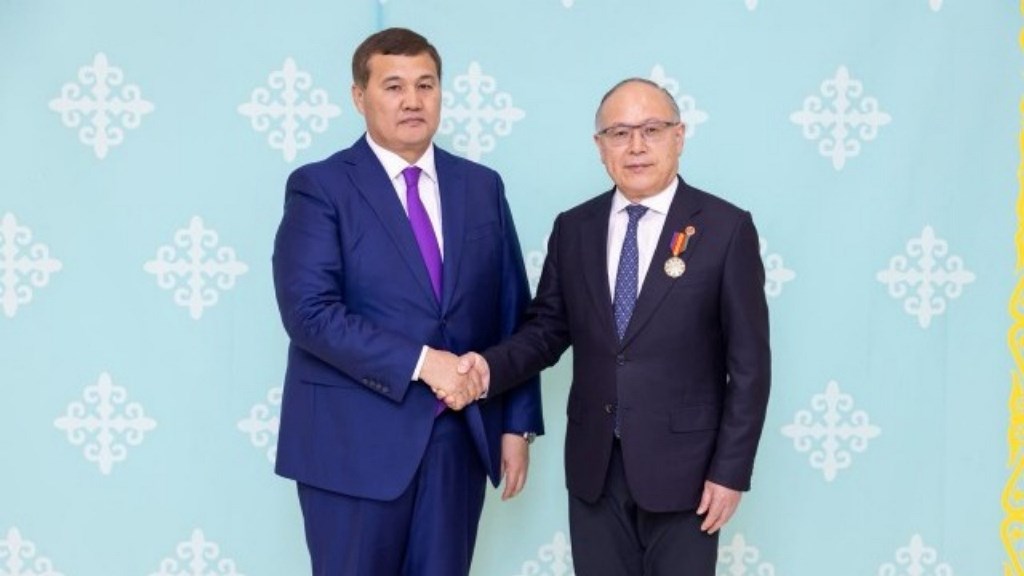
Before the transport forum, Nalibayev presented CITIC Group Chairman Xi Guohua with Kazakhstan’s Order of Dostyk, Grade II, at the Kazakh Embassy in Beijing. The award was presented on behalf of President Kassym-Jomart Tokayev.
According to the government, the honor recognized Xi Guohua’s personal contribution to strengthening Kazakhstan-China friendship and developing mutually beneficial trade and economic cooperation.
Xi described the award as recognition of joint efforts made under agreements between the two countries’ leaders and of the contribution made by their business communities.
For Kazakhstan, the practical test now lies in converting the political relationship and growing freight flows into additional infrastructure and investment projects. Beijing provided another platform to present that offer directly to Chinese officials and some of the country’s largest infrastructure groups.
We previously examined how this transport architecture is already taking shape in practice, with Lianyungang, Khorgos and Aktau emerging as interconnected elements of a new Kazakhstan-China Eurasian logistics corridor.