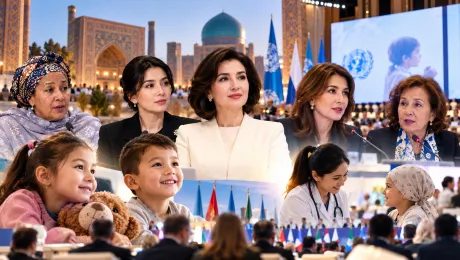

A global declaration on children's wellbeing has been adopted in Uzbekistan. On October 22, 2026, participants at the World Summit in Samarkand approved the Samarkand Declaration on Investing in Children's Wellbeing, establishing shared priorities for child protection, healthcare, education and public financing. The document was adopted at the conclusion of the two-day summit held on October 21–22, DKNews.kz reports.
The declaration calls on governments to increase investment in children, strengthen social protection systems and ensure that public spending produces measurable improvements in young people's lives.
One of its central messages is that investing in children is not simply a social responsibility. It is also an investment in healthier populations, stronger economies, greater social cohesion and long-term stability.

More than 100 countries represented at the Samarkand summit
Uzbekistan organized the summit jointly with the Special Representative of the UN Secretary-General on Violence Against Children, UNICEF, the World Health Organization and the World Bank.
The gathering brought together first ladies, government ministers responsible for social protection, healthcare, education and finance, as well as representatives of international organizations, civil society, academia and business.
Children and young people also participated in the discussions, reflecting the summit's emphasis on including younger generations in decisions affecting their future.
Representatives from more than 100 countries attended the international gathering, which focused on turning political commitments into practical measures.
Children make up one-third of the world's population
The declaration begins by reaffirming the importance of the UN Convention on the Rights of the Child and the principle that children's best interests must be a primary consideration in decisions affecting them.
Participants emphasized that children account for approximately one-third of the global population. Their access to healthcare, education, protection and opportunities will therefore have lasting consequences for economic and social development.
The document also recognizes that children are particularly vulnerable to overlapping global challenges, including armed conflicts, climate change, displacement, economic instability and rapid technological transformation.
Although children bear little responsibility for many of these crises, they often experience their consequences most directly.
Five priorities for protecting children worldwide
The Samarkand Declaration identifies several areas in which participating countries intend to strengthen their efforts, taking into account national circumstances, priorities and available resources.
The principal directions include:
- Social protection: expanding child and family benefits, improving access to social insurance and maintaining assistance during economic and humanitarian crises.
- Protection from violence: preventing abuse, neglect and exploitation, including threats affecting children in digital environments.
- Education and healthcare: strengthening early childhood development, inclusive education, medical services and international cooperation against childhood cancer.
- Family support: helping parents and caregivers provide safe environments while preventing unnecessary separation of children from their families.
- Future employment: developing green and digital skills and expanding opportunities for decent work, including for young people with disabilities.
These priorities reflect an approach in which children's needs are addressed through coordinated policies rather than isolated programmes.
Childhood cancer becomes an international priority
Healthcare occupies a significant place in the declaration, particularly the prevention and treatment of serious childhood diseases.
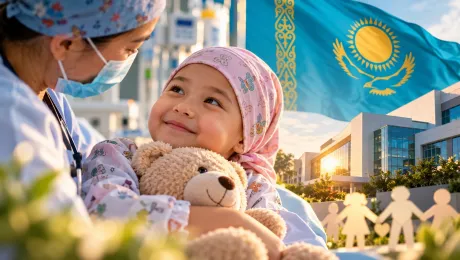
Participating countries called for stronger cooperation in early diagnosis, treatment, rehabilitation and palliative care for children with cancer.
The document also emphasizes access to essential medicines, medical specialists and reliable healthcare services.
International cooperation could help countries exchange medical knowledge and strengthen healthcare systems, particularly where specialized pediatric treatment remains difficult to access.
The declaration does not establish a single international treatment programme or specify a universal funding allocation. Instead, it sets out areas in which governments and development partners are encouraged to cooperate.
Governments urged to increase spending on children
One of the declaration's most important sections concerns financing.
Participating countries acknowledged that commitments to children's wellbeing must be supported by financial resources, institutional responsibilities and mechanisms for evaluating results.
Governments expressed their intention to progressively increase public investment in social protection, early childhood development, education, healthcare and child protection.
They also emphasized the need to make national budgets more transparent and responsive to children's needs.
This approach would allow policymakers to assess not only how much money is allocated but also which groups benefit from spending and whether services are improving.
For example, higher education expenditure would need to be considered alongside actual improvements in access, quality and inclusion.
The declaration encourages countries to strengthen the monitoring of public spending, including the use of data that can identify disparities affecting children of different ages, genders and abilities.
International financial institutions asked to expand support
The declaration also addresses the role of international financial institutions, development agencies, philanthropic organizations and private businesses.
These partners are encouraged to increase financing and technical assistance for national programmes supporting children's wellbeing.
Particular attention is directed towards low- and middle-income countries and states affected by armed conflict, climate change, displacement and natural disasters.
For these countries, limited fiscal resources can make it difficult to maintain essential education, healthcare and social protection services during crises.
The declaration calls for greater international cooperation and innovative financing approaches, although it does not announce a specific global funding target or a collectively agreed financial commitment.
The actual scale of additional investment will depend on future decisions by governments and financing partners.
Children recognized as participants in decision-making
Another significant element of the Samarkand Declaration is the recognition of children and adolescents as rights holders and active participants in social change.
Participants expressed their readiness to promote safe, inclusive and meaningful opportunities for young people to contribute to decisions affecting their lives.
This principle also applies to the implementation of the declaration itself.
Rather than limiting children's participation to ceremonial events, the document encourages governments and institutions to develop ways of listening to their experiences and incorporating their views into public policy.
Such participation must take account of children's age, safety, privacy and individual circumstances.
How will the declaration be implemented?
The Samarkand Declaration is intended to guide action through national policies, development strategies and government budgets.
Countries will determine their own implementation timelines, institutional responsibilities and targets based on national priorities and capabilities.
The document also calls for regular reporting on access to services, their quality and measurable outcomes.
Participants agreed to meet again to assess progress and review the implementation of their commitments.
The summit's co-organizers were invited to assist countries through technical cooperation, monitoring and the development of partnerships.
Importantly, the declaration establishes a framework for cooperation rather than an automatically enforceable international spending obligation. Its practical impact will depend on subsequent national decisions and the resources allocated to implementation.
What does the Samarkand Declaration mean for Central Asia?
For Central Asian countries, the declaration provides an additional international framework for discussing social protection, education, healthcare and children's rights.
Many of the issues addressed in Samarkand require coordination between different government agencies and, in some cases, cooperation across borders.
These include access to specialized medical treatment, support for vulnerable families, inclusive education and protection of children in digital environments.
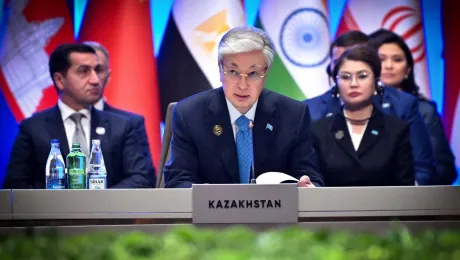
For Kazakhstan, the declaration's priorities are relevant to ongoing discussions about social services, child protection and the development of human capital. However, the document does not itself establish new Kazakhstan-specific budget allocations or programmes.
Its significance for the region will depend on whether participating governments incorporate the agreed priorities into their own policies and establish measurable implementation mechanisms.
Oscar winner Adrien Brody takes part in closing ceremony
The summit concluded with remarks by Academy Award-winning actor Adrien Brody, who reflected on the importance of supporting children and creating opportunities for them to develop their abilities.
Brody also presented Shakhnoza Mirziyoyeva with a painting he had created himself.
The gesture provided a cultural conclusion to two days of discussions involving political leaders, international institutions, specialists and young participants.
Delegates thanked the people and government of Uzbekistan for hosting the gathering in Samarkand, a historic city described in the declaration as a crossroads of civilizations.
From international promises to measurable results
The adoption of the Samarkand Declaration marks the conclusion of the summit but the beginning of the next stage: implementation.
Its success will depend on whether governments expand access to essential services, strengthen protection systems and direct resources towards children who face the greatest disadvantages.
The commitment to regular reporting and future meetings provides a basis for assessing progress, but meaningful improvements will require sustained financing and cooperation.
The declaration's central objective is to ensure that investments made today produce lasting benefits for children, families and future generations.
We previously reported on the opening of the World Summit on Investing in Children's Wellbeing in Samarkand, where representatives from more than 100 countries discussed protecting essential services for children, improving access to healthcare and education, and linking government commitments to funding, deadlines and measurable results. The adoption of the Samarkand Declaration now provides a shared framework for putting those priorities into practice.