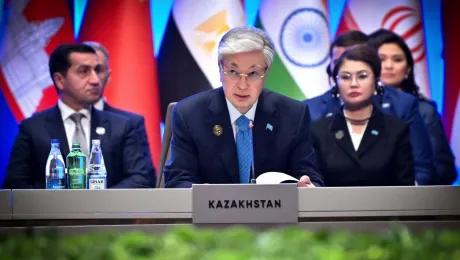

New research released by Micky’s Institute of Global Research and Development underscores Kazakhstan’s continued ascent as the leading investment destination in Central Eurasia amid slowing global capital flows and heightened geopolitical uncertainty. While global foreign direct investment (FDI) declined at double-digit rates in 2024, Kazakhstan sustained strong inflows, reinforcing its reputation as a stable, predictable market for long-term capital and supporting a growing pipeline of large-scale investment projects, DKNews.kz reports.
According to official data from the National Bank of Kazakhstan , the country attracts on average more than USD 20 billion in FDI annually. Inflows reached USD 23.8 billion in 2021 and USD 23.9 billion in 2023, with approximately USD 10 billion recorded in the first half of 2025 alone. Kazakhstan continues to account for around 60% of all foreign investment entering Central Asia.
This performance stands out against a broader global decline in investor confidence across emerging markets. Analysts increasingly attribute Kazakhstan’s resilience to institutional reforms initiated under President Kassym-Jomart Tokayev, often referred to as the “Tokayev investment cycle,” which emphasizes proactive government engagement, streamlined decision-making, and the redirection of foreign capital toward non-resource sectors of the economy.
Macroeconomic stability remains a cornerstone of Kazakhstan’s investment appeal. Despite weaker global commodity markets, economic growth remained around 6% in 2025, driven by infrastructure, logistics, services, and expanding investment in renewable energy alongside the energy sector. International benchmarks reflect this progress: in the 2025 IMD World Competitiveness Ranking , Kazakhstan ranked 34th out of 69 economies, ahead of Japan, India, and Spain, with strengths in tax competitiveness and management quality.
Digital governance has emerged as a further competitive advantage. Kazakhstan ranks 24th globally in the UN E-Government Development Index and is among the world’s top ten countries for the quality of online public services, translating into lower administrative costs, faster approvals, and greater transparency for investors.
A central feature of the country’s investment strategy is the strengthening of institutions governing investment protection, arbitration, taxation, and financial services. The Investment Policy Concept for 2024–2029 prioritizes targeted incentives tied to measurable outcomes in sectors such as logistics, renewable energy, manufacturing, agri-processing, and digital infrastructure. Since 2023, the Government’s Investment Headquarters has supported more than 210 projects valued at approximately USD 113 billion and initiated over 172 legislative amendments to remove administrative barriers and enhance investor protections.
Recent milestones include the commissioning of a KIA automobile manufacturing plant in 2025, creating around 1,500 jobs, as well as the approval of 33 large-scale Investment Agreements in 2025 alone with a combined value of approximately KZT 11.87 trillion, providing predictable conditions for anchor investors.
Kazakhstan has also restructured its development institutions to support investment-led growth. National holding Baiterek has been transformed into an investment holding with expanded mandates for infrastructure, industrial, and export-oriented projects. The Astana International Financial Centre continues to anchor the investment ecosystem, operating under English common law with an independent court and regulator. Since 2018, approximately USD 19 billion has been channelled through the platform, with further expansion of tax and investment residency programs introduced in 2025.
Alongside investment reforms, Kazakhstan maintains a strong emphasis on fiscal stability and social development. Planned state budget expenditures for 2026 total approximately KZT 27.3 trillion, or about 14.8% of GDP, with nearly 39% allocated to social spending. Public finance classification is increasingly aligned with OECD and EU standards, enhancing transparency and predictability for long-term investors.
As global investors seek resilient jurisdictions capable of absorbing long-term capital, the research concludes that Kazakhstan’s combination of institutional reform, targeted incentives, digital governance, and fiscal stability continues to distinguish it as a leading investment hub across the Eurasian region.