

Electric cars are gaining ground. Yet in Kazakhstan, as in many emerging automotive markets, petrol- and diesel-powered vehicles continue to dominate sales, infrastructure and servicing.
Freedom analysts examined how changing consumer preferences are reshaping the automotive industry. For investors, those choices offer a clue to which manufacturers are adapting—and which risk falling behind, DKNews.kz reports.
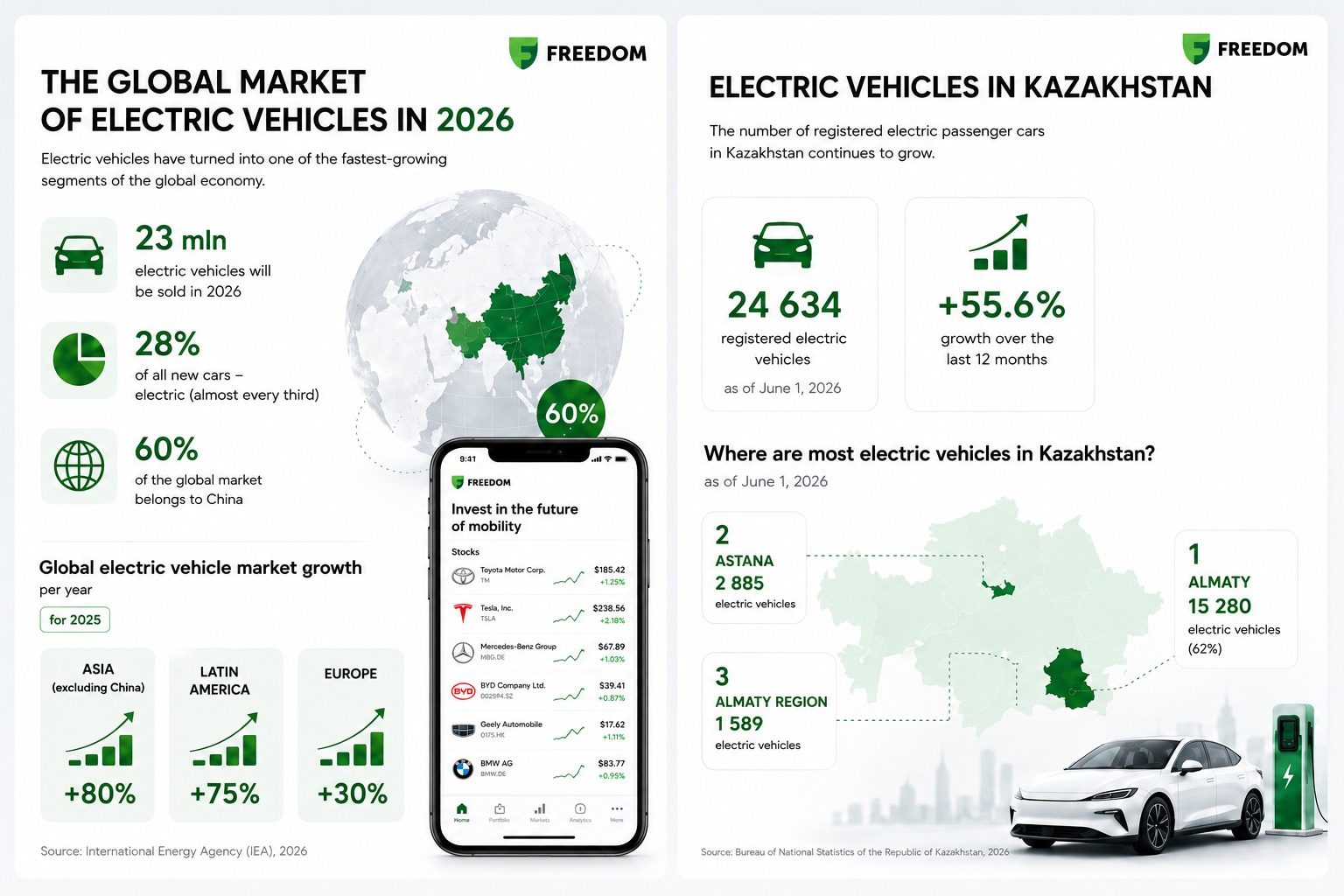
Kazakhstan now has 24,634 electric cars
As of June 1, 2026, Kazakhstan had 24,634 registered passenger electric vehicles, according to the country’s Bureau of National Statistics. The fleet expanded by 55.6% in just 12 months.
Growth, however, is heavily concentrated in the country’s largest urban centres.
Almaty, Kazakhstan’s commercial capital and most populous city, accounts for 15,280 electric cars—62% of the national total. The capital, Astana, has 2,885, while the surrounding Almaty Region has 1,589.
The growth rate is striking, but it started from a relatively small base. Most vehicles on Kazakhstan’s roads still run on petrol or diesel, supported by an established network of filling stations, repair shops and spare-parts suppliers.
Electric cars are spreading fastest where charging points and specialist servicing are easier to find. That helps explain why Almaty and Astana are far ahead of the country’s other regions.
One car generates revenue for dozens of businesses
A buyer sees one badge on the bonnet. An investor sees the supply chain behind it.
Every modern vehicle depends on battery producers, semiconductor manufacturers, tyre makers, software developers, navigation providers, camera and sensor suppliers, and telecommunications companies. Electric vehicles add charging operators and power infrastructure to that list.
Revenue from a car sale therefore extends well beyond the manufacturer. Suppliers of components, electronics and digital systems all receive a share of the spending generated by each vehicle.
Rising EV demand can benefit battery and power-electronics producers. Continued demand for combustion-engine cars supports companies tied to engines, transmissions, replacement parts and conventional maintenance.
Tesla, Toyota, BYD and Geely can also be investment assets
Investors can buy stakes in many of the brands seen on Kazakhstan’s roads.
Tesla trades on Nasdaq under the ticker TSLA. Toyota Motor is listed in Tokyo under the code 7203, while Mercedes-Benz Group trades under MBG and BMW AG under BMW.
China’s BYD is listed in Hong Kong under the code 1211 and in Shenzhen under 002594. Geely Automobile Holdings trades in Hong Kong under the code 175.
The exchange and ticker matter. These securities trade in different currencies, operate under different regulatory systems and may not be available through every brokerage platform.
Buying a particular brand of car also does not make its shares an attractive investment by default.
Toyota, Mercedes-Benz and BMW continue to sell combustion-engine vehicles while expanding their hybrid and fully electric ranges. Tesla and BYD are more directly exposed to demand for EVs. Geely operates through several brands and technology platforms.
For investors, the choice is therefore broader than petrol versus electricity. Sales, profitability, debt, production costs and the ability to earn revenue from software and services can matter just as much as the type of powertrain under the bonnet.
Annual $500 Tesla investments could have grown to $9,783
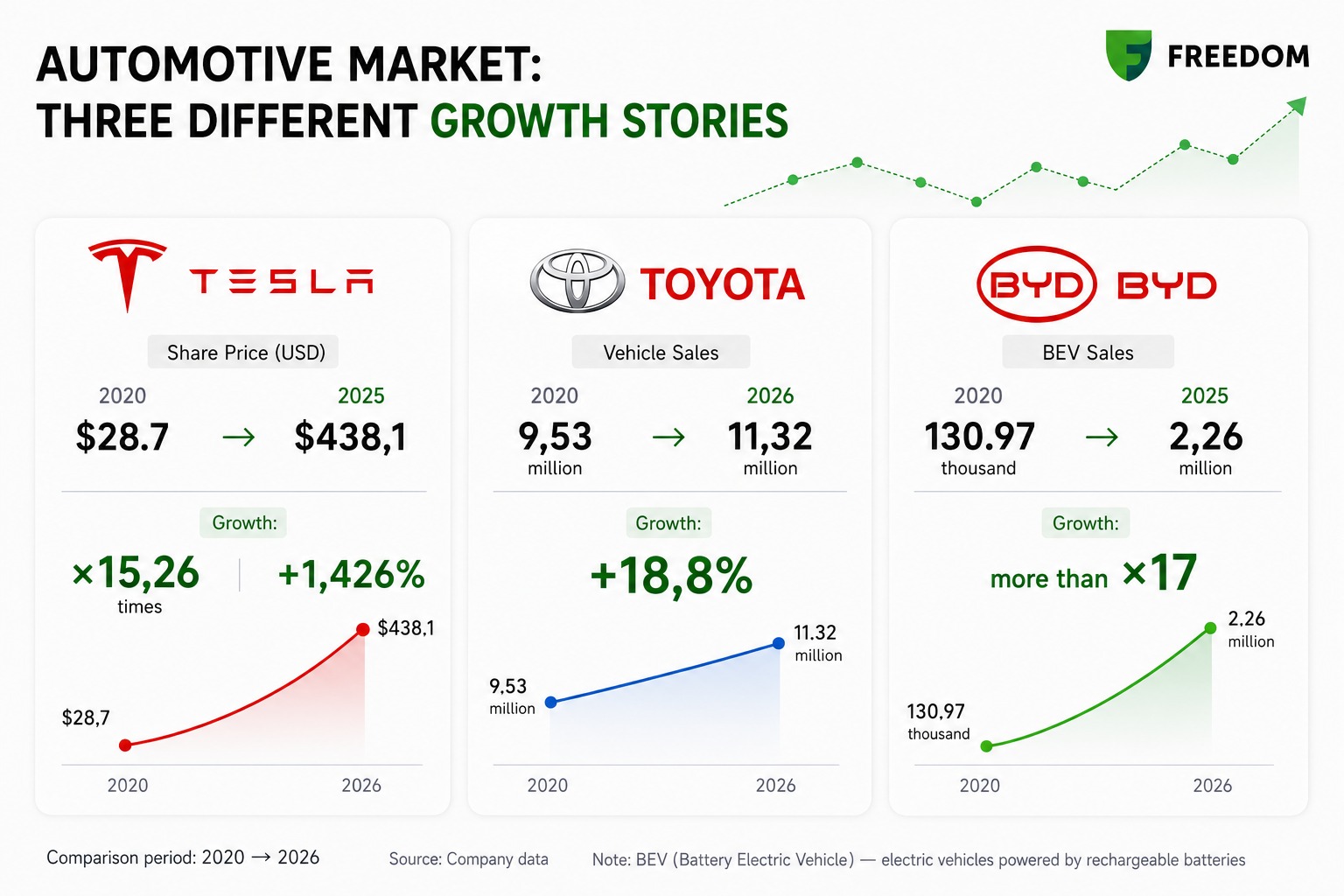
Freedom analysts calculated an illustrative scenario in which an investor bought $500 worth of Tesla shares each year beginning in 2020.
After seven annual purchases, the total amount invested would have reached $3,500. By August 7, 2026, the portfolio would have been worth approximately $9,783—about 2.8 times the original investment. Tesla shares closed at $328.58 on that date.
The result depends on the dates and prices used for each purchase. Brokerage fees, taxes and currency-conversion costs would also affect the final return.
Nor does historical performance guarantee future gains. Share prices can fall just as quickly as they rise—a risk that becomes particularly relevant with volatile automotive stocks.
Car companies are competing beyond the vehicle itself
For the automotive industry, revenue no longer ends when the driver receives the keys.
Owners purchase insurance and tyres, pay for parking, book maintenance and use connected services throughout the life of a vehicle. Many of these transactions are moving into mobile applications.
Within Freedom’s digital ecosystem, motorists can arrange insurance online, request assistance from an accident commissioner, buy seasonal tyres and book tyre-fitting services without visiting an office.
This puts carmakers in competition with banks, insurers and technology companies for the driver’s daily attention. Businesses that remain useful after the sale gain more opportunities to build customer loyalty and generate recurring revenue.
Kazakhstan illustrates both the speed and the limits of the electric transition. Its EV fleet grew by 55.6% in one year, yet 62% of those vehicles are registered in a single city. For automotive companies, that signals rising demand. For investors, it is a reminder that rapid percentage growth does not necessarily mean a market has already reached mass adoption.
This material is provided for informational purposes only and does not constitute personalized investment advice. The value of financial instruments may rise or fall. Past performance does not guarantee future returns.