

Kazakhstan will draw more from its National Fund. The government has increased planned withdrawals for 2027–2029 by KZT 5 trillion, while the central bank is warning that the additional spending must be managed carefully to avoid adding to inflation, DKNews.kz reports.
National Bank of Kazakhstan Governor Timur Suleimenov outlined the risks at a government meeting in Astana on August 25, as officials presented Kazakhstan’s economic and budget outlook for 2027–2029.
For international readers, the National Fund is Kazakhstan’s sovereign wealth fund. It was created to accumulate revenues from oil, gas and other natural resources and to provide financial support to the economy during periods of instability. The National Bank manages the fund’s assets.
“The amount of funds to be withdrawn from the National Fund in 2027–2029 has been increased by KZT 5 trillion,” Suleimenov said.
An extra KZT 5 trillion will go into infrastructure
The government plans to use the additional money for social, municipal, energy and transport infrastructure.
Under the government’s 2027–2029 budget framework, targeted transfers from the National Fund are set at KZT 2 trillion in 2027 and KZT 1.5 trillion in each of 2028 and 2029.
These are in addition to guaranteed transfers, a regular mechanism through which National Fund money is used to support the state budget. The government has set the guaranteed transfer at KZT 2.4 trillion for 2027 alone.
Taken together, the announced targeted and guaranteed transfers imply that roughly KZT 11.8 trillion could flow from the fund to the state budget over the three-year period.
For investors and businesses watching Kazakhstan, the shift matters because it signals a more expansionary fiscal stance: more public money will enter the domestic economy at a time when inflation remains high.
Inflation has eased to 10.2%, but remains a concern
Kazakhstan’s inflation rate has fallen from a peak of 12.9% in September 2025 to 10.2%, with the decline continuing for ten consecutive months, according to the National Bank.
The central bank attributes the slowdown to moderately tight monetary policy, a stronger exchange rate, normalization in consumer lending and coordinated anti-inflation measures with the government.
But double-digit inflation remains well above levels that would allow policymakers to relax.
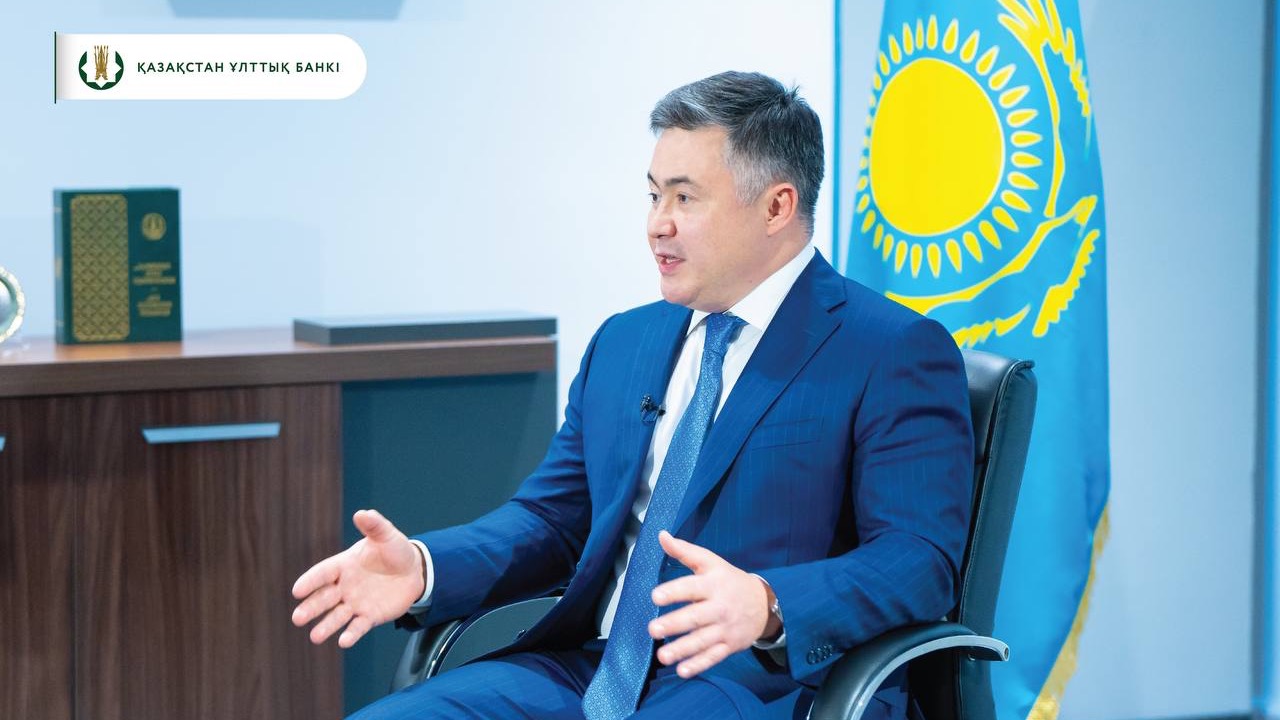
“Nevertheless, inflation remains high. External and domestic pro-inflationary risks persist,” Suleimenov said.
That makes the National Fund decision particularly sensitive. Large-scale infrastructure spending can support economic growth and investment, but if domestic companies cannot increase supply quickly enough, additional demand can spill into higher prices or imports.
Suleimenov therefore called for measures to maximize the economic return from the spending while limiting its inflationary impact.
The central bank is removing trillions of tenge at the same time
Kazakhstan is effectively pursuing two policies at once.
The government is preparing to inject additional National Fund money into infrastructure, while the National Bank is withdrawing liquidity from the financial system to curb excessive demand.
During the first seven months of 2026, the central bank withdrew KZT 2.4 trillion through measures linked to the mirroring of gold-purchase operations. The total is expected to reach about KZT 4.1 trillion by the end of the year.
Minimum reserve requirements for banks are also being tightened gradually. The National Bank estimates that the measure will absorb another KZT 4 trillion, reduce the cost of monetary-policy operations and shrink the monetary base.
The contrast illustrates Kazakhstan’s current policy challenge: fiscal authorities want to accelerate infrastructure development, while monetary authorities are trying to keep demand and inflation under control.
The two goals are not necessarily incompatible. Much depends on how much of the spending translates into new domestic production rather than higher prices and imports.
Kazakhstan wants more of the spending to stay inside the economy
Suleimenov set out several conditions for the new infrastructure spending.
Projects should be prioritized clearly by sector and region, while the government should work with local businesses in advance to expand production over the three-year financing period.
The central bank also wants Kazakh construction companies to play a larger role in the projects.
The logic is straightforward: if domestic contractors, manufacturers and suppliers capture more of the spending, the money can generate local value added, jobs and tax revenue. If demand instead relies heavily on imported goods and services, part of the fiscal stimulus leaves the country while adding pressure to the trade and currency channels.
Suleimenov’s report explicitly calls for greater involvement of domestic construction firms so that the funds generate value added and tax receipts in Kazakhstan’s regions.
Digital tenge could be used to track public money
Kazakhstan also plans to use financial technology to improve oversight.
Suleimenov proposed monitoring the targeted and efficient use of National Fund money through the digital tenge, Kazakhstan’s central bank digital currency, among other tools.
He also called for financing mechanisms to be integrated with the tax authorities so the government can track the transparency and tax impact of individual projects.
For a foreign investor, this is a notable part of the story. Kazakhstan is not presenting the digital tenge solely as a payment instrument; policymakers are increasingly considering it as an infrastructure tool for tracing state expenditure.
The Governor’s speech, however, does not specify which of the 2027–2029 infrastructure projects will be required to use the digital tenge.
Kazakhstan still expects the National Fund to grow
The larger withdrawals do not mean the government expects the sovereign fund itself to shrink over the forecast period.
Under the government’s baseline scenario, inflows into the National Fund are projected at KZT 5.1 trillion in 2027, KZT 5.5 trillion in 2028 and KZT 5.7 trillion in 2029.
Its foreign-currency assets are forecast to rise from $65.2 billion in 2027 to $70.6 billion in 2029. The National Bank separately publishes regular data on the fund’s foreign-currency and gold assets on its English-language website.
That distinction is crucial. The debate is not simply whether Kazakhstan has enough reserves to finance the spending. The bigger macroeconomic question is whether the domestic economy can absorb several trillion tenge in additional infrastructure investment without reigniting inflation.
Trade balance is expected to remain in surplus
The external backdrop is comparatively stable.
The National Bank expects Kazakhstan’s trade balance to remain in surplus throughout the forecast period, despite weaker assumed prices for key exports and continued strong demand for imports. The current account is also expected to remain stable.
For foreign businesses, the next three years therefore present a mixed picture: larger state infrastructure spending could generate new contracts and domestic demand, while persistently high inflation and tight monetary conditions remain significant constraints.
The central test will be whether Kazakhstan can convert National Fund transfers into additional productive capacity rather than simply additional demand.
Earlier, we examined Kazakhstan’s reliance on the National Fund to finance its budget. The new 2027–2029 framework shows that despite previous efforts to reduce targeted withdrawals, the sovereign fund will remain an important source of financing for major state projects.