

You start with a virtual $100,000. Then you are thrown into five of the most turbulent years in recent market history — from the COVID crash and tech-stock boom to inflation, war, rate hikes and the rise of artificial intelligence, DKNews.kz reports.
On August 28 in Almaty, Kazakhstan-based asset manager ATLAS Capital presented Invest Game, an investment simulator built around real historical market data. The first presentation to the media took place at a private dinner for business journalists.
For an international reader, the concept is easy to recognize but harder to beat: participants are shown what investors knew at the time, allocate their money, and only then discover what the market actually did.
$100,000, 14 investment options and no knowledge of the future
Each round begins with $100,000 in virtual capital.
Players receive a summary of major global, US and Kazakhstan events from a particular year and then decide how to allocate the portfolio. Results are calculated automatically using historical performance data. One round represents one year.
The “Classic” version covers 2020 through 2024.
Participants can choose among 14 instruments and asset classes, including Almaty real estate, gold, deposits in US dollars and Kazakhstan’s tenge, exchange-traded funds, and shares of Apple, Coca-Cola, McDonald’s, Meta, Netflix, NVIDIA and Tesla. A maximum of 15% can be invested in any single stock.
That restriction makes one of the game’s central lessons difficult to avoid: even when an investor is convinced one company will win, concentration has a cost.
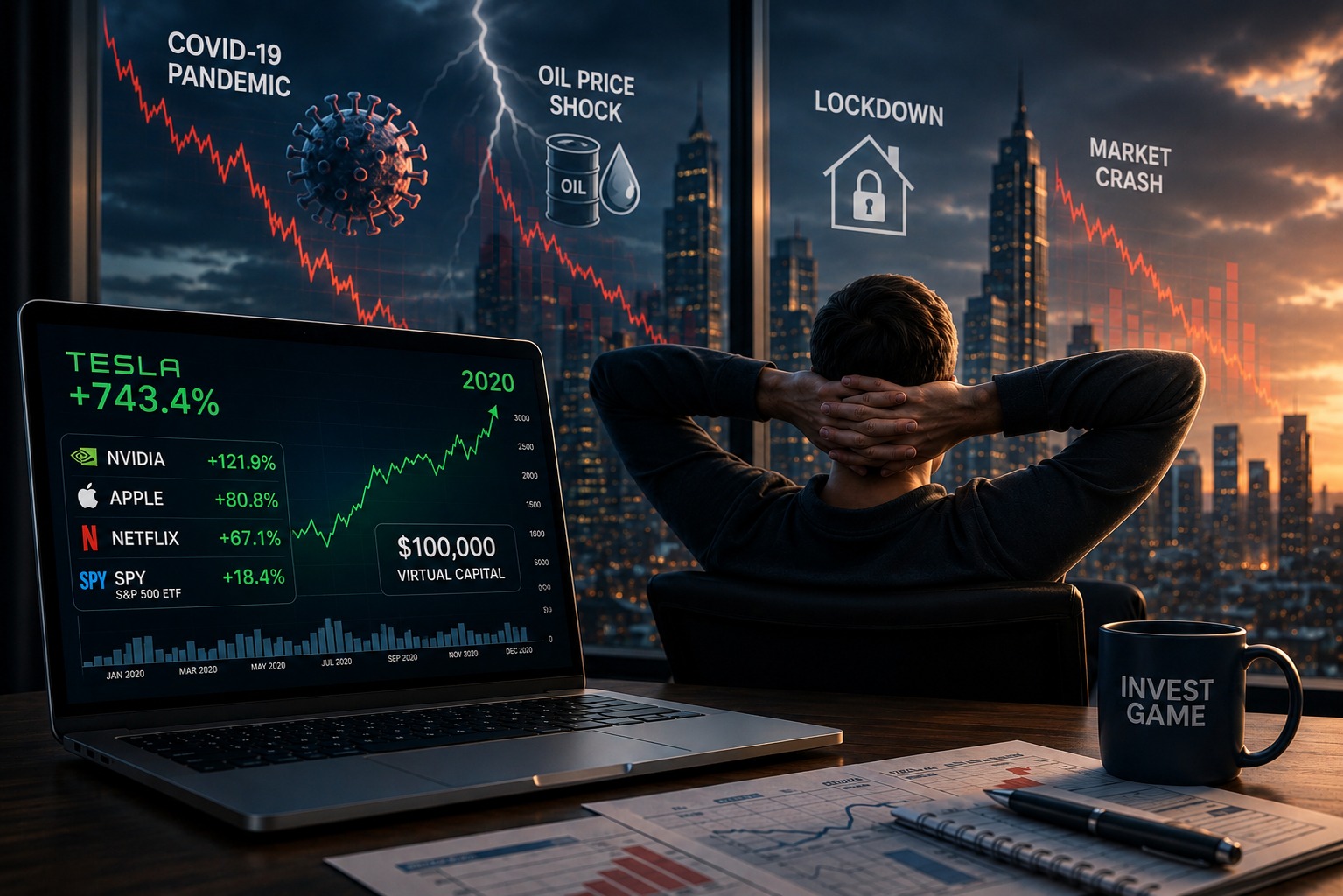
Tesla gained 743% in the year the global economy shut down
The first round immediately exposes the difference between the economy and the stock market.
In 2020, the year of COVID-19 lockdowns, an oil shock and one of the fastest market sell-offs in modern history, Tesla ended the year up 743.4% in the data used by the game.
NVIDIA gained 121.9%, Apple 80.8%, Netflix 67.1%, while SPY, the ETF tracking the S&P 500, returned 18.4%.
The Kazakhstan-linked choices looked far less spectacular.
Almaty real estate returned 2.3% in US dollar terms, a dollar deposit produced 0.5%, while a tenge deposit showed a 1.5% loss in dollar terms as the Kazakh currency weakened.
With hindsight, putting money into Tesla looks easy. In early 2020, when markets were collapsing and uncertainty was extreme, it was anything but obvious.
That gap between hindsight and decision-making is where the game becomes more interesting than a simple stock-market quiz.
The winners of 2021 became some of the biggest losers of 2022
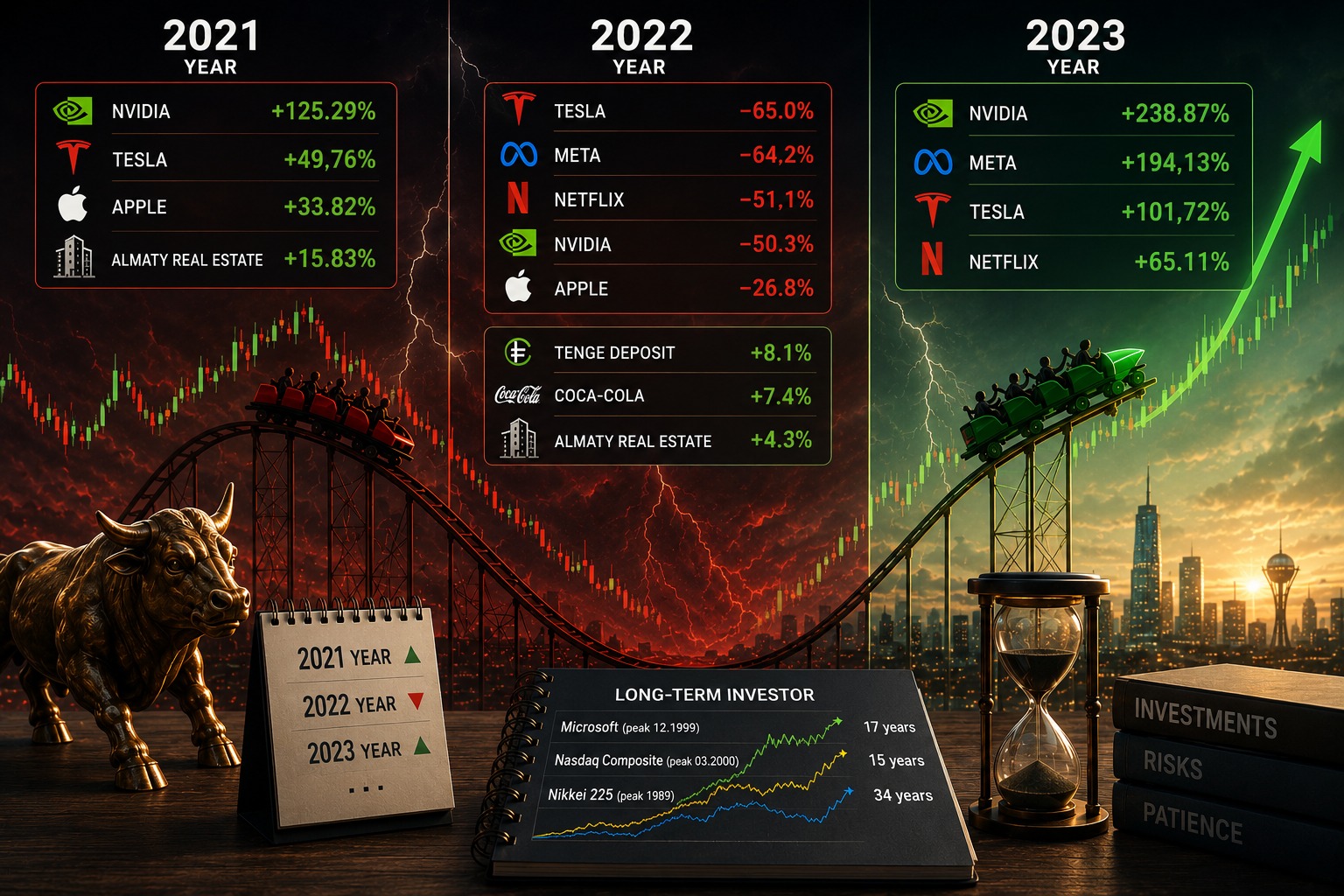
In 2021, NVIDIA led the available assets with a return of 125.29%. Tesla gained 49.76%, Apple 33.82%, while Almaty real estate rose 15.83%.
A player who heavily favored technology after seeing those results might have felt highly confident entering the next round.
Then 2022 arrived.
Tesla fell 65%, Meta lost 64.2%, Netflix dropped 51.1% and NVIDIA declined 50.3%. Apple was down 26.8%.
Meanwhile, some of the least exciting options became the strongest performers in the game: the tenge deposit returned 8.1%, Coca-Cola 7.4%, and Almaty real estate 4.3%.
The lesson is uncomfortable because it is familiar to anyone who has spent time in markets: last year’s winning strategy can become this year’s biggest vulnerability.
NVIDIA fell 50% — then jumped 239%
The next round makes the decision even harder.
After losing roughly half its value in 2022, NVIDIA surged 238.87% in 2023. Meta gained 194.13%, Tesla 101.72% and Netflix 65.11%.
Selling after a major decline can therefore lock an investor out of the recovery.
But buying simply because an asset has fallen can be just as dangerous.
A separate analysis by ATLAS Capital’s investment department illustrates the other side of that problem. An investor who bought Microsoft at its December 1999 peak had to wait almost 17 years for the share price to return to that level. The Nasdaq Composite needed about 15 years to regain its March 2000 peak, while Japan’s Nikkei 225 took roughly 34 years to recover its 1989 record.
In other words, choosing a great company is only part of the decision. The price paid can determine how long an investor waits before being proven right.
Kazakhstan’s 2024 lesson was about currency risk
The final “Classic” round has a particularly local — but internationally relevant — twist.
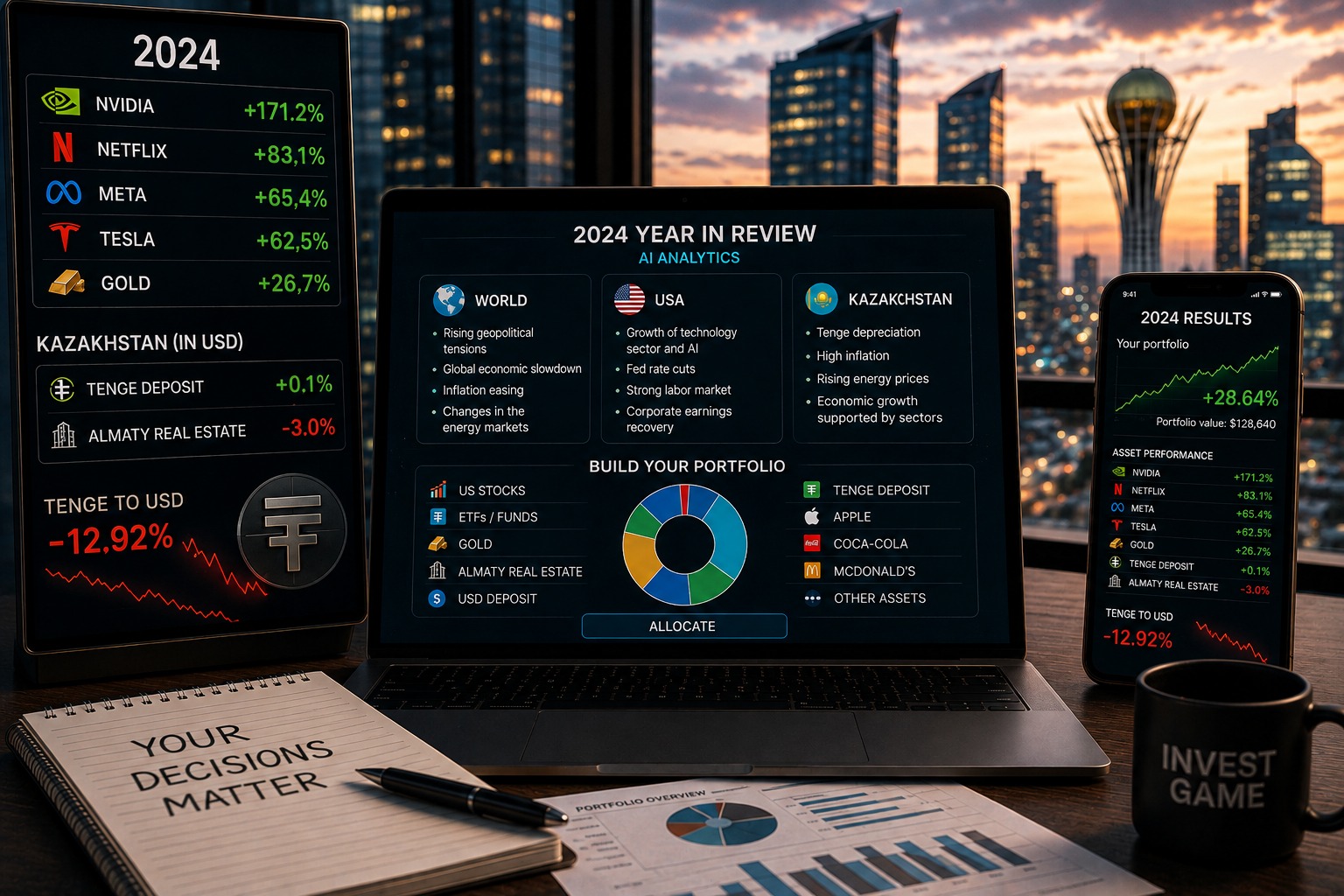
In 2024, NVIDIA again led the group, rising 171.2%. Netflix gained 83.1%, Meta 65.4%, Tesla 62.5% and gold 26.7%.
At the same time, the presentation says the tenge weakened by 12.92% against the US dollar.
That changed the picture for Kazakhstan-based assets.
In US dollar terms, the tenge deposit returned only 0.1%, while Almaty real estate showed a 3% decline in the model.
For international investors, the point is broader than Kazakhstan: a local asset can rise in domestic currency while producing a very different return once foreign-exchange movements are taken into account.
AI provides the context — but refuses to make the decision
Artificial intelligence is built into the game, but not as a stock picker.
At the beginning of a round, AI generates a summary of the major global, US and Kazakhstan developments from that year. A shorter version remains visible while the participant builds the portfolio.
The player still decides where the money goes. The system calculates the result only after the allocation is complete.
That detail feels particularly relevant in 2026, when investors can ask an AI assistant for a list of stocks in seconds.
Invest Game gives AI the easier job — organizing information — while leaving the uncomfortable part, responsibility for the decision, with the human.
Mistakes cost ranking points, not real money
The obvious advantage of a simulator is that bad decisions are painless.
Players can choose a defensive portfolio, take more risk, change their strategy after market shocks and see how those decisions affect the outcome without losing actual capital.

“We viewed this tool as an opportunity to introduce users to the key principles of capital management through practical experience. Independently allocating funds, observing changes in market conditions and evaluating the results of decisions make it easier to understand the relationship between investment strategy, risk and return,” said Timirlan Gumbatov, CEO of ATLAS Capital.
The company says the platform is intended to make concepts such as diversification, risk, investment horizons and emotional decision-making easier to understand through practice rather than theory.
Why this is coming out of Kazakhstan
ATLAS Capital operates within the jurisdiction of the Astana International Financial Centre (AIFC) and is regulated by the Astana Financial Services Authority.
The official AFSA public register lists Atlas Capital Limited’s licence AFSA-A-LA-2022-0019 as active and authorizes activities including managing investments, managing collective investment schemes, advising on investments and arranging investment deals.
The company says it manages capital for private investors, families and businesses through investment funds and individual mandates.
Invest Game also reflects a broader shift in Kazakhstan’s financial market: access to global assets is becoming easier, but easier access does not automatically produce better investment decisions.
The challenge is increasingly moving from “Can I buy this asset?” to “Do I understand why, when and at what price I am buying it?”
The game will move beyond media events
The Almaty presentation was the first media showcase for Invest Game.
ATLAS Capital says it plans to use the platform in other formats, including business meetings, educational events and client sessions.
Historical results in the simulator should not be read as forecasts. ATLAS Capital itself states that investments involve risk and that past or target returns do not guarantee future performance.
We previously reported on ATLAS Capital’s international recognition and its position in Kazakhstan’s asset-management market. The new game takes a different route: instead of telling investors what a winning portfolio should look like, it lets them discover how convincing a bad decision can feel before the outcome is known.