

Kazakhstan’s stock market needs a broader investor base before it can absorb a substantial increase in publicly traded KazMunayGas shares, according to Timur Turlov, the majority shareholder of Freedom Holding Corp. He believes the oil and gas company’s free float could theoretically expand roughly tenfold, to around $10 billion in value. The immediate constraint is domestic demand.
Turlov outlined his assessment at the opening of ITS IDEAS 2026: Markets in Motion. Following its initial public offering, only a few percent of KazMunayGas shares are in free circulation. That is a meaningful amount for Kazakhstan’s domestic market, but a small proportion of a company valued at tens of billions of dollars.
Free float refers to shares available for public trading. Turlov’s estimate describes the potential for expanding that pool as investor demand develops; it is not an announcement of a share sale.
Shares have risen more than fourfold since the IPO
KazMunayGas, often abbreviated to KMG, held its IPO in late 2022. Investors on Kazakhstan’s exchanges were offered a 3% stake at 8,406 tenge per share. The offer price valued the company at approximately 5.1 trillion tenge, or $11 billion at the time.
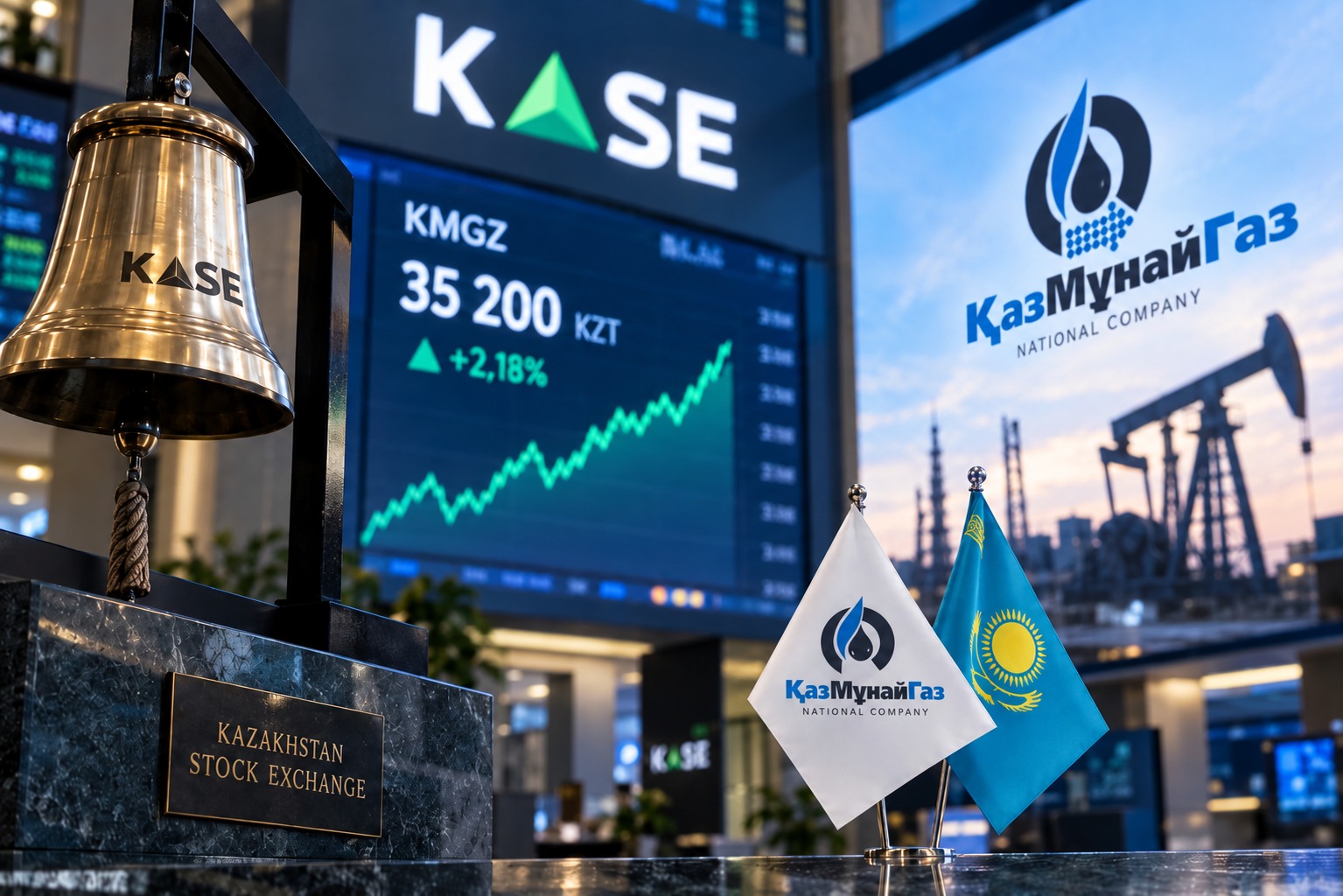
By September 2026, the shares had appreciated substantially. They closed at 35,200 tenge on the Kazakhstan Stock Exchange, or KASE, on September 7—more than four times the IPO price.
KazMunayGas remains Kazakhstan’s largest publicly traded oil and gas company. Making more of its shares available to investors could support liquidity—the ease with which shares can be bought and sold—and broaden private ownership.
A growing market with limits to its buying capacity
Kazakhstan’s exchanges recorded strong growth in the first half of 2026. Total trading volume across KASE’s markets reached 261.9 trillion tenge, up 48.8% year on year. Equity market capitalisation rose 21.9% to 47.6 trillion tenge, while 29 new issuers joined the exchange.
At the Astana International Exchange, or AIX, trading volume exceeded $1.1 billion over the same period, an increase of 49% from a year earlier.
Solidcore Resources led equity trading on AIX with turnover of more than $72 million, followed by Air Astana at $9.86 million and KazMunayGas at $5.5 million. The exchange recorded 74 new listings from 53 issuers, and the number of retail investor accounts opened through brokers exceeded 2.3 million.
These figures point to an expanding market. However, aggregate exchange turnover is not a measure of how much investors would commit to a single equity offering. Absorbing billions of dollars in additional KMG shares would require substantially deeper demand.
That would mean attracting more investors, expanding institutional participation and improving liquidity.
Foreign investment could help broaden the market
Turlov sees the development of Kazakhstan’s stock market as connected to growing foreign investor interest in the country. He links its economic prospects to inflows of foreign direct investment, the development of natural resources and mining, and greater access to international capital markets for Kazakh companies and state-linked entities.
The first-half results suggest that the domestic market is building a broader base for future offerings. KASE’s equity market capitalisation increased by almost a quarter, while AIX continued to add listings and investor accounts.

ITS growth highlights demand for international securities
Activity on ITS, an international trading venue operating within the jurisdiction of the Astana International Financial Centre, provides another indication of growing investor participation.
In August 2026, securities trading on ITS reached a record $3.5 billion, exceeding July’s previous high of $2.78 billion by 26%.
The venue offers access to more than 3,200 global financial instruments. Its total trading volume exceeded $14 billion in 2025, and more than 1.2 million investors had access to trading.
That activity demonstrates an appetite for international securities. The question for Kazakhstan’s equity market is how quickly demand for domestic shares can develop enough to accommodate a significantly larger KazMunayGas free float without creating an imbalance between buyers and sellers.
In Turlov’s assessment, the answer depends on the continued development of the domestic market and its institutional investor base. A larger pool of investors with greater capacity to deploy capital would give KazMunayGas more room to expand public ownership.