

A small monthly habit could build substantial wealth. Money regularly spent on soft drinks, chips and chocolate could instead become an investment portfolio worth thousands of dollars over time. And the companies behind some of the world's most recognizable brands offer investors a way to participate in the businesses they encounter every day, DKNews.kz reports.
According to an investment analysis by Freedom, consistently investing 30,000 Kazakh tenge (approximately $60) per month could potentially generate a portfolio worth nearly 6 million tenge (around $12,000) over ten years, assuming an average annual return of 10% and reinvested earnings.
For investors interested in Kazakhstan, the story extends beyond international giants such as Coca-Cola, PepsiCo and Mondelez International. Local confectionery manufacturers are also publicly traded, while global food and beverage companies are expanding their production operations in the country.
Coca-Cola, Lay’s and Milka: The Billion-Dollar Businesses Behind Everyday Products
A bottle of Coca-Cola, a bag of Lay’s chips or a bar of Milka chocolate may seem like an ordinary purchase. Behind each product, however, stands a multinational company generating billions of dollars in annual revenue.
The Coca-Cola Company owns its namesake beverage brand, PepsiCo produces Lay’s, Doritos and Cheetos, while Mondelez International controls a portfolio that includes Milka, Oreo, Cadbury and Toblerone.
All three companies are publicly traded in the United States, allowing investors to buy shares and potentially benefit from their financial performance.
The global market for these products is enormous.
According to Grand View Research, the worldwide snack market reached $747.6 billion in 2025 and is projected to grow to $778.1 billion in 2026.
Savory snacks, including potato chips, nuts and popcorn, account for nearly a third of the market.
Chocolate is another major consumer category. Figures cited in Freedom's analysis, attributed to IndexBox, estimate global production of chocolate and cocoa products at approximately 35.8 million metric tons in 2025.
These industries rely on enormous manufacturing networks, international distribution systems and millions of customers making relatively small purchases every day.
Kazakhstan is increasingly becoming part of those networks.
Kazakhstan Produces 2.75 Billion Liters of Beverages as PepsiCo Expands
Kazakhstan is not simply a destination for imported consumer brands. International food and beverage companies are also investing in local manufacturing facilities and supply chains.
According to Kazakhstan's Bureau of National Statistics, production of mineral water, sparkling water and other non-alcoholic beverages reached approximately 2.75 billion liters between January and August 2026.
That represents a 4.7% increase compared with the same period a year earlier.
“According to the Bureau of National Statistics, Kazakhstan produced approximately 2.75 billion liters of mineral and sparkling water and other non-alcoholic beverages in January–August 2026, up 4.7% year on year. Production of mineral and sparkling water without sweeteners or flavorings increased by 17.9% to 578 million liters, while output of other non-alcoholic beverages rose by 1.7% to 2.17 billion liters,” said Aliyar Akymgaliyev, an investment analyst at Freedom.
PepsiCo is among the international companies expanding their manufacturing footprint in Kazakhstan.
The company is building a snack production facility in the Almaty Region, with plans to use potatoes supplied by local farmers.
The project's initial investment estimate was $160 million. PepsiCo subsequently increased the planned investment to $368 million.
For Kazakhstan, the project offers an opportunity to connect domestic agricultural producers with a major multinational food company.
Local potato growers could benefit from additional industrial demand, while the facility may support the development of food processing and related supply chains.
Kazakhstan's Rakhat Shares Have Risen Nearly 119%
Investors looking for exposure to the confectionery industry do not necessarily have to purchase American stocks.
Kazakhstan has its own publicly traded chocolate and sweets manufacturers.
Shares of Bayan Sulu, trading under the ticker BSUL, and LOTTE Rakhat, trading as RAHT, are listed on the Kazakhstan Stock Exchange (KASE).
Bayan Sulu reported revenue of 51.8 billion tenge and net profit of 4.44 billion tenge for 2025.
LOTTE Rakhat, meanwhile, has recorded a substantial increase in its share price over the past several years.
According to the figures presented in Freedom's analysis, one Rakhat share was valued at 9,200 tenge on January 10, 2021.
By October 12, 2026, the price had reached 20,117 tenge.
That represents an increase of approximately 118.7%.
What would have happened if an investor had purchased shares regularly instead of making a single investment?
Consider a hypothetical investor allocating 200,000 tenge at the beginning of each year from 2021 through 2026.
Over six years, the total amount invested would reach 1.2 million tenge.
According to the calculation presented in the analysis, the portfolio could have been worth approximately 1.72 million tenge by October 12, 2026.
That would represent a gain of about 519,000 tenge, or 43.3%, relative to the total amount contributed.
The example is illustrative. Its precise outcome depends on the purchase price in each year, the number of shares acquired, transaction costs and any dividends received.
Past share-price performance does not guarantee future returns.
Coca-Cola Has Increased Its Dividend for 64 Consecutive Years
Share-price appreciation is not the only potential source of investment returns.
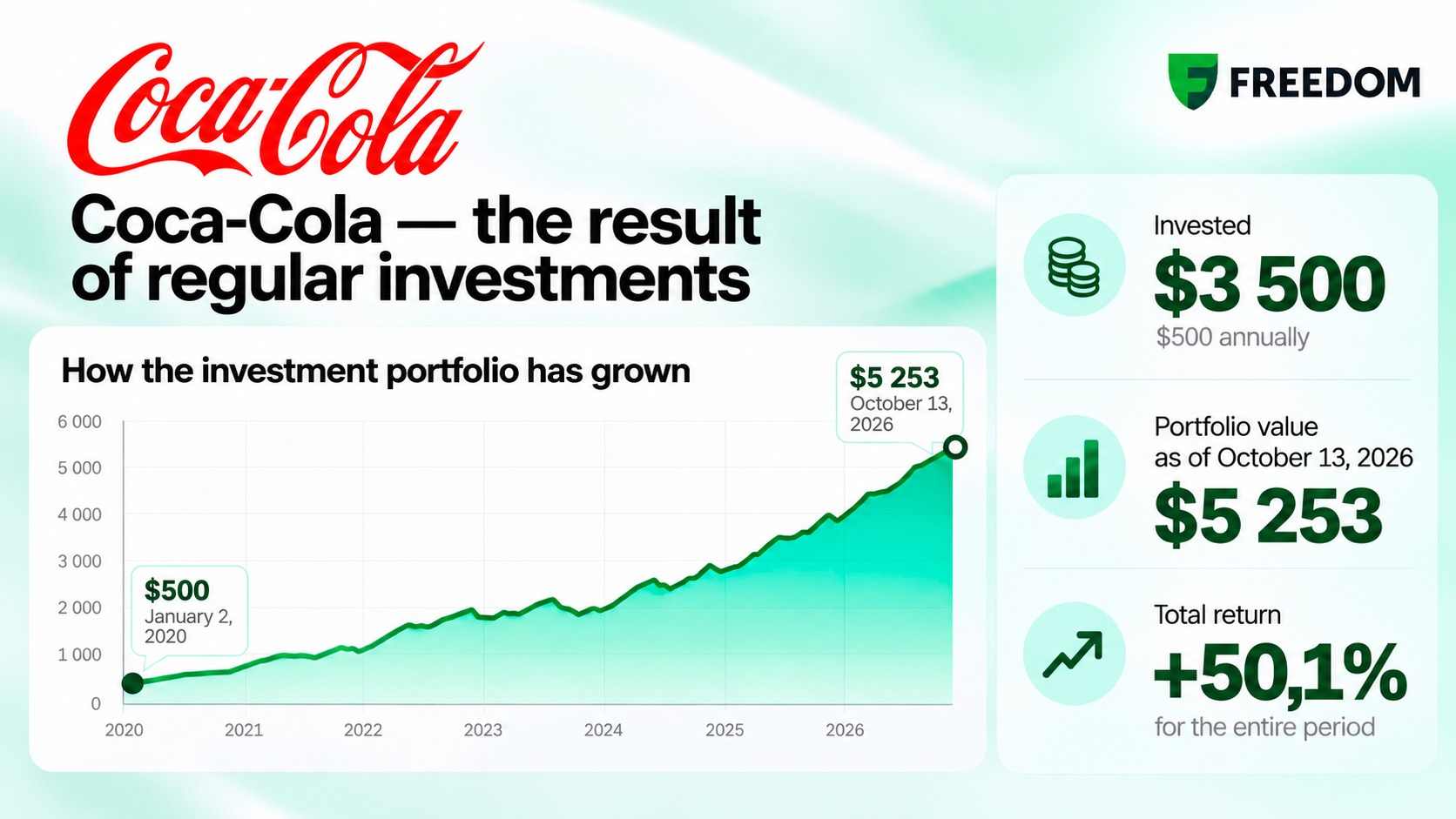
Some companies also distribute a portion of their profits to shareholders through dividends.
Coca-Cola has a particularly long record of increasing those payments.
In February 2026, the company announced its 64th consecutive annual dividend increase.
The quarterly dividend rose to $0.53 per share, equivalent to $2.12 annually if maintained at that rate.
For investors who prioritize dividend income, this history is one of Coca-Cola's distinguishing characteristics.
The scale of the company's operations is equally notable.
Approximately 2.2 billion servings of beverages bearing Coca-Cola-owned or licensed brands are consumed worldwide every day.
Yet Coca-Cola does not manufacture and bottle every beverage itself.
A significant part of its business involves producing and selling beverage concentrates to bottling partners, which manufacture, package and distribute the finished products.
PepsiCo operates through a different business mix.
Alongside beverages such as Pepsi, Mountain Dew and Gatorade, the company owns globally recognized snack brands including Lay’s, Doritos and Cheetos.
Mondelez International concentrates primarily on chocolate, biscuits and other confectionery products, with brands including Oreo, Milka, Cadbury and Toblerone.
Among the three companies, PepsiCo generated the highest revenue in 2025, while Coca-Cola led in net profit, according to the financial figures cited in the analysis.
However, a company's profitability and the performance of its shares are not the same thing.
Even a profitable global business can deliver disappointing investment returns if its shares are purchased at an excessive valuation or market conditions deteriorate.
How Investing 30,000 Tenge a Month Could Build a 6 Million Tenge Portfolio
Consider how much consumers spend on relatively small purchases.
Soft drinks, snacks, chocolate and other everyday treats can add up to 30,000 tenge a month.
Over one year, that becomes 360,000 tenge.
Over ten years, the total reaches 3.6 million tenge.
Now imagine directing that same monthly amount into an investment portfolio.
Assuming an average annual return of 10%, with investment earnings reinvested rather than withdrawn, the portfolio could grow to approximately 6 million tenge over ten years.
Of that amount, 3.6 million tenge would come from the investor's own contributions.
The remaining approximately 2.4 million tenge would represent potential investment gains.
The difference comes from compounding.
When investment returns remain in a portfolio, they can generate additional returns in subsequent periods. Over longer periods, this effect can become increasingly significant.
But there is an important distinction between a mathematical projection and a guaranteed financial outcome.
A 10% annual return is an assumption used for illustration, not a promise of what Coca-Cola, PepsiCo, Mondelez or any other company will deliver.
Actual returns may be higher, lower or negative.
For Kazakhstan-based investors purchasing US-listed shares, exchange-rate movements introduce another variable. A portfolio's performance in US dollars may differ significantly from its return when measured in tenge.
Taxes, brokerage fees and inflation can also affect the final result.
Coca-Cola, PepsiCo or Mondelez: Which Shares Deserve Attention?
The three international companies share several characteristics: established brands, substantial global operations and products purchased by consumers every day.
Their investment profiles, however, are different.
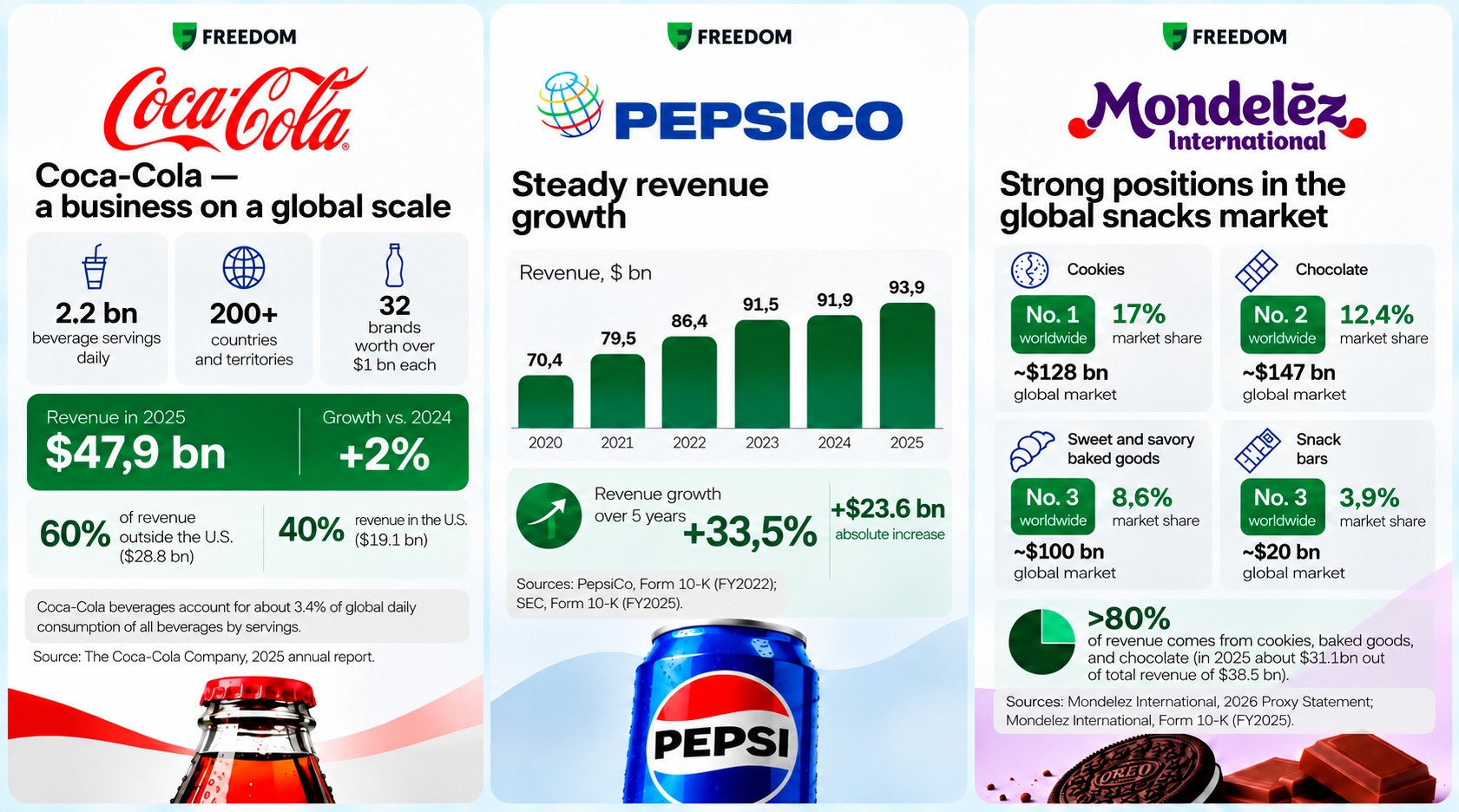
Coca-Cola may appeal to investors researching companies with long histories of dividend increases.
PepsiCo offers exposure to both beverages and snack foods, while Mondelez provides a more concentrated connection to the global chocolate and biscuit industries.
Before purchasing shares, investors should examine profitability, debt levels, dividend policies, growth prospects and stock valuations.
The same approach applies to Kazakhstan's publicly traded companies.
Rakhat's historical share-price increase may be attractive, but the fact that a stock has more than doubled in value does not mean it will repeat that performance.
Diversification also matters. Concentrating an entire investment portfolio in one consumer brand leaves an investor exposed to risks specific to that company.
Familiarity with a product is a useful starting point for understanding a business, but it is not a substitute for financial analysis.
From Everyday Purchases to Long-Term Investments
Many retailers and online platforms offer loyalty rewards and cashback, returning a small portion of customers' spending.
Buying shares in consumer companies is fundamentally different.
Instead of receiving a discount on a purchase, an investor acquires a stake in a business whose value can rise or fall with its financial results and market expectations.
A bottle of soda is consumed, a bag of chips disappears and a chocolate bar rarely lasts long.
The companies producing those goods, however, continue operating, selling products and generating revenue around the world.
For someone investing 30,000 tenge every month, ten years of contributions would amount to 3.6 million tenge even before investment returns.
Whether that grows to 6 million tenge, more or less, depends on the assets selected, their performance and broader market conditions.
For further perspective on investment opportunities, we previously explored 15 stock ideas for autumn 2026.
This article is intended for informational purposes only and does not constitute personalized investment advice. Currency conversions are approximate and used for illustration.